Are NASCAR Cars Really 'Stock'? Questioning Their Resemblance to Showroom Cars
Share This Page
Short answer: no, not anymore. The cars NASCAR calls "stock cars" have gradually drifted away from showroom civilian cars since the 1960s, and today's Cup Series cars are race machines built from scratch, by hand. Even if you see a Chevrolet or Ford logo on the body, the tube chassis underneath, the purpose-built V8 engine, and the independent rear suspension share at best only a name with the car on the road.
Highlights
- NASCAR in 1948 was born as an organization that genuinely raced production cars.
- According to purists, the "stock" identity died around 1965 the forgiving reading extends it to 1978 .
- Next Gen car: 5.86-liter naturally aspirated V8, front engine, rear-wheel drive, 5-speed sequential manual gearbox, minimum 1,451 kg.
- With the Next Gen, independent rear suspension entered NASCAR for the first time; the solid rear axle and track bar faded into history.
- In the 2026 season power on short tracks and ovals is rising from 670 horsepower to 750 horsepower.
Why Have NASCAR Cars Drifted So Far From Production Cars?
The beginning was as innocent as everything else. When NASCAR was founded in 1948, its fleet's name said it outright: "strictly stock," meaning entirely production-based. Doors were shut with belts so they would not open during the race, seat belts were mandatory, and a solid rear axle was required to prevent the car from rolling over. In other words, the cars that took to the track in the early years really were machines you could pick up from the dealer in the morning and drive on the oval that evening. Very little resembles today's Cup car, so let's unpack this distinction together.
But the story quickly shifted. Generation 1 era (1948-1966), the rules still protected "stock" panels; in 1963 engine displacement was limited to 427 cubic inches (7.0 liters) and there was a two valves per cylinder arrangement. Chevrolet's introduction of its small-block V8 in 1955 is considered one of the turning points of stock car racing history. So while there was still a connection to the showroom car even at the engine level, a few more things had to happen for that connection to break. And they did.
First Cracks: The 1960s
Things got interesting in the mid-1960s. Around 1965 the notion of "legal stock parts produced only for racers" began; parts like Hemi brakes were moved to Chevrolets and Fords under the banner of safety, and engines of roughly 366 cubic inches were used that had never been offered for public sale. In other words, the "stock" label began to exist only on paper. In 1966 NASCAR took another step: teams would be able to use a body type for three years from its introduction date. That same year, when the front suspension of the Ford Fairlane and Comet could not withstand oval loads, NASCAR allowed the front chassis end of the Galaxie to be welded. The body name was stock, but the engineering underneath was increasingly turning into purpose-built race machines.
How Did the Body Turn Into a Shell?
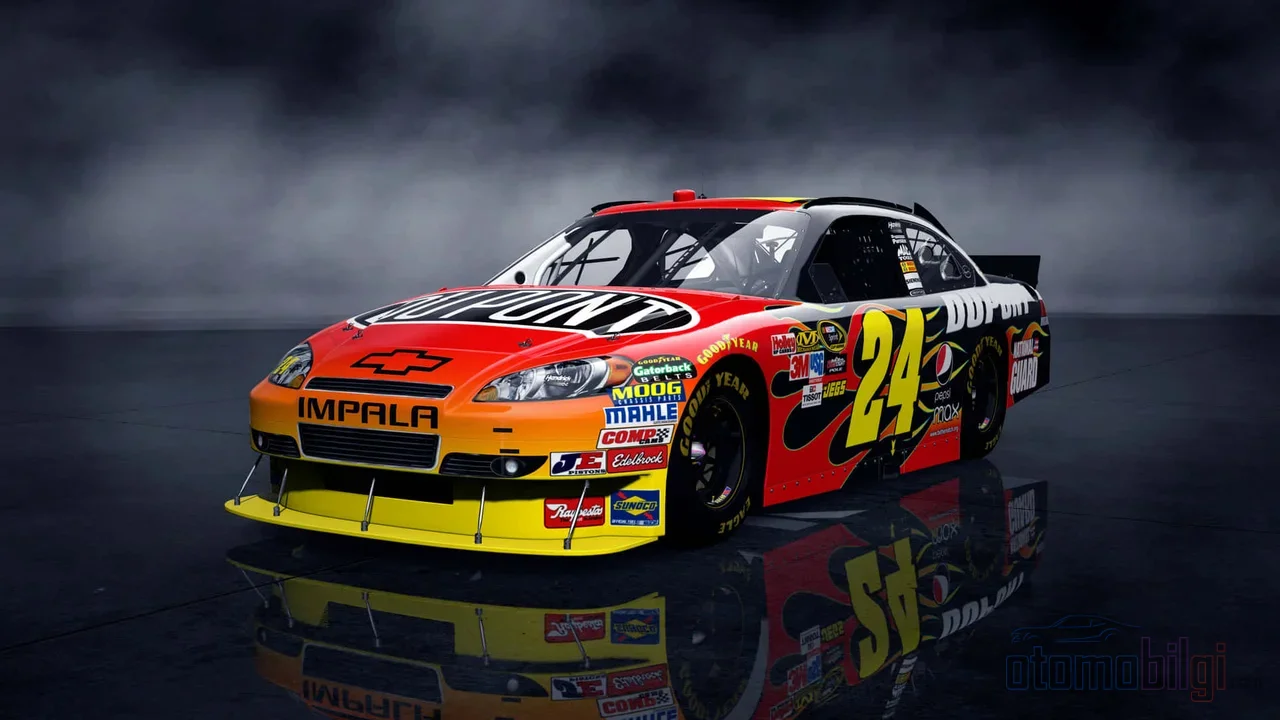
Here's the crux: the tube frame transition. The safety roll cage gradually became the frame itself, and the body turned into a shell hung entirely on a tube chassis. Think about it: whatever steel skeleton sits under the roof of a showroom car, its place in a NASCAR car was taken over by a hand-built tube cage. Around 1970, the side windows were released from their showroom matching; by the late 1970s, the cars had reached the status of 'silhouette racers', machines recognizable only by their silhouette. The body label existed on paper, but in reality it was gone.
The 110-inch wheelbase standard also spread during this period; a 104-inch wheelbase Ford Thunderbird in the 1980s could only race thanks to a rule change. Stretching something that is 104 inches on your own car to 110 is, in my view, the clearest proof that any link with 'stock' was over. There was still a logo, a name, a nose shape - but the engineering was on a completely different planet.
Car of Tomorrow: The Common Chassis Era
Generation 5, that is, the Car of Tomorrow era between 2007 and 2012, ushered in a new age in terms of safety. A common body and chassis was adopted for all manufacturers; the need for track-specific cars decreased, and the front splitter and rear wing provided aero adjustment. But there was a price to this unification: the only things resembling a showroom car on these vehicles were the bumper, nose and tail. The steel bodies had been replaced with fiberglass. So what distinguished Ford from Chevrolet was not the engineering underneath, but the shape of the plastic at the front and rear.
From 2003 onward, common templates had made it genuinely hard to tell a decal-less Ford from a Chevrolet; in 2013, nose-tail differences increased again and the brands' identity became a bit more visible. Today, this identity is still carried largely by logos: Chevrolet's bowtie, Ford's blue oval, Toyota's three ovals. In a spec-weight sport, it is precisely these nose and tail designs that keep brand identity alive. So brand loyalty now lives in the decal, not on the hood.
Did Next Gen Really Bring Back the 'Stock'?
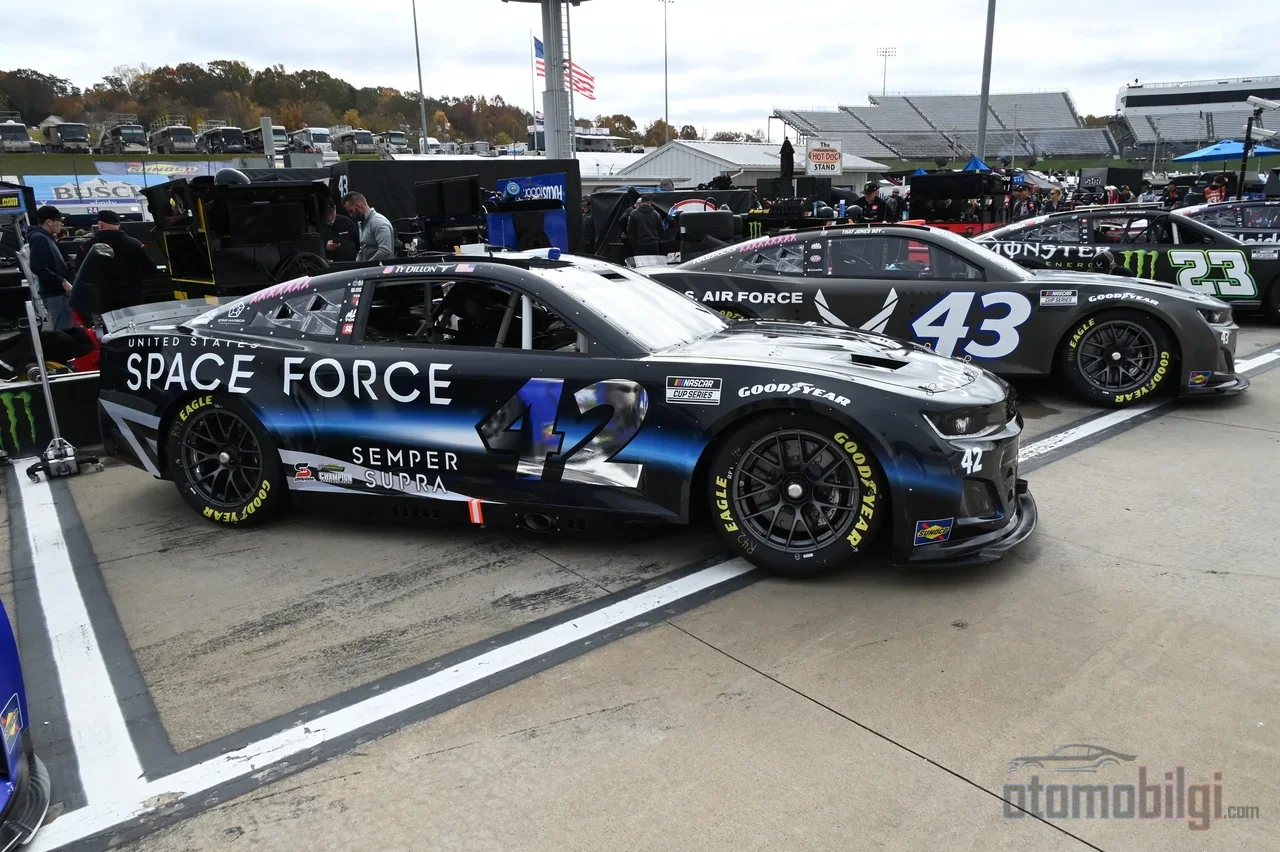
When Next Gen arrived in 2022, NASCAR's message was clear: we're putting the 'stock' back into stock car. But is that really so? Partially. The Next Gen chassis is an evolution of NASCAR's designed Car of Tomorrow chassis and, in some respects, it really does move a bit closer to a road car. Independent rear suspension replaced the solid rear axle, and the track bar disappeared - presented as a first in NASCAR. Rack-and-pinion steering, 18-inch tires, forged aluminum wheels and a sequential gearbox are the other major innovations. The single central locking nut, unlike the classic five-nut system in road cars, allows a wheel change in a single motion.
| Feature | Next Gen Cup Car | Relationship with Road Cars |
|---|---|---|
| Engine | 5.86 L (358 cubic inches) naturally aspirated V8 | Barely exists in road cars |
| Layout | Front engine, rear-wheel drive | Classic layout, shareable logic |
| Transmission | 5-speed sequential manual | Abandoned in daily cars |
| Rear suspension | Independent (since 2022) | Common design philosophy with road cars |
| Weight | Minimum 1,451 kg | Inflated value from race safety equipment |
| Body | Shell hung on a tube chassis | Nothing in common with a road car |
As you can see, the 'stock' connection is mostly conceptual: there are layout-level similarities like front engine, rear-wheel drive, but Cup cars don't share an architecturally identical chassis, suspension, or engine with road-going production vehicles. Each car is built by hand, from scratch. Let's also add that NASCAR tightly audits chassis materials; the main safety tubes are mostly made of mild steel 1.75 inches in diameter, with a 0.090 wall thickness. Does your car have pipes like that? If so, please tell me.
What Are the Real Differences from a Regular Car?
The list isn't short: a NASCAR-approved roll cage, a powerful V8 engine, wider and softer tires than road cars, a single-lug wheel system, and of course the tube chassis that keeps it alive on the track. None of these are found in a showroom car, and that's normal - because one exists to go to the grocery store, the other to stick to the bottom of a corner at 300 km/h. Weighing these two on the same scale seems unfair to me from the start. The real question is whether NASCAR can still carry the word 'stock' in its name.
Was the Move to a Spec Car Logical?
There are still heated debates among fans on this. The purist view says real stock cars disappeared starting in the 1960s; the more forgiving crowd, thinking showroom sheet metal still remained in the tube frame era, pushes the boundary to 1978. After the mid-1980s, however, nearly everyone agrees that the 'stock' quality continuously declined. So there's no single answer to the question 'when did stock die'; it depends on where you choose to look.
There's also a practical fact: a 2006 debate revealed how short the list of production vehicles that actually complied with the rules - rear-wheel drive, V8, American-brand - really was. Even if a modern Cup car actually had a mass-production sibling, racing that vehicle would be both extremely expensive and a safety disaster. Some historians also argue that beyond safety, technology is competition's greatest enemy; as technology advances, costs rise, gaps open, and the racing itself fades from view. That's why every step seemed logical at the time; once the 'win on Sunday, sell on Monday' benefit ran out, nobody questioned it anymore.
There are also criticisms related to the Next Gen being found 'soulless' in early drives; narrower tires, bigger sidewalls, and smaller brakes were suggested, but NASCAR isn't willing to do that. In 2026, power also rises from 670 horsepower to 750 horsepower on short tracks and oval races; testing was done at Bristol with 15 Cup teams. RAM's return as an OEM is also being talked about. So the car becomes more special, more spec, more of an engineering product every year - despite efforts to get one step closer to the showroom.
So the Result: Stock or Not?
My answer is this: NASCAR cars today are stock in name, but in spirit they are entirely purpose-built racing machines. The answer to the question of whether they are tied to the showroom by their body label or by their engineering is clear - by the label. The road from cars whose doors were once shut with belts to V8 monsters with independent rear suspension and single-lug wheels shows that every milestone in the sport is actually a story of moving away. But in my opinion that is not a bad thing; in a sport where we cannot talk about Dale Earnhardt's legacy without the safety cage, no one would want to pay the price of pure 'stock-ness'. What do you think - do you also miss the old real stock cars? I think it would make a great discussion in the comments.
Sources
- NASCAR 75 Stock Car Evolution
- The evolution of NASCAR Cup Series cars
- NASCAR, manufacturers unveil Next Gen models for 2022
- Next Gen (NASCAR) - Wikipedia
- Stock car racing - Wikipedia
- A Detailed Look at Every Generation of NASCAR Car
- How NASCAR engines work
- NASCAR's last Stock Cars
- NASCAR to boost horsepower on select Cup tracks
- NASCAR conducts test with 15 Cup teams for 750-hp package
- Chevy, Ford, Toyota: Manufacturer Logos Shape NASCAR Identity
- What Sets a NASCAR Stock Car Apart
- What Types Of Cars Are Used In NASCAR Racing
- Why Doesn't NASCAR Use Real Stock Cars?
- The NextGen Chassis