How Audi Locked Down Le Mans for a Decade
Share This Page
Audi won Le Mans a full 13 times between 2000 and 2014, achieving a crazy win rate of 72% when you look at the years it entered. It built this dominance not with a single legendary car, but with an unbroken chain formed by the R8's petrol era, the R10 TDI's diesel revolution, and the R18's hybrid victories. So how did Audi sustain this for a decade, unlike the one-night heroics of Ford-Ferrari or Mazda? That is exactly what this page is about.
Highlights
- Audi won Le Mans 13 times between 2000 and 2014; its win rate was 72%.
- R8 took five victories in the six years it entered, winning 63 of 80 races.
- R10 TDI was the first diesel car to win Le Mans in 2006.
- In 2010, the R15 TDI set the still-unbroken distance record with 397 laps and 5,410.7 km .
- R18 e-tron quattro was the first diesel-hybrid race car to win in 2012.
It All Began with a Bold Entry in 1999
Audi began evaluating Le Mans in 1997 under the leadership of Wolfgang Ullrich, and in 1999 was on the track with two different concepts: the open-cockpit R8R developed by Dallara and run by Joest Racing, and the closed R8C signed by Tony Southgate of Racing Technology Norfolk. The R8C struggled with gearbox problems and fell behind, but the R8R made it to the third-place podium. Moreover, two more Audis were right behind the winning BMW V12 LMR: third and fourth.
That year's race also witnessed one of the most chilling moments in motorsport; the Mercedes CLRs took flight, and the Toyota and BMW cars crashed. Staying calm amid this chaos, Audi drew an important lesson: at Le Mans, reliability and composure win just as much as speed. This philosophy shaped the entire strategy of the following fifteen years.
Audi R8: The Machine That Won Everywhere It Entered
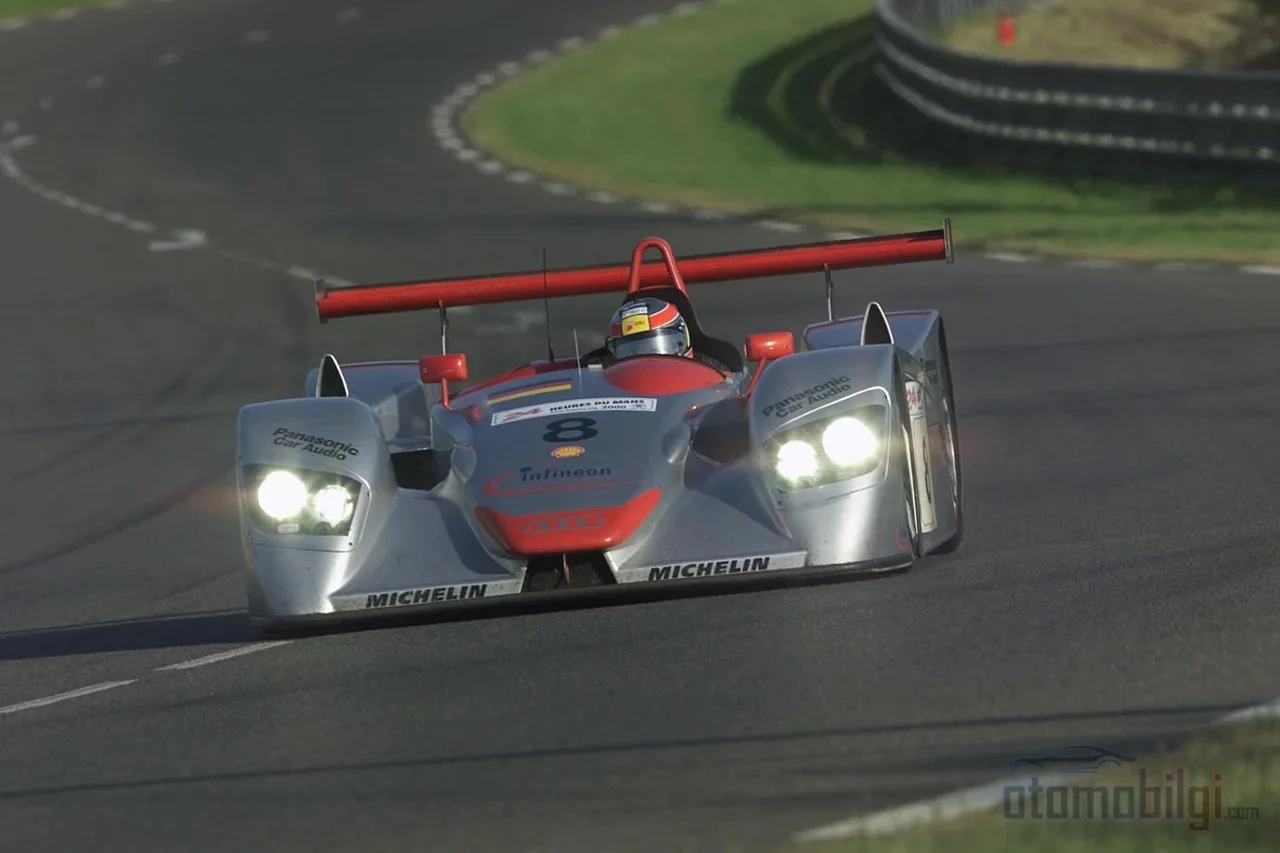
In 2000, in its debut, the R8 finished the race 1-2-3 . The winning trio was Tom Kristensen, Emanuele Pirro, and Frank Biela; the car was run by Audi Sport Infineon Team Joest. What came after? Victories in 2000, 2001, 2002, 2004, and 2005. Five trophies in the six years it entered. So what was the only missing piece in 2003? Here the story gets very interesting: the R8 didn't lose, because the Bentley Speed 8 that won the race was actually Volkswagen Group's own brand and used a modified 4.0-liter version of the R8's V8 engine. So you can think of it as a handover within the family. Kristensen was also in Bentley's driver seat that year, not to mention.
TFSI: Direct Injection Tested on the Track
At the heart of the R8 was a 3.6-liter V8, and this engine carried the Fuel Stratified Injection, or FSI system - the VW Group version of the petrol direct injection we know today as TFSI. It was first used in 2001 and delivered both power and fuel economy. Think of it this way: spraying fuel into the cylinder more precisely means using the tank more efficiently on a long journey. In a 24-hour race, every drop of fuel means seconds on the pit lane.
On the power side, official figures in 2000-2002 were 610 hp was around; according to unofficial claims, with dual ram-air intakes at speeds above 150 mph it 670 hp was approaching. Torque 700 Nm was, at 6500 rpm. The 6-speed gearbox developed with Ricardo used electropneumatic paddle shift, and the R8 reached 338 km/h in 2002 practice sessions; with a low downforce setting this rose to ~350 km/h.
An Engineering Marvel of 3 Minutes and 16 Seconds
Here is one of the details that made the R8 legendary: the gearbox, rear suspension and rear subframe were built as a single unit. The rear transaxle of a crashed R8 could be replaced in just 3 minutes and 16 seconds in a process that normally took 1 to 3 hours. Think of a pit stop - the coffee doesn't even get cold and the car behind is like new! This advantage was so great that the rules later had to balance it by banning the replacement of the gearbox casing. In 2005, the R8 was also slowed with restrictors and added weight - we're talking about a car that the rules themselves, not its rivals, had to slow down.
The 2004 and 2005 victories are also special: the factory team had focused on the ALMS after 2002, so the last two victories came with privateer teams driving. The 2003 rule change allowed the R8 to race under the old regulations, which made this possible. The R8 ended its career in 2006 with its 50th ALMS victory at Lime Rock; a total of 16 chassis were produced, and it won 63 of 80 sports car races.
R10 TDI: How Does a Diesel Car Win Le Mans?
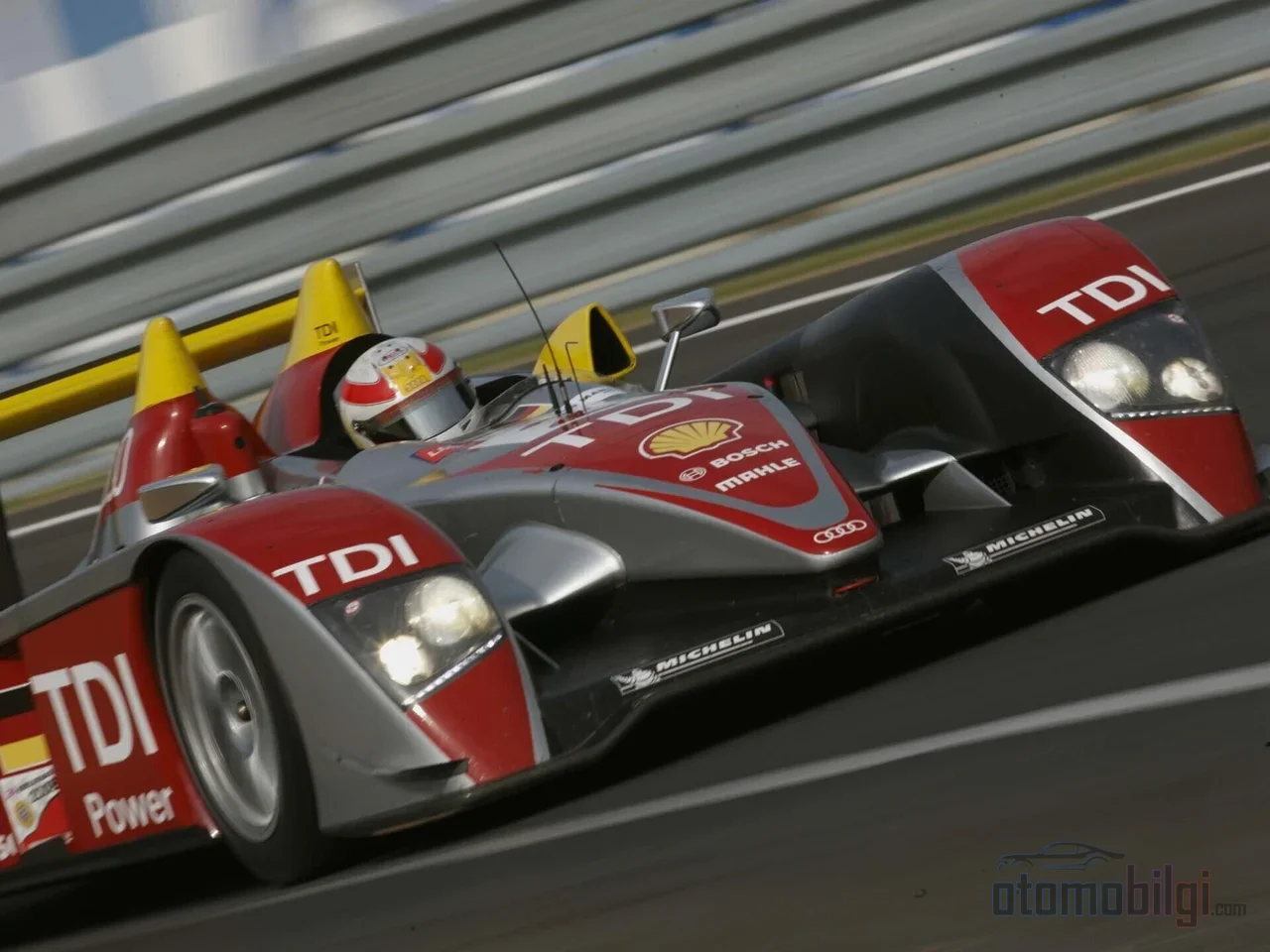
Now we come to the craziest part. Introduced in Paris on December 13, 2005, the R10 TDI, only 200 days later won the 2006 Le Mans. And it was the first diesel car to win Le Mans - even the first non-gasoline car. In that race where the record 235,000 spectators were broken, the growl of a diesel V12 went down in history.
Why diesel? Because the nature of the diesel engine suits endurance racing: high torque and low fuel consumption. The 5.5-liter V12 TDI produced over 650 hp with twin parallel turbochargers, but the real achievement was in torque and efficiency. Fewer pit stops in the race means less fueling time. The placement of a heavy diesel engine also forced a rethink of the center of gravity, cooling, aerodynamics and drivetrain layout - Audi turned it into an opportunity. In 2006, Pirro, Biela and Werner won by completing 380 laps and the R10 TDI went undefeated at Le Mans between 2006 and 2008. That same year, it had also made its debut with a victory at the 12 Hours of Sebring, by the way.
If you ask what TDI means: Turbocharged Direct Injection, that is, a turbocharged direct injection diesel. TFSI is Fuel Stratified Injection, the gasoline side. Audi matured these two technologies on the track first and then brought them to the roads - like a reverse engineering story, but in the opposite direction.
The Peugeot Wars: The Fiercest Duel of the Decade
Dominance stories should never be told without rivals. In 2007, Peugeot played its diesel trump card against Audi with the 908 HDi FAP and launched a serious challenge. Audi answered with victories in 2007 and 2008; 2008 in particular saw an intense battle, and it was said that the speed advantage lay with Peugeot. But Le Mans is not a sprint race, it is a test of patience - and Audi was its master.
In 2009, Peugeot finally took its first victory since 1993 with a 1-2 finish. Then came 2010, and Peugeot prepared to defend its title, but Audi's R15 TDI made history: 397 laps and 5410.7 km broke a 39-year-old distance record. Read once again that Bernhard, Dumas and Rockenfeller's record still stands unbeaten today. The final duel came in 2011; even though Lotterer's leading Audi was laps behind, it could not easily pass Gene's No. 8 Peugeot. This rivalry truly turned the endurance racing of that era into a turning point.
From R15 to R18: Records and the Hybrid Revolution
The R15 TDI, with its 10-cylinder diesel, carried innovations such as a VTG turbocharger and lithium-ion battery; it was Audi's last open-top car, closing the 5.5-liter diesel era. Appearing on the scene in 2011, the R18 brought the brand's 10th Le Mans victory with its compact V6 TDI; the ultra-lightweight construction program also targeted production vehicles.
And in 2012: the R18 e-tron quattro became the first diesel-hybrid race car to win Le Mans. While the rear wheels were driven by the V6 TDI, the hybrid system on the front axle recovered braking energy and used it for propulsion. It also won in 2013 and 2014; three consecutive hybrid victories, 13 Le Mans wins in total. These cars also featured technologies such as an AMOLED digital rearview mirror, full LED headlights, and from 2014 onward, laser headlights. So with every victory, Audi didn't just take a trophy - it also tested the technology of the next commercial car generation on the track.
Three Strategies That Made This Dominance Possible
Technology alone was not enough. Audi's decade-long chain stood on three pillars:
- Technology transfer: TFSI, TDI, and hybrid systems were all proven on the track first, then brought to the road.
- Pit and endurance discipline: Solutions such as the R8's modular rear structure rewarded pit stops down to the seconds; fuel efficiency was at the center of strategy.
- Team structure: Working with reliable partners like Joest Racing since 1999 and efficiently managing driver rotation made the difference in battling the fatigue that 24 hours brings.
The lack of competition in the 2000 field was not left undiscussed either: the pre-season cancellation of Porsche's LMP project gave rise to rumors involving Ferdinand Piëch's influence; BMW and Toyota also turned to F1. But winning even during a period when a car has no rivals is a separate matter - and Audi proved it. In 2005 it did not even take pole (the fastest R8 started third) but took its fifth victory through endurance. That race was Kristensen's sixth consecutive, and Jacky Ickx's seventh Le Mans victory, surpassing his six.
Audi's Departure and Return: The Story Does Not End Here
Audi withdrew from endurance racing in 2016, and years have passed since that departure. But as of 2026, the picture is changing: Audi has announced its return to endurance racing, and at the same time Allan McNish is leading the team from the pit wall in Formula 1. In other words, a new chapter of this story is being written.
Looking at the fierce competition of today's Hypercar era, it becomes clearer just how difficult an achievement the order Audi established in the 2000s was. The Ford-Ferrari war was the epic of a single era, and Mazda was defined by one historic night. Audi, on the other hand, won with every rule set, every engine, and every generation for more than a decade. Do you think such a streak could ever be built again? I eagerly await the answer to that question.
Sources
- Audi R8 (LMP)
- Le Mans - Audi
- Audi R10 TDI
- Audi R8: developing a gearbox for a Le Mans legend
- Twenty-five years since Audi's remarkable Le Mans winning streak began with the R8
- Peugeot and Audi: the rivalry that defined a generation
- The Audi era celebrated: Part 1
- 2006 Audi R10 Design & Development Info
- A diesel-powered car wins the race – The Audi R10 TDI story
- Audi Engines Explained: What Does TFSI and TDI Mean?
- Kristensen and Brabham lift the lid on intense Le Mans rivalry
- The Audi R8 LMP900 Comes to Project Motor Racing
- Allan McNish on guiding Audi into F1 from pitwall
- Audi confirms return to endurance racing