The Man Walking in Front of the Car with a Red Flag Requirement
Share This Page
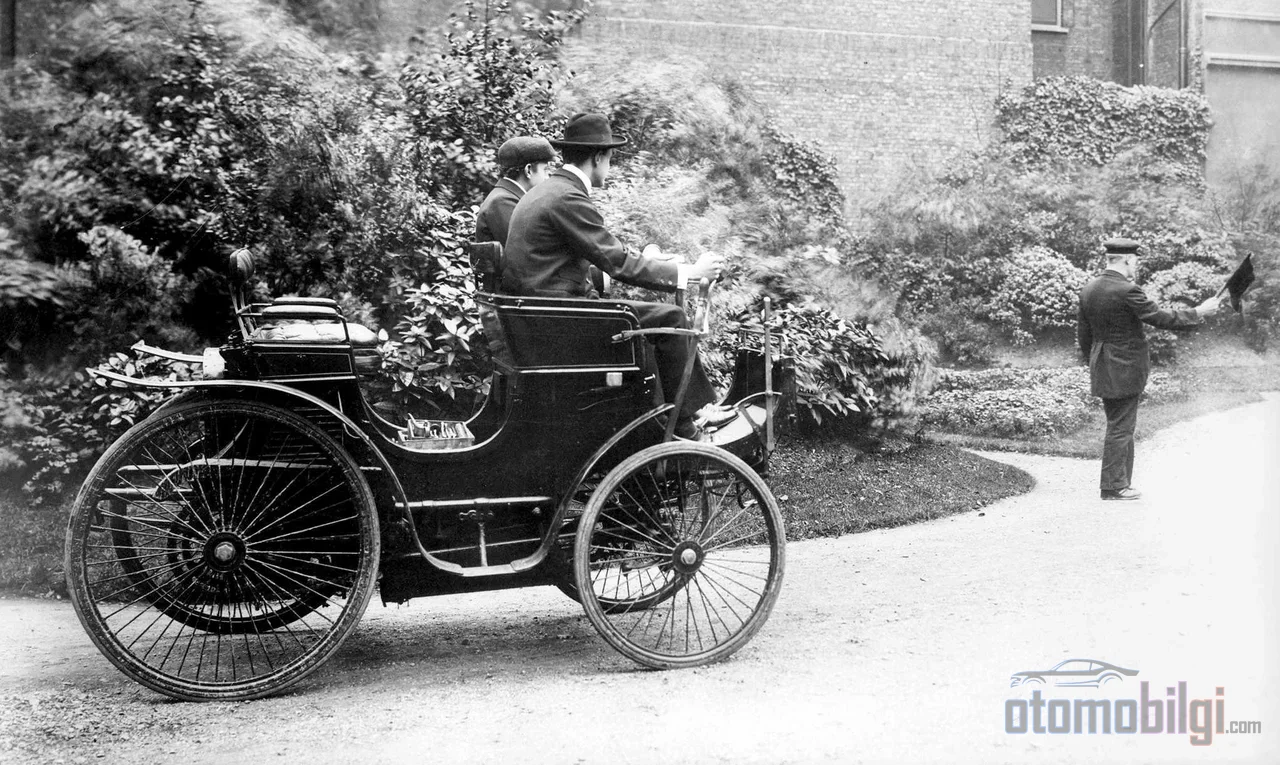
The Locomotives Act of 1865 in England, popularly known as the Red Flag Act, required every self-propelled vehicle to be preceded by a person continuously carrying a red flag. Combined with a speed limit of 4 miles per hour in the countryside and 2 miles per hour in the city, these rules effectively banned the development of the automobile for nearly 31 years and pushed the British automotive industry behind France and Germany.
Highlights
- The flag-bearing pedestrian had to walk at least 60 yards (55 meters) ahead of the vehicle.
- Speed limit: in the countryside 4 mph (6 km/h), in cities and towns 2 mph (3 km/h).
- Fine for violation: 10 pounds; a three-person crew was mandatory in the vehicle.
- The flag requirement was abolished in 1878 , while the main restrictions were only relaxed in 1896. relaxed.
- The celebratory Emancipation Run became the origin of today's London to Brighton Veteran Car Run, which is still held.
Just think about it: the coolest invention in the world has just emerged, and the government comes out and says, "Nice, but a man waving a flag will walk in front of it." It sounds funny, doesn't it? But for the engineers and entrepreneurs living in England between 1865 and 1896, this was no joke at all. That is why historians often view this period as the "lost generation of the automobile." Let's take a closer look at the strangest and most influential law in automotive history.
What Is the Red Flag Act, and Exactly What Did It Ban?
Officially named the Locomotives Act 1865, it received royal assent on July 5, 1865, and came into force on September 1, 1865. The law's original target was not automobiles; because a practical automobile did not yet exist. The rule-makers were thinking of the steam traction engines and agricultural engines that filled rural roads. But the result was a cascade of restrictions affecting every self-propelled land vehicle.
The provisions of the law seem almost unbelievable when viewed from today:
- Every vehicle was to carry a three-person crew: a driver, a stoker, and a person walking ahead.
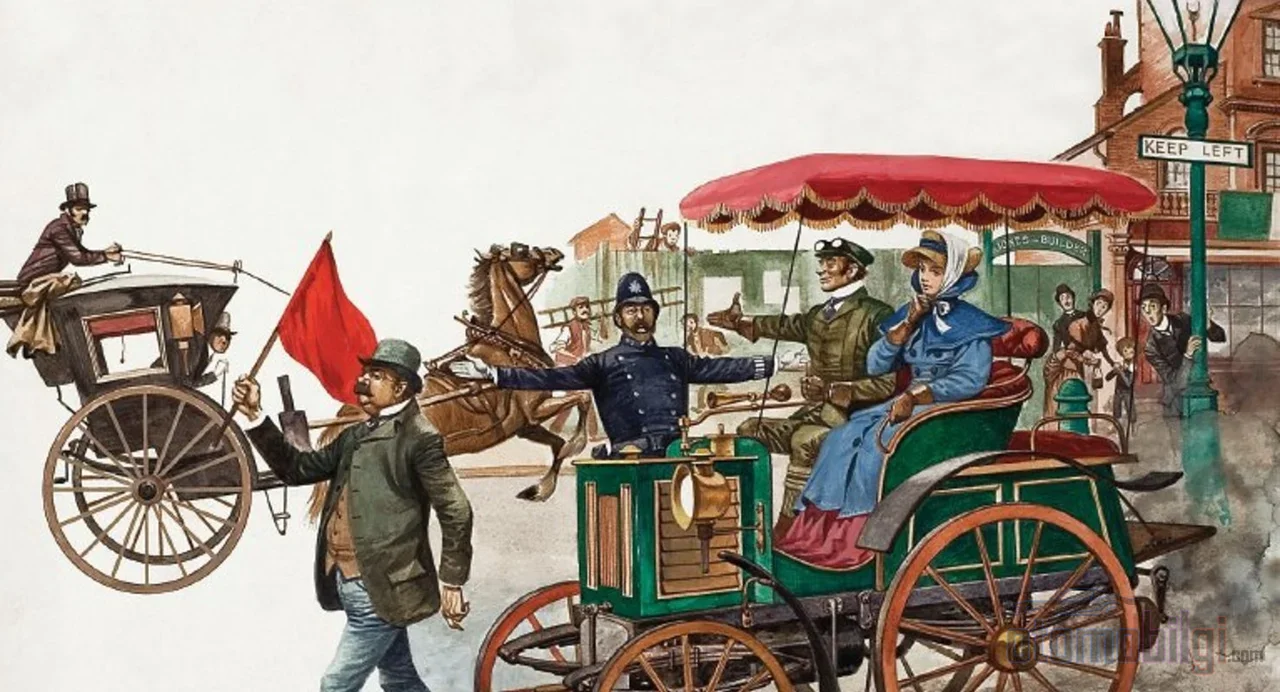
- A pedestrian carrying a red flag all day long had to walk at least 60 yards (55 meters) ahead of the vehicle. This person was tasked with warning horse riders and carriage drivers and, if necessary, stopping the vehicle.
- The speed limit was 4 mph in the countryside and 2 mph in cities and towns; the fine for exceeding it was 10 pounds.
- Two lights were mandatory for night travel; whistling on the road and releasing steam were prohibited.
- Vehicles could weigh at most 14 tons and be at most 9 feet wide.
Let me draw a comparison: If you bought a super sports car today, you would have to hire a stoker, have a friend run 55 meters ahead carrying a flag, and your vehicle would be too slow to race a bicycle. So the invention exists, but using it is nearly impossible. That is why the law functioned as an outright ban. One more detail: these rules are considered to be the world's first road speed limit. In other words, the idea of the speed limit entered the motoring tradition with this strange birth.
| Rule | 1865 Act | 1896 Act (light vehicles) |
|---|---|---|
| Speed limit | 4 mph rural / 2 mph city | 14 mph |
| Flag-waving pedestrian | Mandatory, 60 yards ahead | Repealed |
| Crew | 3 people | Repealed |
| Applicability | All vehicles up to 14 tons | Only vehicles lighter than 3 tons |
Why Did Such a Law Come About? The Fears of the Era
To understand the logic behind the law, we need to look at Britain in the 1860s. Agriculture was being introduced to steam power, and much of the roads were being used by steam-powered agricultural engines. There was no asphalt around, only muddy, narrow stone roads. On the other hand, according to the claims of the era, the new steam road locomotives weighed 14 tons, were 9 feet wide, and could travel at 10 mph. Public fears were tied to this: fatal accidents, scaring horses, blocking roads, and night operations.
In fact, none of these fears were scientific. One of the counterarguments of the era was this: There was evidence that thanks to their brakes and wide wheels, steam cars caused less damage to roads than horse-drawn carriages. In other words, the road damage justification was at least debatable. A sharper claim says that behind the law was the lobbying of railway and horse-drawn transport interests. Let us note: this lobbying claim has not been fully proven and is debated among historians. But what is certain is this: the law came out through the Liberal government of Lord Palmerston's era and, in one writer's words, effectively halted motorized road transport innovation in Britain for more than a quarter of a century.
Why Did the Automobile Industry Shift from Britain to France and Germany?
Here begins one of history's most bitter ironies. In the late 1880s, while Karl Benz and Gottlieb Daimler were in Germany and French pioneers were rapidly developing the gasoline automobile, every idea that came to a British engineer's mind ran into the same wall: the 2-4 mph speed limit and the three-person crew requirement made the motorized vehicle unable to compete with horse-drawn transport. So why would an investor put money into the automobile? It could not legally be sold or used.
The most striking comparison comes from the USA. The state of Vermont passed a similar law in 1894 but repealed it two years later. This quick retreat allowed the industry in that region to grow much faster. Britain, on the other hand, kept the same mistake for a full 31 years. Until 1896, France and Germany had clearly taken the lead in automobile technology. In other words, the Red Flag Act is a textbook example showing that a country not only slows down a technology, but can also cause the center of that technology to shift to other countries.
The 1878 Amendment: The Flag Went, But the Trouble Remained
The red flag requirement was repealed by the Highways and Locomotives (Amendment) Act of 1878. After this date, the person on foot now walked without a flag, but continued his duty: holding the road at least 20 yards ahead to assist horse-drawn vehicles. Moreover, some local authorities overstepped their powers and continued to impose the flag requirement; West Sussex is one of the known examples of this.
The key point is this: the 1865 speed limits and crew requirement remained exactly as they were. In other words, the automobile did not gain freedom just because the flag was gone. There was still a man walking ahead, still a speed limit below walking pace, still a three-person crew. That's why the law continued to be popularly known as the "Red Flag Act" even after 1878. The flag was gone, but the mindset it represented remained firmly in place. So when was this restriction finally broken? This is where the best part comes in.
1896: The Night of Freedom and the Symbolic Tearing of the Red Flag
One of the most powerful figures behind the liberalization was the Coventry entrepreneur Harry J. Lawson . Lawson bought the Daimler engine patents in 1895 and later founded The Daimler Motor Company. Alongside him were advocates such as Sir David Salomons, founder of the Self-Propelled Traffic Association. The details that capture the atmosphere of this campaign are just as telling: British Motor Syndicate published the first issue of The Autocar magazine on 2 November 1895; the Prince of Wales, the future Edward VII, took a test drive in an automobile and became the patron of Britain's first motor show. In other words, the aristocracy was now on the automobile's side too.
The result was the Locomotives on Highways Act 1896 . The law defined a new class called "light locomotives" for vehicles lighter than 3 tons and imposed none of the old laws' restrictions on these vehicles. The flag-bearing pedestrian went, the three-person crew went, the bridge restrictions went. The speed limit was raised to 14 mph; local authorities could, at their own discretion, set a lower limit of roughly between 8 and 16 mph. For heavy locomotives, the strict regime continued, tied to a registration system by an 1898 law; indeed, regions such as South Wales and Middlesex closed their roads to all locomotives altogether.
The new law came into force on the night of 14 November 1896, just after midnight. And England knew how to celebrate it: the following day, a celebratory drive was organized from London to Brighton. Its name was quite fitting: the Emancipation Run, that is, the Freedom Run. The program began with a breakfast at the Charing Cross Hotel, and the day's most unforgettable moment took place: Conservative politician Lord Winchelsea symbolically tore a red flag in two. The burial of a thirty-one-year-old restriction with a single symbolic gesture. Wouldn't you say this is the most impressive "closing scene" in automobile history?
From the Emancipation Run to Today's Rally Tradition
Here's the most beautiful connection: that celebratory drive in 1896 did not remain a one-time event. The London to Brighton Veteran Car Run, held every November today, is the direct continuation of the Emancipation Run and is regarded as the longest-running automobile event in the world. For over a century, historic vehicles built before 1896 have been reliving that first journey of freedom from London to Brighton. In a way, the seeds of the automobile rally culture we know today were sown on those very roads where the man with the red flag once walked. The date has even been announced for the 2026 event: Sunday, 1 November.
Let's also make a balanced assessment: the Red Flag Act did not completely erase England from the automobile age. The British automotive industry was born in the final years of the 19th century and became the world's second-largest producer in the 1950s. But the thirty years lost until 1896 were enough for the leadership in the breakthrough to pass to France and Germany. As the clearest proof of how a law can shape an industry, and even leave a mark on a country's technology history, this law still deserves to be told today.
Next time you watch flag cars take the start at a race, remember how much a flag being torn a century ago changed things. The history of the automobile is sometimes constrained by a flag and set free by the very same flag.