Why Is the Start Everything in Rallycross?
Share This Page
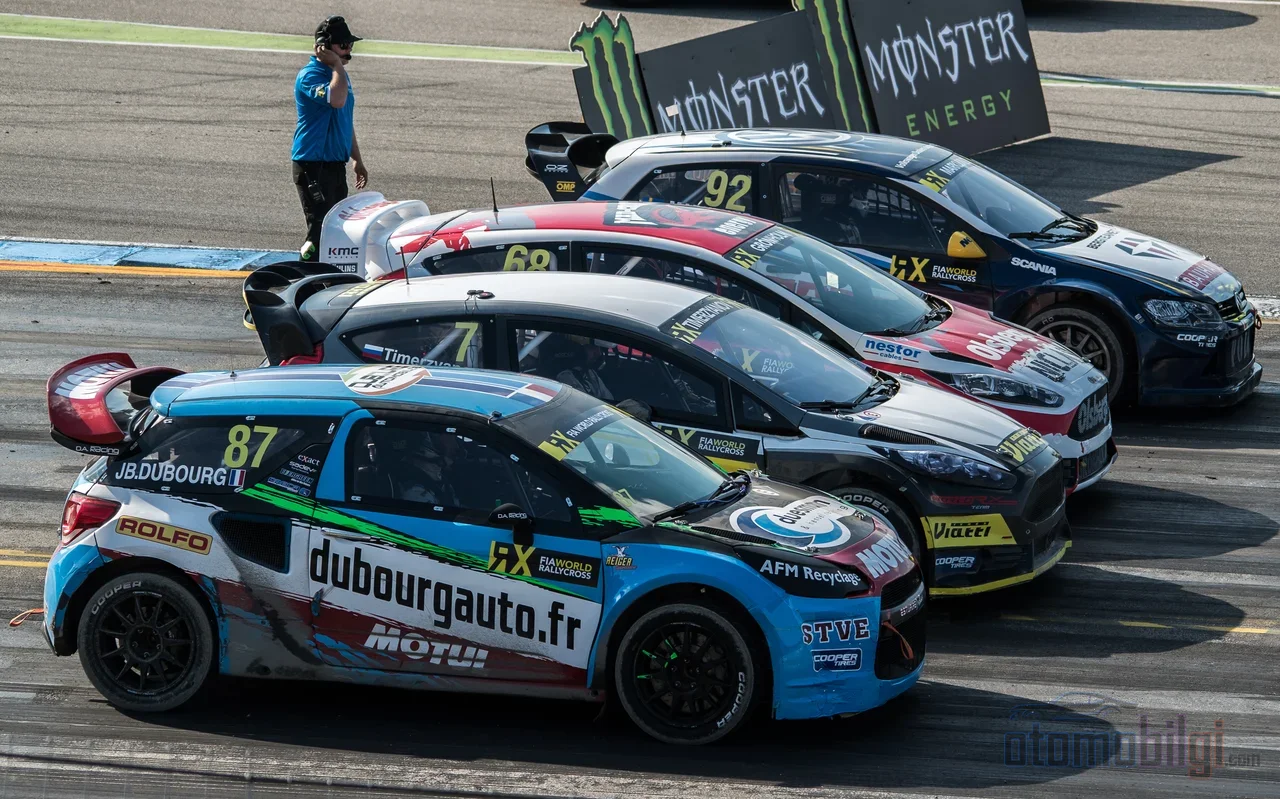
In rallycross, the start is everything, because in this sport where four to six vehicles launch side by side, the few seconds between the moment the lights turn green and the first corner determine far more than the tens of tenths you later lose per lap. A good start gains you positions, while a bad start condemns you to playing by everyone else's rules.
Highlights
- Ken Block's Ford Fiesta ST rallycross car completes 0-60 in 1.9 seconds .
- In World RX, five cars can enter the first corner side by side.
- The joker lap typically costs 2-3 seconds , and every driver must take at least one per race.
- From 2026, the Rallycross World Cup will require two mandatory joker laps per race.
When the Lights Go Out: Why Reaction Time Is So Critical in Short Races?
Think about it: in a 100-meter sprint, a good start moves you a few steps ahead. But what if the entire track is just a few dozen meters of straight with the first corner right after? That's exactly what rallycross is like. As academic studies on motorsport and sledding races also emphasize, the better the reaction time at the start, the faster the driver moves and the more advantageous position they capture. And as the race gets shorter, the effect of a fast start grows - a principle that fits rallycross's short, intense laps perfectly.
But hold on, don't jump to "then the one with the fastest reflexes wins." The view even discussed in simulation communities is this: reaction time matters, but clutch release and throttle control may be even more decisive. Because reacting to the light is one thing, while transferring that reaction to the ground without damaging the car or losing traction is quite another. Now we come to the truly critical part.
Releasing the Clutch Is an Art: The Anatomy of Launch Technique
To put it simply, the start in rallycross goes like this: the lights go out or turn green, the drivers release the clutch and hit the throttle, and the grid practically explodes. Sounds easy, right? But in reality, a car whose clutch is released too abruptly either wastes traction as if the wheels lock up, or one released too gently holds onto that golden second. That fine point where throttle and clutch meet demands different settings on every surface. Have you ever thought about launching on a bicycle? If you press too hard, the wheel spins; if you press too gently, the one behind you passes - a car behaves exactly the same way, just at much higher speeds.
Legendary names have a lot to say on this subject. In his accounts of the Red Bull Global Rallycross era, Ken Block openly emphasizes how critical the start is for race success, and his Ford Fiesta ST with 0-60 in 1.9 seconds talking about a car that completes it. In other words, with a successful launch, you already have the physical power in your hands to help you; the point is releasing that power at the right moment, in the right way. Systems like launch control come into play exactly at this point: WRC driver Mārtiņš Sesks sums it up in a video where he explains the best way to launch a high-performance rally car, saying "When every second matters, performance begins where the road begins."
"When every second matters, performance begins where the road begins."
How Does All-Wheel Drive Transfer Power in Sand and Mud?

One of the biggest things that sets rallycross cars apart from ordinary rally cars is how the power reaches the ground. These machines, which slide through a mix of dirt, asphalt, and jumps, are compact monsters producing around 600 horsepower of power. So why does this power grip so well in sand and mud? The answer lies in the structure of the all-wheel-drive system: locked differentials ensure that power reaches all four wheels even in deep mud or snow. When the differential is unlocked and one wheel loses traction, the power flows away uselessly through it; locking captures that escaping power and distributes it to the wheels that still have grip.
The tire side is just as important as the differential. Rally tires are manufactured with high-grip compounds that provide strong traction on dirt and gravel surfaces. So at the start line, you're actually watching a three-way collaboration: the driver's clutch-throttle management, the power distribution of the locked differentials, and the tire's grip on the surface. If any one of these three collapses, that dreamlike 1.9-second acceleration scenario instantly turns into wheelspin smoke. In rallycross categories, racing tires must also be road-legal certified, and only a small number of light modifications are allowed on the cars - in other words, there's no "throw everything at it, pure performance" approach; you have to build the best package within the rules.
Five Cars Side by Side into the First Corner: How to Win the Position Battle?
Now picture the scenario: the start is given, five cars accelerate side by side, and all of them try to reach the first corner at the same time. You can imagine the pressure - it's not the drivers' favorite sentence, but the reality is exactly this. Among drivers who receive racing instruction, there is a common principle: the pilot who enters the first corner from a good position earns the right to choose the racing line, while those who start poorly are exposed to other drivers' moves. In other words, the driver who launches well determines their own fate; for the rest, the doors narrow in the corner, and judging by the compilations dedicated to World RX start-line drama and first-corner crashes, anything can happen.
That's why in rallycross, the first corner is a skill area separate from the rest of the race. It requires not just speed, but courage, reading the gaps, and a bit of "there's room for me here" calculation. There are even recorded multi-car pileups from RallyX events - bitter proof of the fact that those with low starting positions enter the most dangerous zone first.
The Joker Lap: The Invisible Extension of the Start Tactic
Welcome to the unique rule that makes rallycross what it is: the joker lap. Every driver must use the alternative section added to the track's main route at least once per race, and this lap usually costs 2-3 seconds of time. So what does it have to do with the start? Everything. When choosing when to take your joker, you factor in the positions of the cars ahead of and behind you - that is, the outcome of the start.
- Early joker: Niclas Grönholm caught the fastest time by taking the joker on the first lap of a World RX qualifying heat - a driver entering a clean track can complete the joker calmly and stay out of the traffic.
- Late joker: Watching your rivals and waiting for their jokers, but the risk is great; if everyone enters the joker at the last moment, the merge point can turn into chaos.
These merge points are a battlefield in their own right: as one of the rallycross teams also put it, the joker lap adds strategy to rallycross, but the merge point can quickly turn into a fight for track position. Two RX5 drivers making contact at the merge point at Euro RX Hungary is proof of how real a risk this is. And one last piece of news before we stop: FIA's new Rallycross World Cup format brings an 8-car semifinal and final, along with two mandatory joker laps per race and a new Superpole format. Two jokers means the starting position has twice the impact on strategy.
Got a Bad Start? Is Your Recovery Plan Ready?
Not everyone can nail their dream launch, let's admit it. So what happens next? Here's the beauty of rallycross: because the race is short, there isn't even time to give up. The existence of season-opening videos showing drivers talking about a bad launch alongside split-screen compilations of their in-race recoveries carries the message of this sport: "everything can change in the next corner." It can be said that the joker lap is a recovery tool precisely at this point: a driver who starts badly tries to gain positions by turning the joker strategy against their rivals and holding them behind the joker.
Legendary examples are ready in advance, too. Petter Solberg repaired his car with emergency fixes and continued the race at the 2014 Kouvola event - a bad moment for "Mr. Hollywood" did not determine how the story ended. This mindset applies to start errors as well: a driver who loses three positions in the first corner aims to win them back with joker tactics and clean driving without losing a lap.
Solberg and Ekström: Lessons from the Start Masters
When it comes to legends, two names stand out. Petter Solberg won the first World Championship event in rallycross history at Montalegre, Portugal in 2014 - the race remembered as the victory where rallycross's world conquest began. With his 2014 and 2015 championships, Solberg holds the title of the only driver in history to win a global championship in two different disciplines. His wheel-to-wheel duels with Mattias Ekström in Barcelona and in Germany in 2014 are a living archive of just how sharp rallycross start and first-corner battles can get. Duels with Andreas Bakkerud between Norwegian drivers offer another example of the same lesson.
Rallycross in Türkiye: How Does the Start Scenario Work for Us?
The Turkish leg of this sport is also gaining momentum. World RX of Türkiye was held in Istanbul on September 20-21 in the 2025 season and was the 5th round of the World and European Championship. Nationwide, the Türkiye Rallycross Championship 2026 calendar has been announced; the final race will be run on November 28-29, 2026. On the European front, the 2026 FIA European Rallycross Championship consists of four classes with the newly added RX4 and RX5 classes alongside RX1 and RX3, and the season starts on May 9. So we have a track, a calendar, and cars lined up on the starting line - and the same golden rule applies to each of them: the winner is not decided before the lights go out, but the first second after they do usually tells you who the winner is.
In Summary: The One Who Wins the Start Writes the Race Their Own Way
In rallycross, the start is not a single thing; it is a whole made up of reaction time, clutch-and-throttle mastery, the power of four-wheel drive, and first-corner courage stacked on top of each other. Joker lap strategy is an invisible layer that joins this whole by reading the outcome of the start. My advice to you is simple: when watching a World RX race, watch not only the leader but also the two seconds between the start line and the first corner. That is where the scenario of the rest of the race is written.
Sources
- Ken Block Explains How to Get the Perfect Start -- Red Bull Global Rallycross
- Master the perfect take off - MRF Tyres
- How to nail a World Rallycross race start
- The importance of reaction time to the starting signal (Markowski et al., 2023)
- The Science of Reaction Time in Sprint Performance
- How important is reaction time - r/iRacing
- Rallycross Explained - Peugeot Sport
- Guide: WRX Joker Lap: When to Take It?
- The FIA Rallycross World Cup Sporting Format is revealed - FIA Rallycross
- Strategy Takes Gronholm to Top Qualifier Spot
- sargamotorsport - joker lap merge
- How to Approach the First Corner in a Race
- Rallycross - iRacing.com
- FWD, AWD, RWD, and 4WD: the differences
- Rally Cars: Pushing the limits
- What Is RallyCross?
- Petter Solberg
- The Solberg win that started rallycross's world takeover
- 2026 FIA European Rallycross Championship
- 2026 National Competition Calendar Announced - TOSFED
- Türkiye Rallycross Championship Final Race 2026
- World RX of Türkiye 2025