Why Was the Camshaft Moved to the Cylinder Head?
Share This Page
The question of where the valves would sit in the engine and what mechanism would control them has fueled one of the longest-running engineering battles in the history of the internal combustion engine. The answer; followed a 130-year evolutionary line from the L-head layout, which kept the valves in the block, to OHV, where a cam inside the block opened the valves in the head via pushrods, and from there to the OHC and DOHC architectures that moved the cam into the cylinder head. This article examines the milestones of that evolution and the real pros-and-cons balance of each design, backed by technical data.
Highlights
- 1876: Nikolaus Otto's first working four-stroke engine used sliding valves inherited from steam engines.
- 1894: The Diesel prototype presented the first known OHV engine with the familiar camshaft + pushrod + rocker arm layout.
- 1904: The Buick Model B was the world's first mass-produced OHV engine; around the same years, the Marr Auto-Car used one of the first known OHC engines.
- 1980: The Alfa Romeo Spider 2000 was the first mass-produced engine with variable valve timing; the idea's roots go back to a 1903 Cadillac patent.
- 1994: The Mercedes-Benz 500I pushrod engine won the Indianapolis 500 by a wide margin against rivals using OHC.
Why Was the Cam Moved to the Cylinder Head? The Origin of the Problem
The question looks simple: the valves should be as close to the combustion chamber as possible, because the shorter a path the flame front travels, the more controlled the combustion. But the camshaft needs a drive; it has to be rotated from the crankshaft by gears or a chain. If you place the valves in the block, that is, below the combustion chamber, you can also put the camshaft in the block and keep the whole mechanism short and simple. If you move the valves up to the head, you either have to keep the cam in the block and build a long transmission chain, or move the cam to the head as well and lengthen the drive system. The entire war of valve architectures consists of different solutions to this simplicity-efficiency tension.
The first players started outside this tension. The first working Otto engine in 1876 operated with sliding valves inherited from steam engine tradition. As the internal combustion engine matured, sliding valves gave way to poppet valves in today's sense; a design with a small friction surface and fast response. An interesting intermediate form appears in early vehicles like the 1885 Daimler Reitwagen: the intake valves were in the head, but they were opened not by a cam but by the vacuum of the intake stroke, that is, atmospherically; the exhaust valves, however, were still in the block and were controlled by the camshaft.
L-head: The Golden Age and Limit of Simplicity
In the layout called flathead or L-head, both valves are below the combustion chamber, inside the block. The camshaft is in the block and opens the valves directly; there is no pushrod, rocker arm, or drive chain passing through the head. It is an engine that is cheap to produce, easy to service, and practically free to assemble. This simplicity was found so appealing in the USA that flathead engines remained widespread until the mid and late 1950s.
But simplicity came at a price: since the valves had to be crammed against the edge of the combustion chamber, the chamber was bent into an odd inverted-L shape. The flame front lengthens, thermal efficiency drops, and breathing difficulties at high rpm become inevitable. Engineers' desire to keep the combustion chamber compact and spherical is the source of all the pressure to move the valves up into the head. This pressure eventually removed the L-head from the stage of history.
We must not forget a hybrid in between: In the F-head or IOE (intake-over-exhaust) arrangement, one valve per cylinder sits in the block and the other in the head. It was produced for years as a pragmatic middle path that lifted the intake valve upward while avoiding some of the mechanical complexity.
OHV: Why Did America Choose Pushrod?
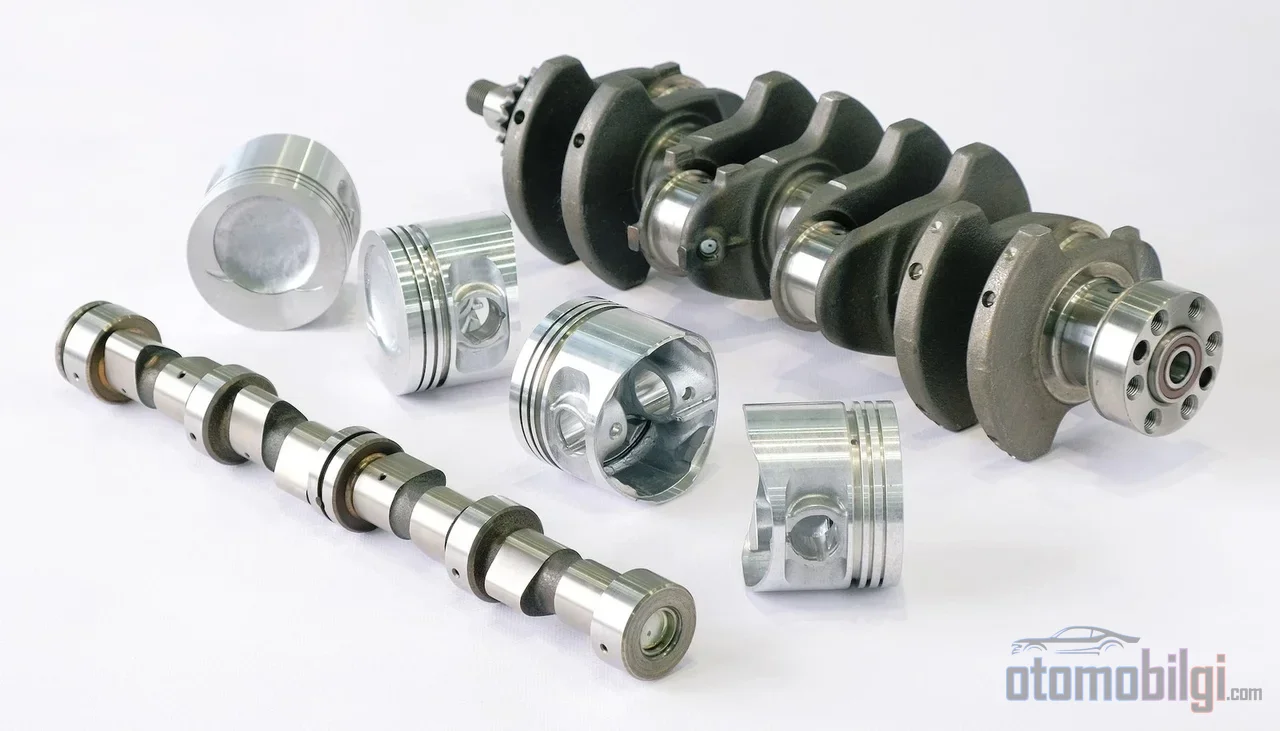
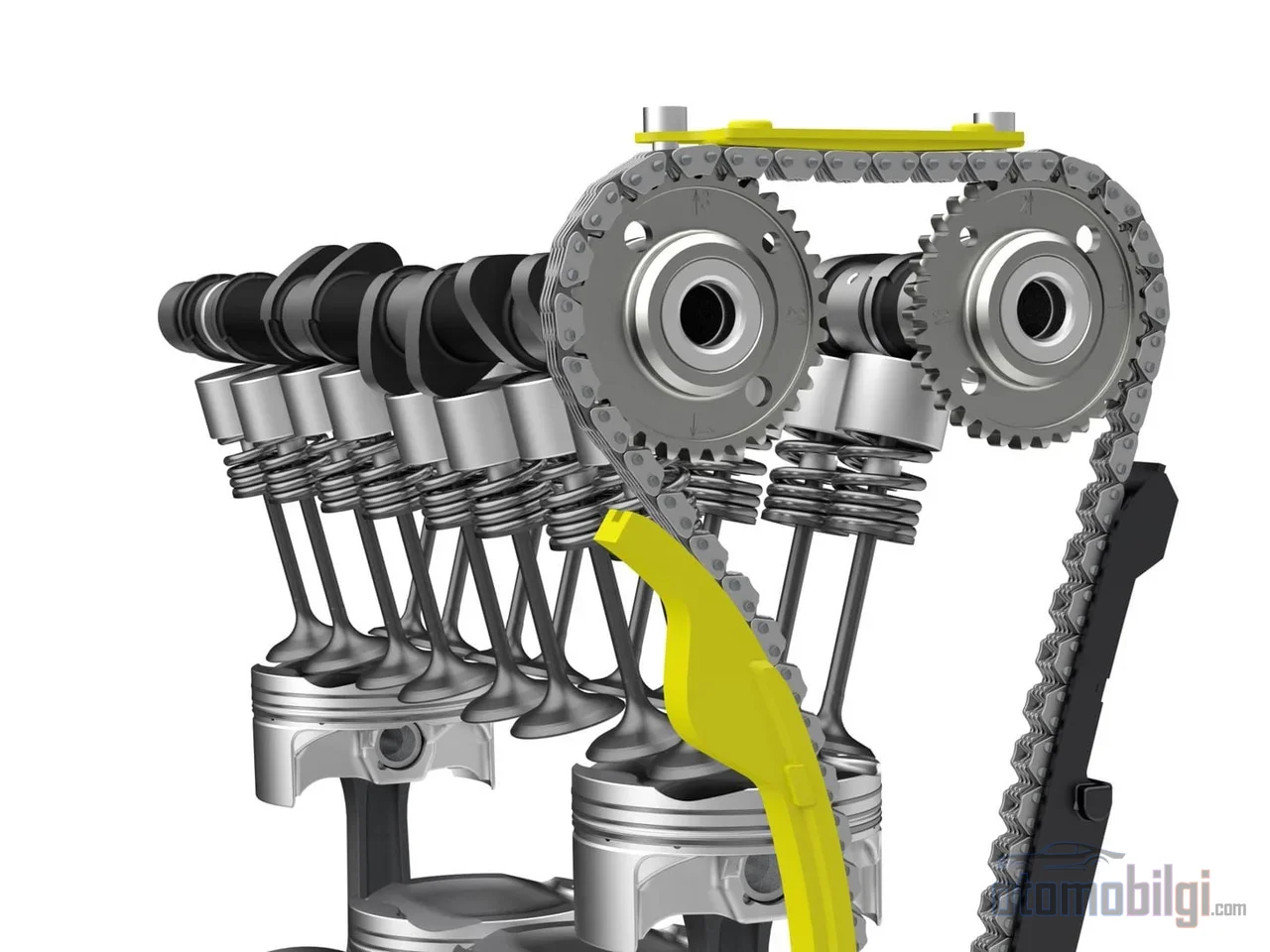
The OHV arrangement is a clever compromise: the valves move up into the head, the combustion chamber takes a proper shape; but the camshaft stays in the block and commands the valves through a chain of lifters, pushrods, and rocker arms. The battle is fought precisely in this chain. The advantages of the chain are indisputable:
- Hood height drops, the center of gravity lowers; the packaging advantage is significant in V engines.
- The camshaft is close to the crankshaft; it is driven by a short chain or a direct gear connection, with no belt-chain-tensioner combination as in OHC.
- Lubrication is simplified: rocker arms suffice, the pushrods can be hollow, and a smaller oil pump does the job.
- Abundant low-end torque and durability; tailor-made for pickup trucks and muscle cars.
The price, however, is hidden in the number of moving parts in the valvetrain. The inertia of the mass formed by lifter, pushrod, and rocker causes the valves to fail to follow the cam at high rpm and float (valve float). Moreover, the space the pushrods occupy in the head effectively fixes the number of valves per cylinder at two; a four-valve OHV head is so difficult that it can practically be called impossible.
The historical order is also interesting: OHV is an older idea than we think. The 1894 Diesel prototype is known as the first OHV engine, with overhead poppet valves operated by a camshaft-pushrod-rocker chain. In 1896, William F. Davis received a US patent for an OHV with a liquid-cooled head (no working model was built); in 1898, Walter Lorenzo Marr produced his OHV-engined trike and matured this design between 1899-1902 within the then-fledgling Buick. The result was the 1904 Buick Model B: the world's first mass-produced OHV engine, a flat-twin with two valves per cylinder. 750 units were sold in 1905, and from that day on, Buick remained almost entirely OHV. In 1911, even Chevrolet, like Buick, produced almost exclusively OHV engines.
Two events showing OHV's ceiling should be noted. At the 1994 Indianapolis 500, Team Penske, equipped with the volume and boost advantage born of a rule loophole, started from pole position in the Mercedes-Benz 500I pushrod engine and beat its OHC rivals by a wide margin. In 2008, the fourth-generation Dodge Viper launched with the first mass-production pushrod engine using VVT; 21st century: In the early years, GM and Chrysler added cylinder deactivation to their pushrod V8s to break the fuel consumption barrier. Every era in which pushrod was declared dead, it breathed once again.
The Rise of OHC: The Challenge from Europe
The history of OHC is as old as OHV and, paradoxically, passes through the same name: The 1904 Marr Auto-Car, carrying Walter Marr's design legacy, used one of the earliest known OHC engines. The camshaft sits in the cylinder head, operating directly above the valves; the pushrod chain disappears, and valve timing gains rigid precision. But for decades this solution was reserved only for high-performance vehicles; it was far too expensive for mass-production economics.
The balance 20. 20th century. OHC spread from the 1950s to the 1990s along a slow but steady curve, and by the early 21st century (with a few North American V8s as exceptions), the majority of automotive engines were built with the cam moved to the head. the beginning of the 21st century (with a few North American V8s as exceptions), the majority of automotive engines were produced with the cam moved to the head. Two layers need to be distinguished: In the SOHC layout there is a single cam per cylinder bank; it controls intake and exhaust together, is mostly limited to two valves per cylinder, and is cheap and easy to maintain. DOHC, on the other hand, uses two separate cams for intake and exhaust; four valves per cylinder, superior airflow, high-rev tolerance and VVT support are this layout's natural territory.
A small footnote complicates the architectural classification too: In some designs such as the Ford CVH and Opel CIH, the cam is in the head but sits below or beside the valves. Judging by mechanical realities, these essentially count as OHV - the control chain is as decisive as the cam's physical position.
How Many Valves per Cylinder? The Birth of the Efficiency Race
Once the cam moved to the head, the next move was obvious: more valves per cylinder. The roots of multi-valve designs go back to race cars of 1912, but it was the mid-1980s before the concept effectively became standard. The Ferrari 308 GTB Quattrovalvole (1982) and BMW M635CSi (1983) were models that showed four valves per cylinder had become almost mandatory in the high-performance world. Four valves meant intake and exhaust being optimized separately, the spark plug moving closer to the center of the chamber, and increased breathing capacity at high revs.
Four valves were not the ceiling either: In the period stretching from the 1980s to the early 2000s, five-valve engines remained popular but always out of the ordinary. As complexity increased, the gains diminished; five valves remained an engineering show, never an industry standard.
The list of iconic DOHC examples is long: The Alfa Romeo Twin Cam (1954), the Chrysler Hemi (1964) and Honda's CVCC architecture introduced in 1972 are the classics of this list. CVCC went into series production with the 1975 Civic, carrying Honda to a leading position in powertrain innovation and becoming the symbol of Japanese engineering's global challenge to valve architecture. The same Honda announced VTEC, launched with the Integra in 1989; The program, which began in March 1984, had already seen an early preview in the 1987 City. VTEC's DOHC-based variable timing and valve lift control was at a level comparable to Honda's own racing engines.
Variable Valve Timing: An Idea Eighty Years in the Making
VTEC is seen as revolutionary, but the idea of variable valve timing is surprisingly old. The 1903 Cadillac Runabout is the first recorded example with a patent for a variable valve mechanism; sources of the period write that Cadillac was at that time producing a driver-controlled VVT, predating Soichiro Honda's birth by three years. From 1903 to 1979, Cadillac, Porsche and Fiat tried different VVT designs, but none reached series production.
The threshold was crossed with the 1980 Alfa Romeo Spider 2000: the first series-production engine with VVT. In Japan, too, the ranking differs from what most people assume; in Japan, the company that produced the first VVT engine is not Honda but Nissan. Nissan's NVCS (Nissan Valve-Timing Control System) dates back to 1986 and was first used in the VG30DE 3.0-liter 24-valve V6. Honda's VTEC, on the other hand, traces its origins to the REV (Revolution-modulated valve control) system introduced on the CBR400 motorcycle. So VVT is not the story of a single inventor or a single brand; it is the story of an idea patented in 1903 slowly maturing into an industry standard in the 1980s.
Desmodromic Valves: Dead End or Treasure of Those Who Abandon Springs?
The most marginal solution in valve architecture approaches the problem in a fundamentally different way: do not use a spring to close the valve. In the desmodromic arrangement, the poppet valve is positively opened and closed by a cam and rocker system instead of a spring. The advantage is clear in theory: the weakness of valve springs is eliminated, and much higher valve acceleration and deceleration is allowed without the risk of spring failure. It also saves power at high rpm and is not as complicated an arrangement as most people think.
The counterargument is equally strong: what determines an engine's true rev ceiling is not spring risk, but the mass and geometry of the valvetrain. Modern metallurgy and materials science have made valve control far smoother than before; as spring mechanical strength increased, the advantage desmo once carried on its own melted away. Desmo today can be described as a solution that stands primarily on its mechanical elegance and marketing value, while its technical justification grows ever weaker.
Which Valve Architecture Is Better? Comparison
| Architecture | Cam position | Typical valve count | Strength | Weakness |
|---|---|---|---|---|
| L-head (flathead) | In the block, valves in the block | 2 per cylinder | Manufacturing and maintenance simplicity | Inefficient combustion chamber, low rev ceiling |
| OHV (pushrod) | In the block, valves in the head | 2 per cylinder | Compact package, low-end torque, simple drive | Valve float at high rpm, difficulty with 4 valves |
| SOHC | In the head, single cam | 2 per cylinder | Simple, cheap, easy to maintain | Limited airflow compared to DOHC |
| DOHC | In the head, separate intake and exhaust | 4 per cylinder (typically) | Superior flow, high rpm, VVT support | Complex and expensive drive system |
The table yields no single winner; that is also the conclusion the sources commonly reach. For torque-focused, heavy-duty and V8 applications, OHV is still a reasonable choice; SOHC is sufficient for balanced mass production; when performance and fuel efficiency are at stake, DOHC, with more advanced valve timing and airflow, is usually the most efficient option. A similar engineering calculation lies behind GM's insistence on pushrod: high-end output and an engine bay space advantage can come together in the same engine.
The Balance of 130 Years: Where Are We Today?
The closing chapter of the valve architecture wars did not declare a single winner. Flathead faded into history; OHV became confined to a narrow but solid base in the North American pickup and V8 world; while the DOHC and VVT combination became the de facto standard for performance and efficiency. Moving the cam into the cylinder head began as an eccentric curiosity in 1904, became a performance privilege within half a century, and turned into the industry's default in the 1990s. The question of where the valves would sit advanced in direct parallel with the question of how efficient, how lively and how durable the engine would be - and 130 years later, it is still not fully closed.
Sources
- Overhead valve engine - Wikipedia
- Valve Train 101: Understanding OHV and OHC - Enginetech
- OHV vs OHC vs SOHC vs DOHC Engines - EngineDIY
- Multi-valve engines - Autozine
- The VTEC Engine / 1989 - Honda
- The 1960s Trajectory of Challenges - Honda's History
- Desmodromic valve - Wikipedia
- Ducati Desmodromic Valves Explained - Motorcyclist
- All About Ducati's Desmodromic Valve System - Dirt Bike Magazine
- Variable valve timing - Wikipedia
- How VTEC Changed the World - Road & Track
- Technical Focus: Pondering Variable Valve Timing - Snap-on
- Otto engine - Wikipedia
- Flathead engine - Wikipedia
- Five Engines with Five (Or More) Valves Per Cylinder - EngineLabs
- 5 Good Reasons Why Pushrod Engines Still Exist - mechanics.com.au