Why Were the First Electric Cars Marketed with Women Drivers in Mind?
Share This Page
The question that determined the fate of the electric car early on was not "why" but "who." Features such as easy starting and quiet, clean operation turned the vehicle into a product marketed to women a century ago; this strategy kept manufacturers afloat in the short term but confined the electric car to a narrow niche in the long run.
Highlights
- Only 22% of cars produced in the US in 1900 were gasoline-powered.
- Between 1900 and 1904, only 22% of electric car ads targeted women; by the 1910s this figure rose to 77%. result.
- Detroit Electric produced a total of 13,000 electric vehicles and remained the only major electric manufacturer to survive into the 1920s.
- Charles Kettering's electric starter motor solved the crank problem with his 1912 Cadillac, invalidating the electric car's main sales argument.
The Crank Problem: The Electric Car's Strongest Sales Argument
At the turn of the century, starting a gasoline car was not "starting" in today's sense but a physical endurance test. The driver would stand in front of the hood, turn the hand crank, and wait for the moment the engine would kick back. If the engine kicked back at the wrong moment, the result was often a broken arm or a broken wrist; this is a real and documented risk in the sources, not an elaborate myth.
The electric vehicle eliminated this entire chain. A machine that started with a key or button, silent, odorless, and easy to use, offered a technically superior starting solution compared to a gasoline car that had to be fought with a crank. Cranking was considered "man's work" in the eyes of the era; women drivers therefore felt constrained in gasoline vehicles. It was impossible for manufacturers not to see this gap.
This physical difference is the starting point of a story that extends from technology to social history. When the electric car's cleanliness and ease of use combined with the social expectations of the era, a decision would have to be made about the vehicle's identity: to whom would this car be sold?
Women Were Not the Target at First
Contrary to popular assumption, the electric car was not born as a product for women. Between 1900 and 1904, only 22% of electric car ads appealed to women. The earliest ads targeted businessmen and family fathers; the message was a vision of a clean, reliable commuter vehicle against the gasoline car's image of a noisy "adventure machine." Colonel Albert A. Pope, head of Pope Manufacturing Company, summed up this vision with a blunt sentence: "You can't get people to sit on top of an explosion." By 1897, Pope had produced approximately 500 electric cars.
The figures also showed a serious market. In 1900, only 22% of cars produced in the US were gasoline-powered; the rest was shared between electric and steam vehicles. In the 1910s, the average range of electric vehicles was about 135 km and charging at home was cheaper than gasoline. So the electric car was not a marginal toy but a technically defensible alternative.
Market Loss and the Turn to the "Women's Car"
The balance was disrupted by Ford's Model T. As cheap, mass-produced gasoline cars came to dominate the market, electric manufacturers turned to a different audience to preserve market share: urban, affluent women drivers. By the 1910s, 77% of electric car advertisements 77% were aimed directly at women.
Behind this shift lay more than just the crank. The Victorian notion of "separate spheres" - the idea that women's need for mobility was more limited than men's - aligned with the electric car's urban, short-range nature. Manufacturers adapted the product to this social framework; in a sense, technical limits (range, speed, lack of infrastructure) were turned into a social positioning.
In the short term, the strategy worked. Manufacturers advertising to women survived far longer than rivals who abandoned electric cars. But the price was tying the electric car to a single niche instead of an entire market.
What the Advertisements Promised: Baker, Detroit Electric and Others
Luxury, silence and ease of use
Companies such as Anderson, Woods, Baker, Borland and Milburn used the image of women in their advertisements, emphasizing luxury, beauty, ease of use and economy. A 1903 Pope-Waverly ad described the vehicle as "absolutely silent, odorless, clean and stylish," highlighting the lowest operating cost per mile. Baker Motor Vehicle Company's 1910 ad titled "The Social Prestige" described the car's safety in language whose implication was plainly clear: this machine was so easy even a woman could operate it.
Some messages carried a questionable duplicity by today's standards. Argo's 1912 model was presented as "a woman's car that every man would be proud to drive," while Anderson recommended the Detroit model to men like so: no other wedding gift would mean as much for your bride-to-be.
The product was designed for women
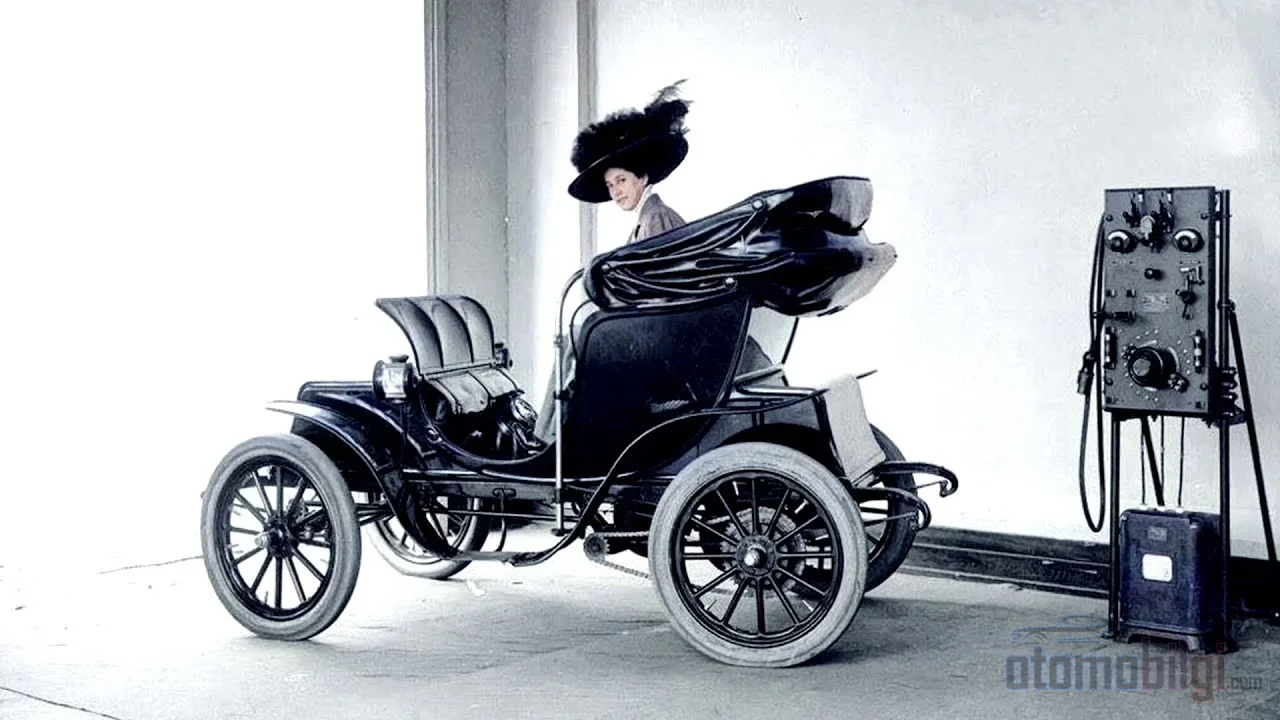
Marketing alone was not enough; the product was also shaped toward the target. The 1915 Detroit Electric offered headroom to accommodate tall hats, a spacious cabin for wide skirts, swivel seats and recessed flower vases. Coupes and broughams were delivered to wealthy women along with flower vases and makeup boxes. The 1914 five-seat Opera Coupe was designed to appeal to affluent women living near city centers. Famous customers included Clara Ford, John D. Rockefeller and Thomas Edison; Clara Ford used her 1914 Brougham into the 1930s.
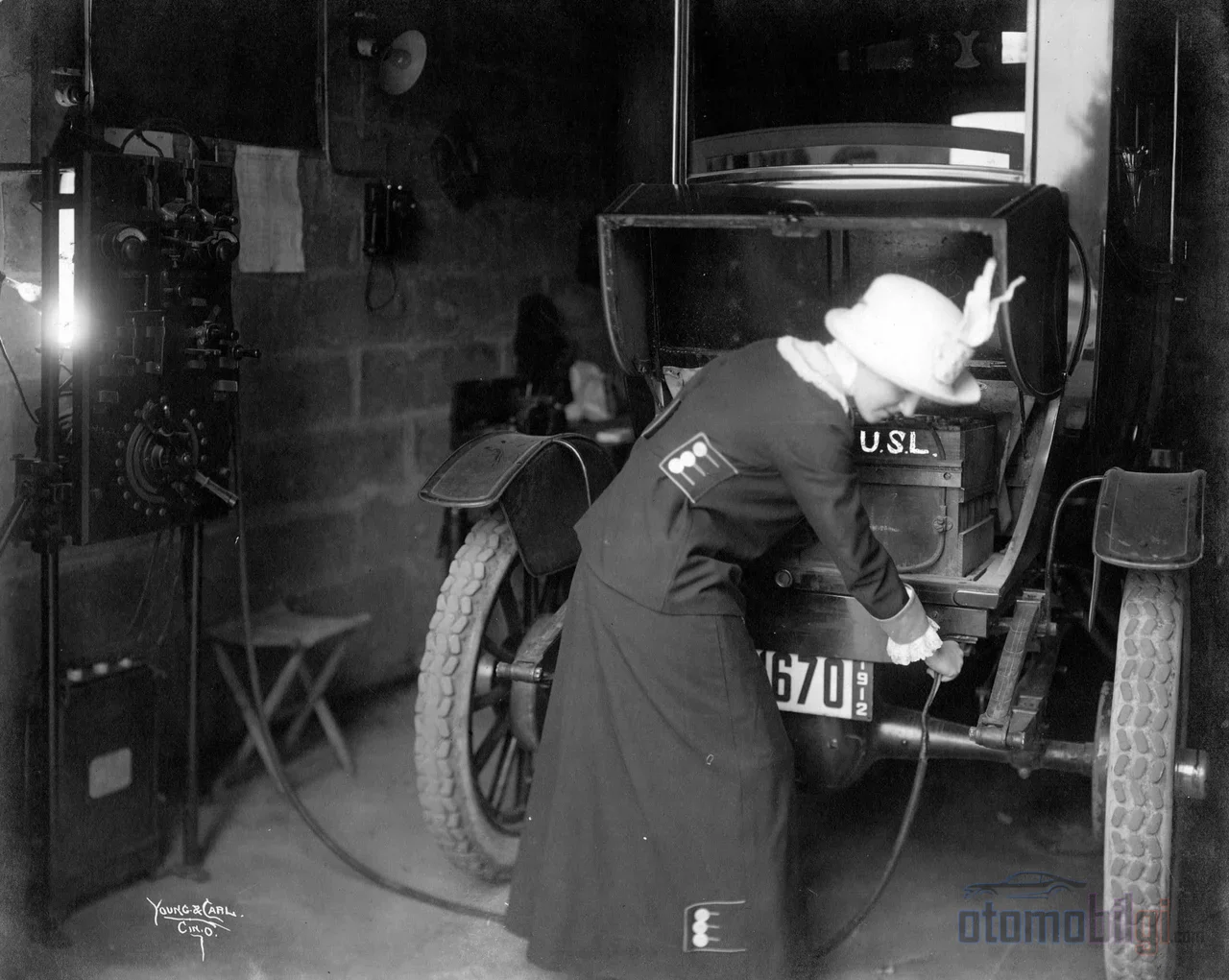
The technical details are meaningful too. The Baker Electric was a vehicle over 2.1 meters long with the look of a "giant telephone booth": twelve 6-volt batteries under the front and rear hoods powered a 72-volt motor. On a single charge, it could travel 40 km at a speed of about 175 km per hour. It did not even have a steering wheel; steering was done with a lever that folded from the left. Meanwhile, the Detroit Taxicab and Transfer Company, starting in 1914, roughly 100 produced electric taxis; customers preferred the cleaner electric even while gasoline taxis sat idle.
| Feature | Baker Electric | Detroit Electric |
|---|---|---|
| First production | Early 1900s | June 1907 |
| Total production | Niche luxury manufacturer | 13,000 vehicles |
| Supply voltage | 72 volts (12 x 6V batteries) | Lead-acid battery |
| Range (Baker, single charge) | Approximately 175 km | Urban use |
| Survival | Late 1910s | Until the 1920s |
Separating Legend from Fact
The crank really could break arms - this is a documented risk, not a legend. But not all the early-era women driver stories are without exaggeration. The known concrete records are as follows: in 1898, Genevera Delphine Mudge and Daisy Post were driving electric cars in New York; in 1900, the Chicago City Engineer complained that many women were driving cars without licenses; a trade journal wrote that while only eight women had been granted electric vehicle permits in the city, 25-50 women were regularly using these machines. So women drivers were real, but the advertising language of the era turned this reality into a uniform, idealized image of the customer. Some of the detailed anecdotes circulating in popular culture, however, cannot be verified by archival records; what can be trusted are the advertising figures and production data.
How the Electric Starter "Killed" It: The 1912 Cadillac and Beyond
The electric car's strongest argument was installed inside its rival. The electric starter motor developed by Charles Kettering was fitted to the 1912 Cadillac and solved the crank problem with a few seconds of turning a key. What is interesting is this: the electric starter was initially welcomed as a "feminine" feature. But when it became standard on the 1919 Model T, the calculation changed - when gasoline cars offered "feminine" qualities like glass, electric starters, and convenience to everyone, the electric car would no longer remain privileged. What was decisive in the electric car's decline was not a single company's decision, as conspiracy theories blame, but this technological asymmetry.
Detroit Electric nonetheless held on and remained the only major electric manufacturer still standing into the 1920s. But this was not a victory - it was the longest leg of a slow decline.
Did Gendered Marketing Condemn the Electric Car?
There is no single answer to this question, and the debate continues. Initially, the biggest problems were the lack of infrastructure, range, and speed; the gendering was a response to these developments - in other words, it was a consequence, not a cause. By contrast, the long-term picture is clearer: the electric car lost the battle for the public's imagination of the automobile and mobility. Its failure to recover despite falling electricity prices can be explained by the vehicle becoming locked into a conservative gender order - the "lock-in" effect can prevent a market from redefining itself.
This also has relevance today. In the first six months of 2023, only 33% of electric vehicles sold in the United States were purchased by women; whereas women buy half of all new cars in the US. The echoes of the narrow answer given to the question of "who" a century ago can still be measured in today's sales data.
Conclusion: The Lesson of a Niche Survival
Did women drivers save the electric car? Partially. Manufacturers targeting women survived far longer than their competitors; Detroit Electric's 13,000 vehicles are proof of that. But this was a niche survival, not the survival of the industry. When the electric starter rendered the single sales argument offered by the crank meaningless, the question of identity had to be asked again - and the electric car no longer belonged to anyone.
Sources
- Electric cars were once marketed as 'women's cars'. Did this hold back their development over the next century? (Josef Taalbi)
- Femininity and the Electric Car: Early Automobiles and "Separate Spheres" (Virginia Scharff)
- On the gendering of the early American electric car (Taalbi)
- The Baker Electric (Automotive Heritage Foundation)
- Detroit Electric
- 1910 Baker Electrics Advertisement, "The Social Prestige" (The Henry Ford)
- How The Electric Starter Killed the Electric Car
- The U.S. Faces a Persistent Gender Gap in EV Sales