How ACC Determines the Monitoring Target During Lane Changes
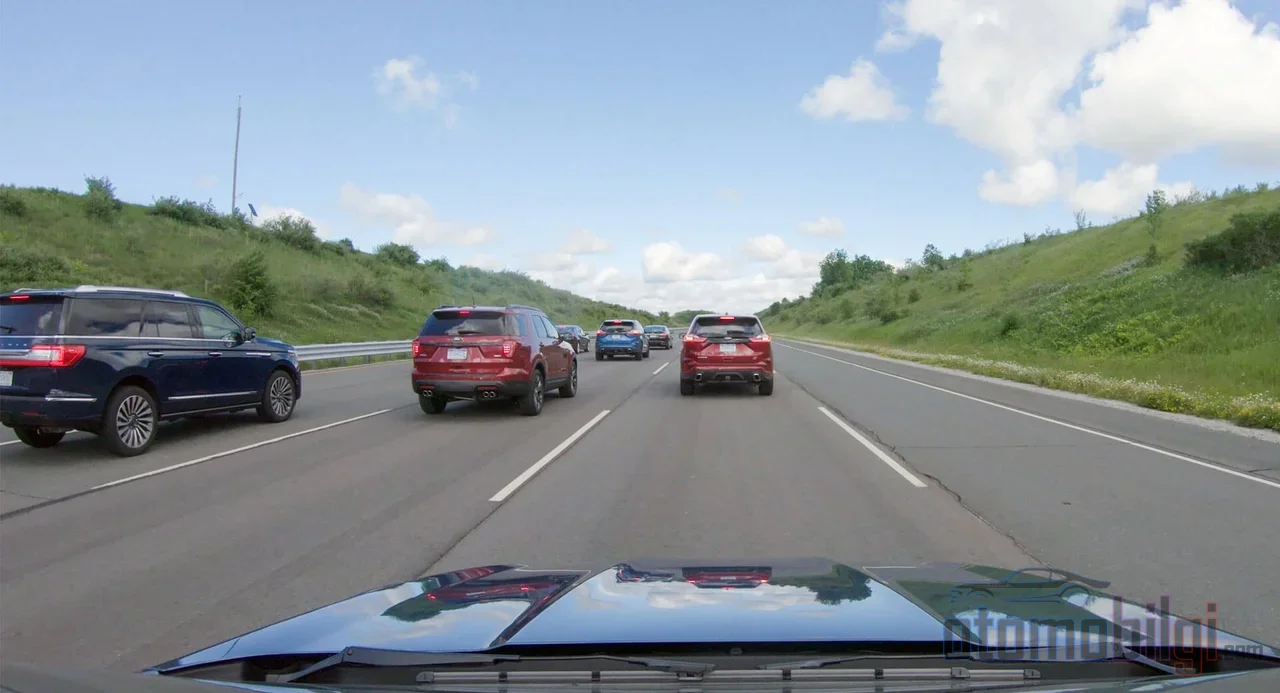
Adaptive Cruise Control (ACC) is on, on the highway, traffic is flowing, everything is fine. Suddenly, the vehicle ahead drifts to the right, the lane opens up, and your car, which was accelerating hard a second ago, suddenly slows down the next. Or quite the opposite: a vehicle slips in from the adjacent lane, and the system keeps accelerating as if nothing happened. Those few seconds are ACC's most critical and least talked-about moment: the transition window where the system hands its radar target over from the vehicle ahead to the new one. On this page, we will explain exactly that moment.
So why is this topic so important? Because most drivers see ACC working, but they do not know which vehicle is selected as the "target" in the background, how that selection changes, or why devilish surprises can appear at the moment of change. If you're ready, let's dive into the decision chain behind that signal.
How Does ACC Select and Track the Vehicle Ahead?
First, a quick recap, because understanding target changes goes through knowing the system's logic. ACC works by radio waves emitted from a radar hidden behind the front grille or bumper bouncing off surrounding objects. In most modern systems, a camera positioned around the interior rearview mirror is also in play: this camera distinguishes vehicles, lane markings, and traffic signs with image recognition software. In manufacturers that use radar and camera together, the data from the two sensors is blended; this multi-sensor approach provides far more reliable detection than a single sensor.
The really interesting part is the processing speed: the car's computer processes the sensor data 10-20 times per second, and in each cycle it measures how the distance to the vehicle ahead is changing. Is that vehicle slowing down, speeding up, or moving at a constant speed? Based on these measurements, the system tries to predict what will happen in the next few seconds. In other words, ACC is essentially a prediction machine constantly running mini calculations; it does not just look at the car in front of it and react.
What Happens When Multiple Vehicles Are in the Monitoring Zone?
The radar beam actually sees multiple objects at the same time; it is just that the system has to answer the question "which one is in my path?" by looking at lane markings and vehicle trajectories. This is where multi-object tracking comes into play: by matching detections across consecutive camera frames and radar scans, the system tries to maintain each vehicle's identity and trajectory. The radar data is projected onto and matched with the camera's image; this way, "the white car cutting into the lane" is not confused with "the red car two lanes ahead". At least, not in theory.
In practice, things are not as smooth as you might think. And this is exactly where we get to the main topic of this page.
What Happens When the Vehicle Ahead Changes Lanes?
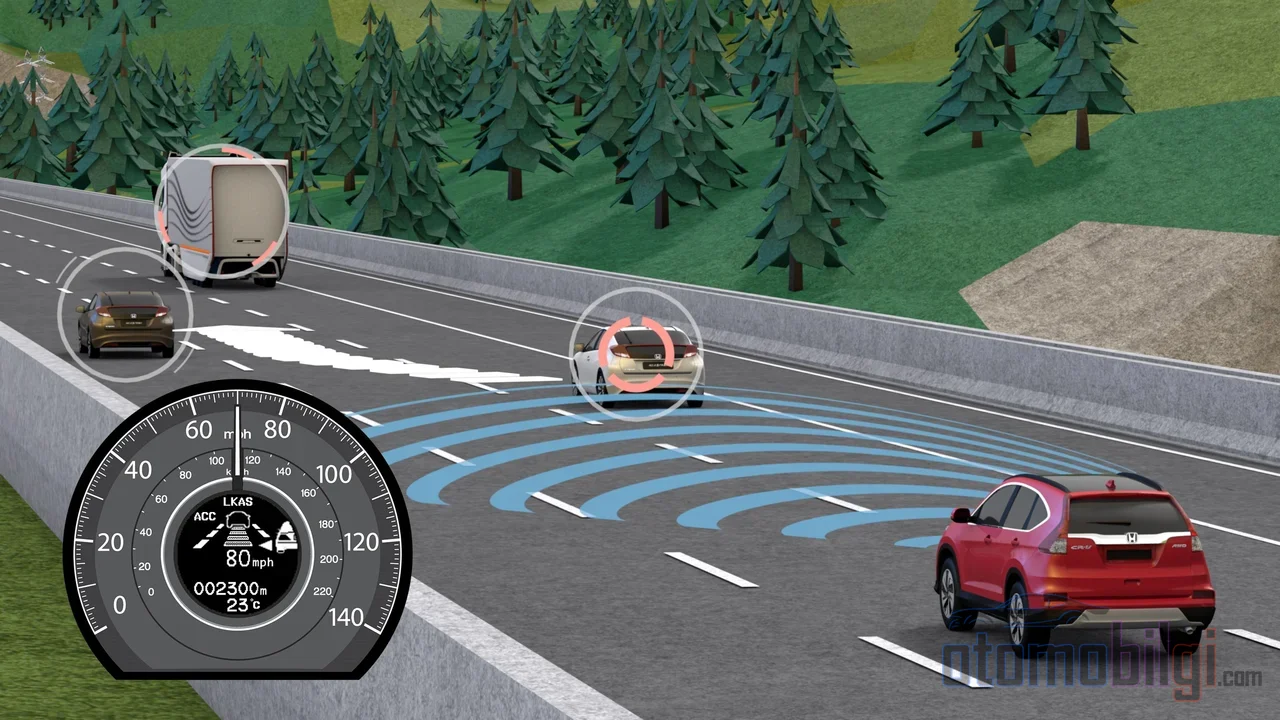
Let's make the scenario clear: ACC is following the vehicle in front of it. That vehicle drifts to the right and leaves the lane. When the system notices this, it detects that the vehicle it was tracking is no longer in your path, and the car accelerates back toward the newly set speed. Quite logical, if you are paying attention, right? But that detection takes several processing cycles of the sensor, and during this transition window the system lives in decision uncertainty: the old target is leaving, the new one has not yet fully settled in.
Key Highlights
- The ACC sensor processes data 10-20 times per second; target transitions are completed across these cycles.
- According to a 2021 peer-reviewed study, conventional ACC cannot effectively recognize and respond in advance to a vehicle cutting into the lane.
- Following distance settings usually range from about 1.5 seconds to about 3 seconds; the safety recommendation is 3-4 seconds.
- On curves, ACC may mistakenly target a vehicle in the adjacent lane.
- ACC does not take over the brakes: when the system reaches its limit it issues a warning, and the driver must intervene immediately.
New target selection during the transition is based on these criteria: whether the candidate vehicle is inside your lane markings, its trajectory angle, speed difference, and distance. When radar is combined with a camera, the system tries to distinguish which vehicle is actually ahead. Advanced systems can go one step further: by monitoring a neighboring vehicle's turn signal or steering angle, they predict in advance the likelihood of it cutting into your lane. But beware, this capability is not present in every vehicle; many systems ignore the signal and are forced to react the moment the cut-in happens.
How Is the Following Distance Recalculated During the Transition?
When a new target is determined, the system also establishes the following distance from scratch. The driver usually chooses one of 3-4 distance levels; these levels extend from a close setting of about 1.5 seconds to a far setting of 3 seconds. The physical equivalent of the distance varies with speed: a 2-second following distance equals about 88 feet (roughly 27 meters) at low speed, and about 205 feet (roughly 62 meters) at highway speeds. While switching to the candidate target, the system must measure the new vehicle's speed and distance over several cycles; if it makes a braking or acceleration decision before the measurement settles, that is exactly when those "why did it slow down?" moments arise.
Why Does the System Get It Wrong During This Transition?
Now let's come to the crucial part of the matter. Although a target transition looks like an ordinary record swap, this moment is the system's most vulnerable moment, and the reasons are quite physical.
Cut-in Scenario: The Harsh Reality
A 2021 peer-reviewed engineering study puts the picture clearly: in the cut-in scenario, meaning a vehicle merging in front, conventional ACC usually fails to identify the cutting-in vehicle effectively and cannot respond in advance. So far from "selecting" the new target, the system may even struggle to reliably detect the vehicle that has cut in. From the driver's perspective, this means the car reacting later than expected at the moment of the cut-in, or not reacting at all.
Adjacent Lane Confusion: Wrong Target Syndrome
There is also the opposite problem, and the forums are full of examples of it: even though a vehicle is traveling in the lane beside them, some drivers report that their car unnecessarily slowed down, thinking it was ahead. The technical explanation lies in sensor geometry: Forward-looking radar and cameras essentially look straight ahead. In a curve, the road bends but the sensor beam does not; as a result, the vehicle in the adjacent lane on the far side of the curve suddenly appears to drop into your path, or the system loses its lead vehicle in the middle of the curve. Most unexpected slowdowns and speed-ups come from exactly this. The solution is simple but annoying: increasing the following distance in curves and keeping your foot ready above the brake.
Signal Clutter with Close Targets
One more technical detail: when targets are very close to the radar, the sensors can produce multiple detections even for a single vehicle. When a vehicle following very closely behind you coincides with an overtaking moment, these extra detections create the technical ground for target confusion. In other words, the system sometimes has to deal not with incomplete data but with excessive and contradictory data when making decisions.
What Should the Driver Do During Overtaking?
Now that you know all this, let me give you the bad news: no ACC will take your place in those overtaking seconds. Official road safety authorities say the same thing - the driver must continuously monitor this assistance feature and maintain responsibility for driving. In fact, drivers who see ACC as autonomous driving are known to carry a significantly higher accident risk compared to those who use it fully attentively. To avoid broken hearts and broken bumpers, pay attention to the following during overtaking:
- Watch the target icon on the instrument display: when the vehicle ahead changes lanes, you can see which vehicle has been selected as the target on the panel; check whether the icon has switched to the new vehicle during the overtake.
- Keep the following distance generous: even though the system settings offer around 1.5-3 seconds, the safety recommendation is 3-4 seconds; as the overtaking margin grows, the cost of the system being wrong shrinks.
- Be skeptical in curves: sensors cannot bend; keep your foot near the brake as a curve approaches.
- Never forget the brake: the accelerator pedal overrides the system, while the brake pedal instantly gives you full control. Most ACC systems have no emergency stopping capability; once the limit is exceeded, they give a visual and audible warning and you must take over.
- Don't forget intersections, traffic lights and oncoming traffic: ACC only tracks traffic going in the same direction, in the same lane; anything that cuts across your path is your job.
Is Target Confusion a Fault or a Limit?
There is an ongoing debate in driver communities about this. According to one view, the unnecessary slowdown when the vehicle ahead changes lanes is not a fault, but the natural consequence of the system's capability limits. On the other hand, there are user experiences where the display shows the vehicle in the wrong lane and the problem persists despite repeated calibration, so the possibility of a software bug deserves serious consideration. The truth is this: you don't need to book a service appointment for every wrong slowdown, but if the behavior repeats and persists after calibration, it is worth consulting the service. Because ACC cannot read the minds of the vehicles around it; it only reacts to what they do. Adjusting your expectations accordingly is half the solution.
The Picture on the Ground in 2026
Nor is the topic free of timeliness issues. In 2026, some manufacturers are grappling with software anomalies causing unwanted harsh braking and intermittent ACC sensor faults that can lead to erratic acceleration-braking behavior; some fixes have even been temporarily suspended. Reports on user forums -sudden ACC shutdowns, complaints of excessive braking- are still unverified field feedback, but they show that the maturation process of target selection software is ongoing.
Short Answer: How Does the Transition to a New Vehicle Happen, and What Should You Watch Out For?
Let's sum up: When the vehicle ahead changes lanes, ACC -processing sensor data 10-20 times per second- detects that the vehicle is no longer in its path, releases the target, and selects a new target based on matching lane lines and trajectory; this transition takes a few processing cycles, during which the following distance is re-established for the new vehicle. The transition window is the system's most vulnerable moment: cutting-in vehicles may go unrecognized, and vehicles in adjacent lanes can become false targets in curves. That's why at the moment of transition, your eyes must be on the road and your hand on the brake; because in those few seconds, the one making the decision should not be the sensor, but the sensor monitoring the sensor - that is, you.
Sources
- Adaptive Cruise Control: What It Is, How It Works, and Cost
- Adaptive Cruise Control for Cut-In Scenarios (Chen et al., 2021)
- Commercial ACC and capacity (Lapardhaja et al., 2024)
- Advanced Driver Assistance Systems (ADAS) - RSA Ireland
- Sensor Data Fusion - Bosch Mobility
- Sensor Fusion Using Synthetic Radar and Vision Data - MathWorks
- How to Use Super Cruise | Vehicle Support
- Adaptive Cruise Control Increasing Risk of Car Accidents?
- GM Suspends Super Cruise Brake Assist Fix on 2026 Models
- Understanding Adaptive Cruise Control: A Guide for BC Drivers