The Road Cars That Led to the Birth of DTM
Share This Page
DTM homologation models are road cars with racing-car hearts, sent by manufacturers to their showrooms because of the rules of the German Touring Car Championship. The rules required that a race car be based on a road model coming off the production line, and that a certain number of that model be sold; that is why Mercedes, BMW and Alfa Romeo produced legends in batches of only a few hundred units. Mercedes 190 E 2.5-16 Evolution and BMW M3 Sport Evolution are precisely the products of this strange and wonderful rule.
Highlights
- A total of exactly 502 units each were produced of the Mercedes 190 E 2.5-16 Evolution I and Evolution II. 502 units each were produced.
- The BMW M3 Sport Evolution on the other hand, only 600 units were made in 1990.
- The road version of the Evo II produces 232-235 hp ; the race version pushed this figure to 350-360 hp.
- An Evo II found a buyer at auction for 715,000 dollars ; it is now a collectors' legend.
- Today the Evo II is on display in the Youngtimer exhibition of the Mercedes-Benz Museum.
What Is Homologation, and Why Did It Give Us Road Cars?
First let's understand the logic, because this is the heart of the story. Group A was the FIA regulation covering production-derived touring cars, and the basic idea was this: the car you race on the track must be based on a car that can be bought on the street. In other words, teams were competing not with prototypes born in laboratories, but with race versions of cars that came off the dealer's lot. An elegant idea, isn't it?
But there was one more condition: a sufficient number of the model on which that race car was based had to be produced. For Mercedes this figure was 5,000 sales a year; the 190 E 2.3-16 met this comfortably, selling more than 8,000 in 1985. However, to be able to compete in the championship, manufacturers had to produce short series of hundreds of units of the versions that suited them. This very rule gave birth to the few hundred perfect road cars that remained under the radar: homologation special models.
Let me make a simple analogy: imagine the condition for joining the school team is also selling at least 500 of the same t-shirt to your friends. To get on the team you have to design a really good t-shirt - and in the end you're left with 500 wonderful t-shirts. This is exactly what those t-shirts were that created the golden age of DTM.
A note: this rule did not last forever. In 1993 the Class 1 rules arrived, granting teams enormous technical freedom; 2.5-liter engines were permitted, but costs skyrocketed, and this trajectory led to the end of the series' then-international version in 1996. In later years DTM turned to GT3-based rules. Homologation models, however, are the signature of that very first, Group A era.
Mercedes 190 E 2.5-16 Evolution I: Sold Out
The 190 series was introduced in November 1982, and a total of 1,879,629 units produced; only 1.4 percent of those were 16V versions. So even within the 16V family, it was a special fruit. Mercedes originally planned this car for rallying, but Audi Quattro's four-wheel drive entry ruined the plans and the target was shifted to DTM. There is another scene in between: on May 12, 1984, the young Ayrton Senna won the opening race of the new Nürburgring, beating names like Lauda and Prost - proof of how serious the road to this series was.
The Evolution I was introduced at the March 1989 Geneva Motor Show and formed the basis for the development of the Group A car for the 1989 DTM season. Exactly 502 units were produced and all of them found buyers within just three months. Mercedes was not generous with colors: all of them were Blauschwarz, i.e. blue-black metallic. The 2.5-liter engine produced 195 hp as standard; those who wanted could raise this to 19,000 DM with the AMG Power Pack, reaching 225 hp and 240 Nm with 0-100 km/h in 7.1 seconds and a top speed of 236 km/h.
The racing heritage was everywhere: 300 mm front and 278 mm rear brakes from the 500SL, 16-inch wheels, a body 19 mm lower than standard, front track 14 mm and rear track 24 mm wider, and 23 percent stiffer suspension. The most surprising detail? Electronically adjustable ride height that could be set from inside the cabin - and the default position was 19 mm lower than standard. As for the transmission, it was Getrag's 5-speed dogleg box; the same box was also used in the BMW M3 E30. The rivals even shared connecting components.
Evolution II: The Rear Wing Actually Worked
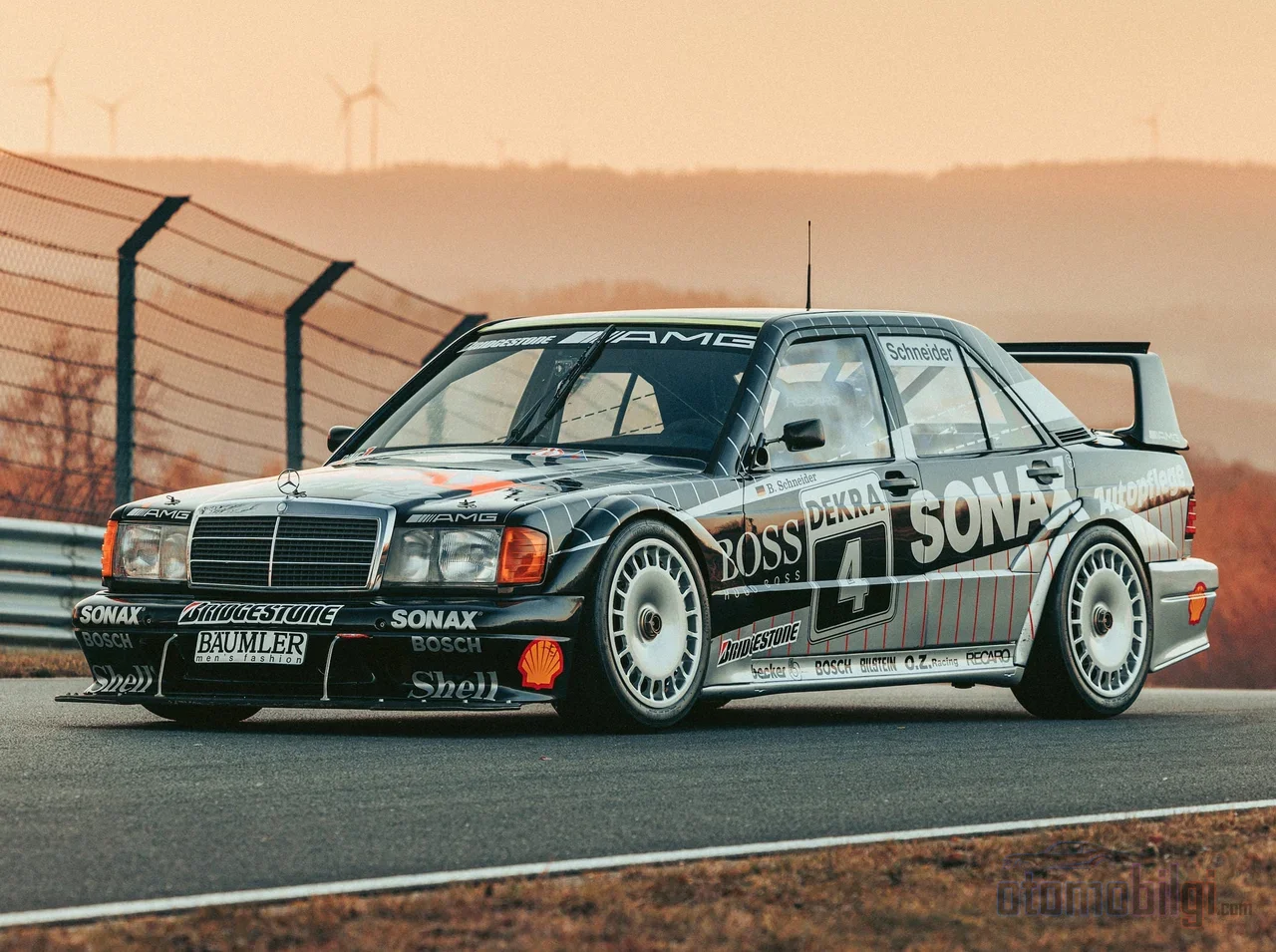
The Evolution II was introduced at Geneva in March 1990 and again 502 units were produced. What is most striking is this: all of them had been sold even before the motor show presentation. The famous big wing was not just for show; the aerodynamic package developed in the wind tunnel reduced air resistance and pressed the car onto the road at high speeds. The wing worked so well that we read on the BMW side that the aerodynamic data was found surprising and confidence in the tunnel measurements was shaken - meaning the Stuttgart folks had not slapped on a wing without measure.
The engine side was the peak of this generation: the 2.5-liter, Cosworth-developed M102 E25/2 unit produced 232-235 hp and 181 lb-ft of torque and was the last race engine developed under the Mercedes name before AMG took over the business. The rev limit rose from 7,250 in the Evo I to 7,800 rpm; a shorter-stroke crank and larger cylinders were used. The brakes moved to Brembo's 4-piston calipers, the wheels became 17 inches, and the body was lowered by a full 45 mm compared to the standard 16V. The suspension could be adjusted from inside the cabin in three stages between 15-45 mm.
Small treasure troves of information for those who love details: two of the 502 vehicles were painted silver and, according to legend, these were the test vehicles used in the development of the road version; one remained at Mercedes, the other at AMG. All vehicles were left-hand drive, the gear knob carried a number between 001/500 and 500/500, and an EVOLUTION plate gleamed on the fender.
What about on the track? In the 1992 DTM season, the Cosworth-built race engine went from 235 hp to approximately 350-360 hp was raised to: 10,000 rpm, slide throttles, dual variable cam control and a Bosch Motronic ECU. That year the top spots went to Mercedes factory drivers: Klaus Ludwig first, Kurt Thiim from Zakspeed second, Bernd Schneider third; the Evo 2 DTM won nearly the entire season against Audi's 3.6-liter V8 all-wheel-drive car.
BMW M3 Sport Evolution: Munich's Answer
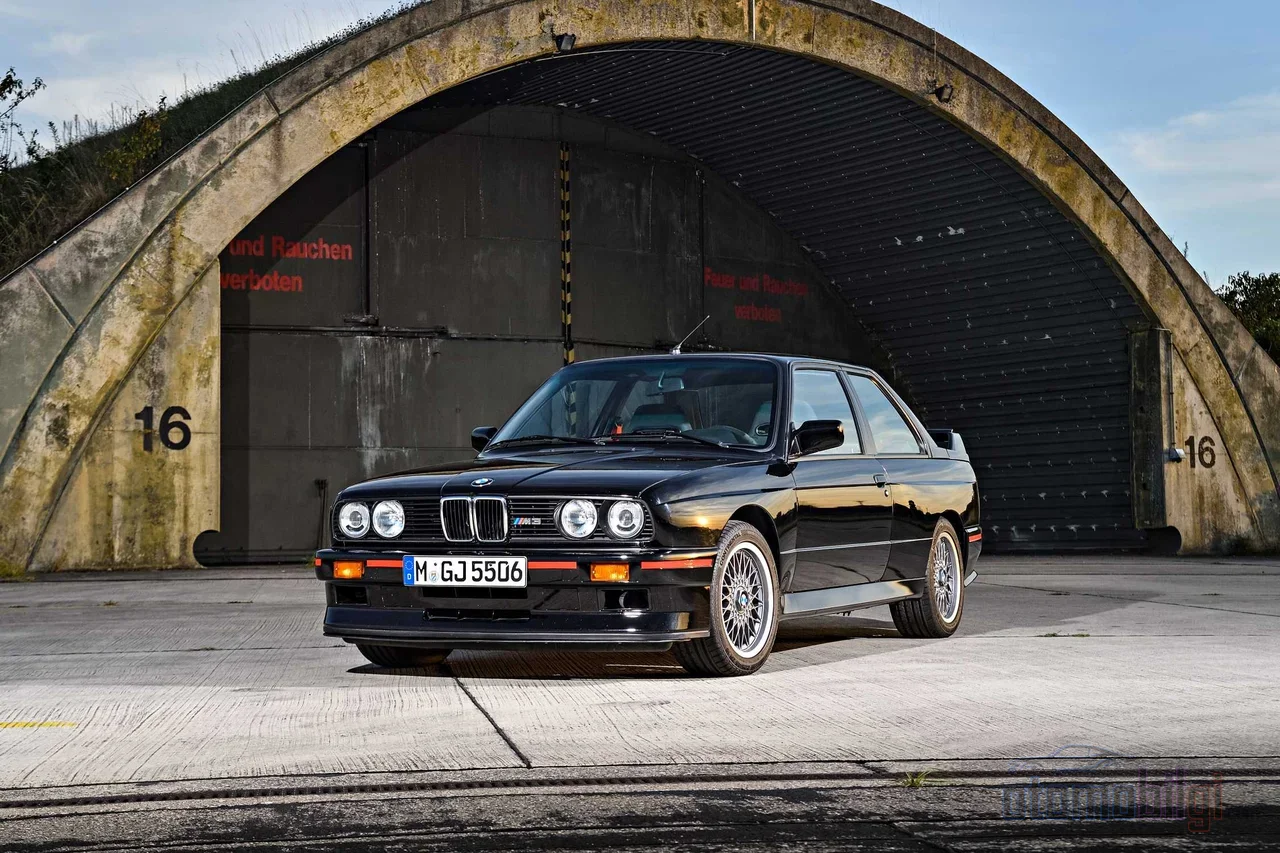
Mercedes' entry into the series pushed BMW to build the M3 - meaning this homologation war was not a one-sided duel. The E30 M3 was introduced in 1986 as a Group A homologation special for touring car racing and rallying; the first M3's price was 58,000 DM and by the end of the Sport Evolution era the base price had exceeded 85,000 DM. For the 1988 DTM season, a homologation run of around 5,000 units is cited; meaning that, unlike Mercedes' one-off short series, BMW put the M3 on a broader production base.
The Sport Evolution, popularly known as the Evo 3, was the final and most extreme version of this series: only 600 units were produced between January and March 1990. The S14 engine was enlarged to 2,467 cc and produced 238 hp . In the DTM, a modified 2.3-liter S14 was used first; the Evolution I and II homologation versions were developed from the civilian model. No fiction is needed to show the character difference: in contemporary comparisons, the BMW was found to be lighter, more agile and more aggressive, while the Mercedes Evo II was described as a more dignified and serious machine. A driving review of the era noted that the BMW's engine was not as smooth but its mid-range torque was reasonable. So whichever one you chose, you were choosing a character.
Alfa Romeo 75 Turbo Evoluzione: The Third Party in the War
This story does not unfold only among the Germans. Alfa Romeo also played its own card for Group A and produced the 75 Turbo Evoluzione for homologation purposes. The model was homologated on August 2, 1986 when the required 5,000 cars were completed; a series of 500 units of the road version came out in the spring of 1987. The road version produced 155 hp and reached 210 km/h - modest figures compared to its rivals perhaps, but the car's purpose was racing, not road physics, and most examples were developed for exactly that purpose. Today, the number of people driving around claiming to own one of them can be counted on one hand.
Side by Side: Homologation Specials in Numbers
| Model | Year | Production | Power |
|---|---|---|---|
| 190 E 2.5-16 Evolution I | 1989 | 502 | 195 hp (225 hp with AMG package) |
| 190 E 2.5-16 Evolution II | 1990-91 | 502 | 232-235 hp |
| BMW M3 Sport Evolution | 1990 | 600 | 238 hp |
| Alfa Romeo 75 Turbo Evoluzione | 1986-87 | 500 | 155 hp |
Looking at the table, the pattern becomes clear: they are all series of a few hundred units, all with enlarged or tuned engines, and all carrying a body that is still usable on the street. The question enthusiasts debate the most is exactly this: E30 M3 or 190 E Evo II? The honest answer is that they competed in different classes - one is a light and aggressive pony, the other a dignified sedan that is furious with its naturally aspirated power. The choice depends entirely on what you want.
How Much Are These Cars Worth Today?
Short answer: a lot. Long answer: homologation specials are writing one of the most dramatic value appreciation stories, turning from classics forgotten in attics into collection stars. While an ordinary 190 series example hovers around $2,000 today, flawless and rare collector versions can exceed $250,000 - the same body, the only difference being that small EVOLUTION badge.
The Evolution II's auction record is truly striking: in 2016 an example was listed for £292,000; later an example failed to find a buyer despite a price of €275,000, but historical records show that an Evo II was sold for $715,000. For the Evolution I, current market data points to an average of around $225,795. Just think: these cars, waiting at the dealership in 1990, are circulating at auctions today like works of art.
And an even nicer detail: the Evo II is on display in the Mercedes-Benz Museum's Youngtimer exhibition, open until April 12, 2026. So even after all these years, it is still in the spotlight, in front of the camera, a star collecting admiration. To me, this is the sweetest result of homologation models: they were born out of a rule, but they became immortal thanks to their talent.
Which One Do You Think Won: Munich or Stuttgart?
The legacy of the DTM's first era is twofold: captivating brand wars on the track, and on the street, road cars limited to a few hundred units, carrying racing technology. The Group A era was, by many passions' standards, the series' finest time; the cars still resembled models sold on the road, and the homologation models stood as proof of this closeness. The Class 1 era was technically magnificent, but the costs wore the series down - regulatory freedom does not always yield good results.
For me, the verdict is clear: the Evo II's wing and the M3's lightness are two halves of the same story. If it were you, which one would you take to your garage - the winged Mercedes or the agile BMW? I look forward to your answer.
Sources
- This 190E 2.5-16 Evo II Is Homologation Royalty - Road & Track
- HISTORY - MB190e16v
- Mercedes-Benz 190E Evo 2 DTM [TECH TOUR] - HP Academy
- Mercedes-Benz Museum Instagram - Evo II
- The BMW M3 E30 - BMW M official
- 1990 BMW M3 Sport Evolution - RM Sotheby's
- Guide: BMW E30 M3 Sport Evolution - Supercar Nostalgia
- BMW M3 (E30) DTM - Invelt Collection
- Guide: Alfa Romeo 75 Turbo Evoluzione - Supercar Nostalgia
- Alfa Romeo 75 Turbo Evoluzione IMSA - Stellantis Heritage
- Group A - Wikipedia
- Class 1 Touring Cars - Wikipedia
- Rare Mercedes-Benz 190E 2.5-16 Evo 2 Eyes $286K - gtspirit
- Mercedes-Benz 190E 2.5-16 Evolution II auction results - Glenmarch
- Mercedes-Benz 190E 2.5-16 Evolution - classic.com
- Which is better, BMW E30 M3 or Mercedes 190E? - Top Gear
- BMW E30 M3 Sport Evolution vs. Mercedes 190E 2.5-16 Evo II - Road & Track