How Präsident Became Central Europe's First Automobile?
Share This Page
Karl Benz's three-wheeled vehicle, Daimler's engines, Ford's assembly lines... Every book telling the story of the automobile's birth opens with the same few names. But what if I told you that in the middle of a continent, in a town that slips past the map, a carriage factory bought an entire Benz license and built its own automobile? Or that in Canada, while the country was still brand new, a steam car's spinning sparks lit up a fairground? On this page, I have gathered the firsts that fall outside the main narrative but truly complete the history of the automobile: if you're ready, we're heading to Moravia in 1897.
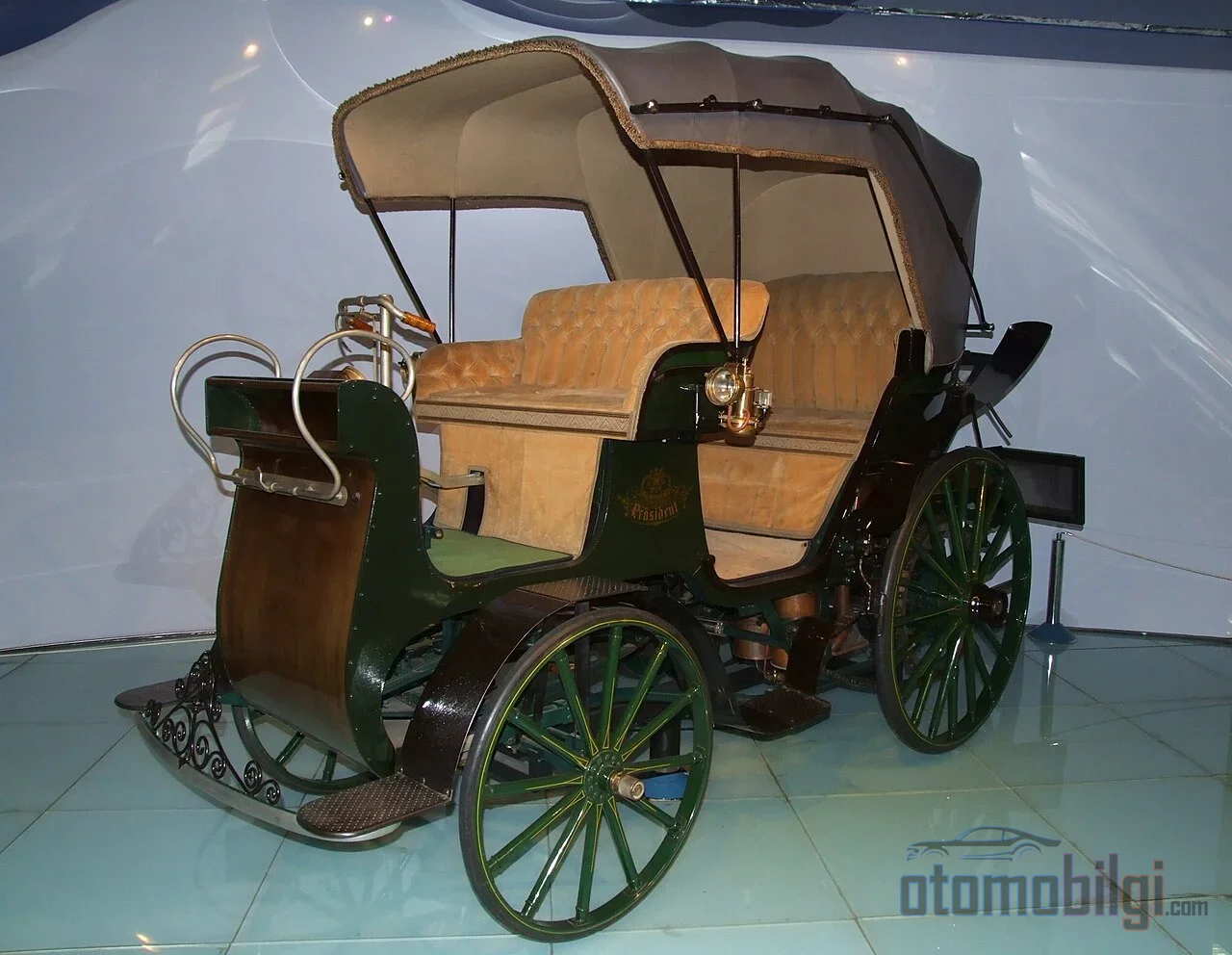
Präsident: How Central Europe's First Automobile Was Born
The hero of this story is not actually an automobile company, but a carriage (that is, horse-drawn carriage!) company. In 1850, Ignaz Schustala founded a carriage workshop in the town of Nesselsdorf in Austria-Hungary (Kopřivnice in today's terms, in Moravia). When Hugo von Roslerstamm became technical director in 1891, the company took the name Nesselsdorfer Wagenbau-Fabriks-Gesellschaft - briefly, NW. So by the time they started experimenting with automobiles, they already had years of experience in bodies and suspension. A carriage maker moving on to the automobile is like a bicycle factory switching to e-bikes today: the craft is the same, the power source is new.
And the spark came from an unexpected place: Baron Theodor von Liebieg made a 2,500-kilometer journey in a Benz Viktoria in 1894. Inspired by this feat, NW established an experimental automobile workshop in 1895. In the winter of 1896-97, chief machinist Franz Cahel traveled to Mannheim and bought a license directly from Benz. The company acquired another Benz Viktoria - this vehicle was named the Instruktor and used as a working model - and added Benz's new flat-twin (horizontally opposed twin-cylinder) engine, which Benz had patented in 1896. The Viktoria arrived at the Neutitschein station on March 7, 1897, work began in June, and the vehicle was completed that same autumn.
Why the Name Präsident?
Names like Leopold Sviták and Hans Ledwinka worked on the car's design - make a note of Ledwinka; as Tatra's future legendary engineer, he will have a big role in this story. The vehicle took the name Präsident on February 6 in honor of Count Gustav Pötting-Persing, the first president of the newly founded Austrian Automobile Club. The total cost was a whopping figure for the time: 400,000 gulden. A bold bet for a carriage factory, isn't it?
One detail needs to be conveyed accurately: The Präsident's "first" title is a carefully defined first. There were earlier motorized vehicles that Siegfried Marcus experimented with in Vienna, but these remained experimental. The Präsident, however, was the first practical, factory-built gasoline automobile produced in Central and Eastern Europe - that is, the vehicle that made history not with an experiment but with a production line.
Highlights
- 1897: Nesselsdorfer builds the Präsident in Kopřivnice - Central Europe's first practical, factory-built gasoline automobile.
- 21 May 1898: Nesselsdorf–Vienna, 328 km without a single breakdown, averaging 22.6 km/h.
- 1867: Canada's first vehicle, a steam-powered carriage built by a watchmaker in Quebec.
- 1907: Japan's first domestically produced gasoline car, the Takuri, is completed in Tokyo.
- 1908: The Grieve, the first car produced in South America, takes to the roads in Lima.
Technical Specifications of the Präsident: What Remained of the Horse Carriage?
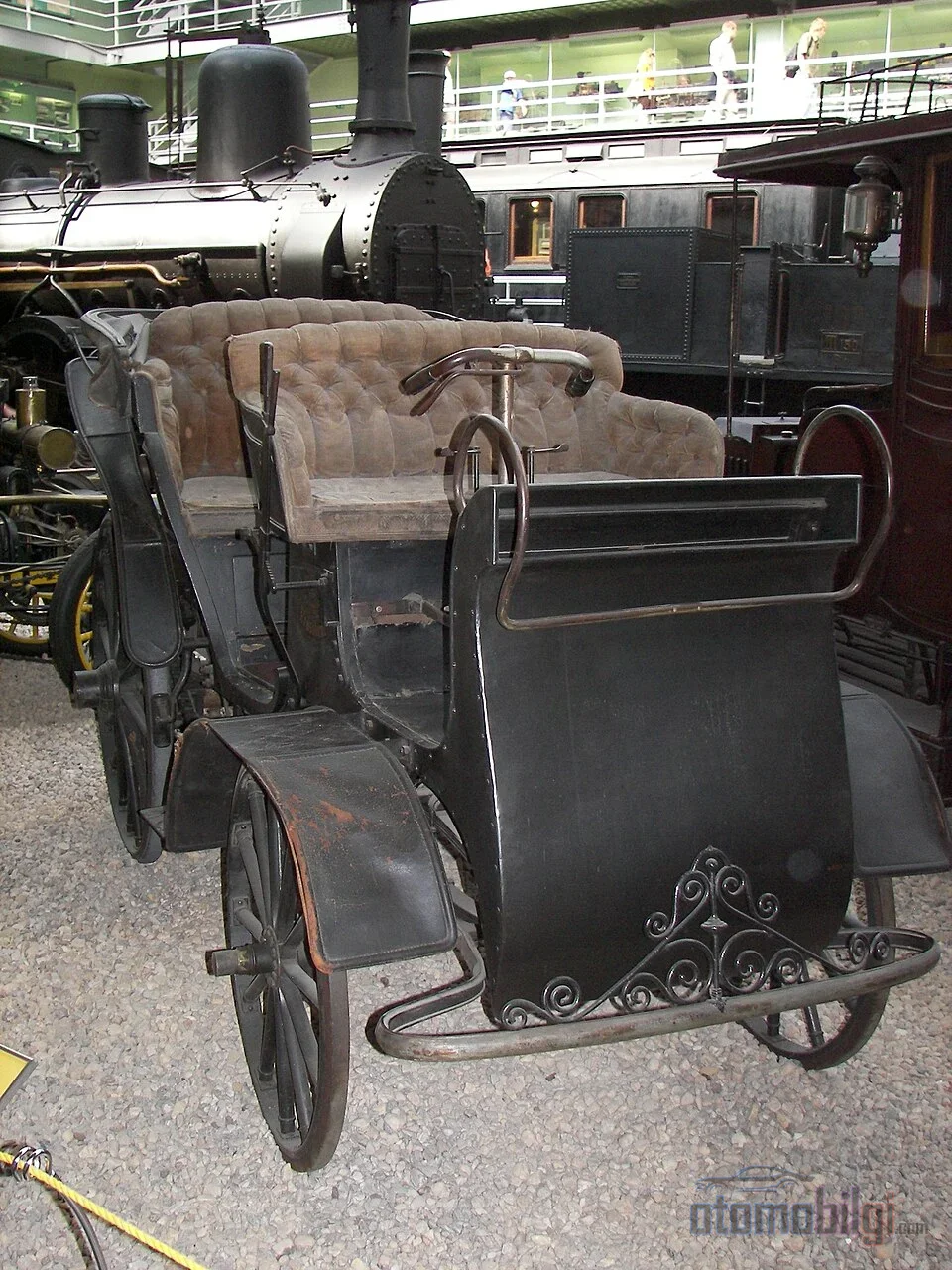
The conditions of the era are felt in every centimeter of the vehicle. The body is wooden, mounted on an iron chassis, and takes its shape from a Mylord-type horse carriage. Even the steering is a bicycle handlebar - a considerably practical choice compared to the tiller steering used in most cars of the era. The transmission is two-speed, with power transferred to the rear axle via belt drive. But let me say without exaggeration: the presence of a differential and a genuinely functional bumper in this vehicle is among the original details of the era.
| Specification | Value |
|---|---|
| Engine | 2,714 cc water-cooled flat-twin Benz |
| Power | 6.5 hp |
| Transmission | 2-speed, belt drive |
| Top speed | Approximately 30 km/h |
| Weight | 1,072 kg |
| Wheelbase | 1,780 mm |
| Body | Wooden, iron chassis, folding canopy |
A small note about speed: the top speed is usually given as ~30 km/h; some assessments point to 35 km/h with 6 hp @ 600 rpm. This difference is the kind of drift caused by measurement methods - it does not change the essence: the vehicle offered performance that could comfortably travel the roads of its time.
The Journey to Vienna: A Feast of 328 Kilometers
What is the best way to convince people of an automobile's existence? Driving it in front of everyone's eyes on a long journey. On 21 May 1898 Hugo Fischer and Baron Liebieg drove the Präsident from Nesselsdorf to Vienna: 328 kilometers, 14.5 hours, an average of 22.6 km/h - and not a single breakdown. Today it may look like a delivery route, but think about it: the road is neither smooth nor asphalted, there is no such thing as a gas station, and the vehicle's type is not even two years old yet. This journey proves as effective as a commercial, and the vehicle is exhibited at the Collective Exhibition of Austrian Automobile Manufacturers as part of the Franz Joseph Jubilee Exhibition. It is then donated to the Austrian Automobile Club for driver training.
From Präsident to Tatra: How Does a Trace Become Permanent?
This is where the story of the Präsident ceases to be an ordinary "first". On 23 October 1899, the Wien and Nesselsdorf derived from the vehicle take part in Austria-Hungary's first automobile race - and Liebieg, with the Wien, is on the winning side. In 1900, NW produces its first series-production car, the Type A (22 units), and signs the first race car of Central Europe, the Rennzweier. The line emerging from that experimental workshop never breaks: the company takes the name Tatra and continues automobile production in Kopřivnice until 1998, that is, up to the T700; heavy truck production, meanwhile, continues. The seed of one of the world's oldest vehicle manufacturers still in production was sown in that winter of 1897.
The President himself is not forgotten. The original vehicle is on display at the National Technical Museum in Prague - still in working order, but not in its original state: the original Benz engine is not in place and the vehicle has been modified over the years. In 1977, an exact replica is produced for the Tatra factory museum. And a nice twist: Vietnam-based VinFast gives its limited-production President model its name from this very vehicle. The name of 1897 still circulates in sales catalogs more than a century later.
Quebec's Two Firsts: Taylor's Steam Car and the Fossmobile
Let's turn to the West. The same year as the automobile, in 1867 - yes, the year the Canadian Confederation was proclaimed - watchmaker and jeweler Henry Seth Taylor of Stanstead, Quebec, built the first known car in Canada: a steam-powered buggy. He made its first showing at the Stanstead Fair; the first public demonstration took place at the Stanstead agricultural fair on September 24, 1868. A small but honest footnote: some automotive historians suggest the buggy may have been purchased from steam vehicle master Sylvester Roper; whether the vehicle was entirely original is still a matter of debate.
The Canadian firsts on the gasoline side begin with a Missouri experience. George Foote Foss of Sherbrooke was a self-taught bicycle engineer. In the winter of 1896, he paid to ride in an electric automobile in Boston, and that short journey made one thing clear to him: he could build his own vehicle. That same winter he set to work on his single-cylinder, 4-horsepower gasoline automobile, and in the spring of 1897 he completed the Fossmobile. Only one example was produced, but it went down in history as Canada's first successful internal combustion gasoline automobile. In short, Canada's firsts are split in two: Taylor for steam, Foss for gasoline.
Japan's Takuri and Peru's Grieve: The First Motor in the East and the South
When the main narrative gets crowded with American and Western European names, the firsts in Asia and South America are overlooked. Yet in 1907, Komanosuke Uchiyama, an engineer at Tokyo Motor Vehicle Works, completed the first fully Japanese-made gasoline automobile, the Takuri. In the same period, Kunisue Automobile Works produced the Kunisue; some manufacturer sources also mention a vehicle from the same year called the Taklee - the names can be spelled differently in sources as Takuri/Taklee. Japan's timeline then accelerates: In 1904, Torao Yamaha produced Japan's first bus, in 1914 Kwaishinsha signed the DAT, followed by the Mitsubishi Model A in 1917 and the Datsun Type 11 in 1932. The Takuri is the cornerstone at the head of this line.
Shall we head south? In Lima, engineer Juan Alberto Grieve was a name that stood out for his knowledge of internal combustion engines. In 1905, he built South America's first internal combustion engine, founded Lima's first automobile club a year later, and in 1908 introduced his own automobile design, the Grieve. it is enough for him to be remembered as the first person to design and build a quality automobile on the continent. A pioneer who would inspire the engineers heading south in the future, in short.
So Why Did These Firsts Fade Away?
To be honest, there is no solid country-specific record explaining why most of these early ventures failed to become global brands; drawing up a list of exact causes would be making things up. But there is a general context: in the failure of early automobile companies, causes such as investing in the wrong fuel type, weak management, and shifting consumer preferences stand out. And in truth, we should remember that not every pioneer had to build a brand - Taylor was a watchmaker, Foss a bicycle engineer, Uchiyama an employee of a company, and Grieve an engineer. For some, being first was not a commercial venture but a proof of concept.
On the other hand, the Präsident example shows how the right conditions made a mark permanent: when carriage-making craftsmanship combined with a Benz license, an entire century-standing industry emerged. Where road infrastructure, industrial experience, and institutional support did not come together, the first vehicles remained mostly symbols - but symbols write history too. Today trucks are still produced in Kopřivnice, the automotive giants of Tokyo count Takuri as their root, and Lima remembers Grieve as the pioneer of South American automobiles.
The First Automobile of Every Region: In Brief
Let us gather a clear answer to the question at the top of the page: Which was the first automobile of Central Europe? The 1897 Präsident - with the designation of a "practical, factory-produced gasoline automobile," if experimental vehicles are set aside. Was Canada's first car steam-powered or gasoline-powered? Both: In 1867 Taylor's steam vehicle, in 1897 Foss's gasoline one. Who built Japan's first automobile? In 1907 Komanosuke Uchiyama, with the Takuri. The first automobile produced in South America? In 1908 Juan Alberto Grieve's vehicle in Lima.
In my view, the most striking part is this: the story of the automobile is not the story of a single continent and a few geniuses. From Kopřivnice to Stanstead, from Tokyo to Lima, the same thing happened everywhere - someone dreamed of building a motorized carriage, tried it with the carriage, bicycle, or watchmaking craftsmanship at hand, and wrote the first page of their own region's history. The Western-centric narrative skips these pages; we completed them. You decide which overlooked first we should pull from the archive next.
Sources
- Präsident - Wikipedia
- The Beginnings of Tatra: From Wagons to Automobiles
- Tatra (company) - Wikipedia
- Henry Seth Taylor steam buggy - Wikipedia
- Henry Seth Taylor Steam Carriage - Ingenium
- The Inventor - Fossmobile
- Fossmobile - The Canadian Encyclopedia
- 75 Years of Toyota - Takuri
- Car production in Japan in the Taisho and early Showa periods - Nissan
- Grieve - Wikipedia
- Juan Alberto Grieve - Britannica
- Latin America's Automotive Innovators and Trailblazers - AAA
- Automobile History - History.com
- Early Cars: Fact Sheet - Smithsonian
- Automotive History - Library of Congress