How Did Dalmier Succeed in His Break from Maybach's Horse Carriage?
Share This Page
In 1889, Daimler and Maybach produced the first Daimler vehicle designed from scratch, rather than placing the engine into an existing horse-drawn carriage; this break is considered the starting point of modern automobile architecture. So why did the duo, who just a few years earlier had prided themselves on squeezing the engine inside a horse-drawn carriage, suddenly decide to redraw everything? Here is the story, spanning 1885 to 1889, of how the automobile truly broke away from the horse carriage.
Highlights
- 1885: The Reitwagen was patented as the first motorcycle with an internal combustion engine
- 1886: The first four-wheeled Daimler vehicle was a motorized horse-drawn stagecoach
- 1889: The Stahlradwagen was the first from-scratch design to break away from the horse carriage mold
- 1889: The world's first V-type two-cylinder engine produced 1.5 hp at 600 rpm
- Inspired by this design, Panhard et Levassor and Peugeot began licensed production
The Starting Point: How Was the 1885 Reitwagen Born from a Bicycle?
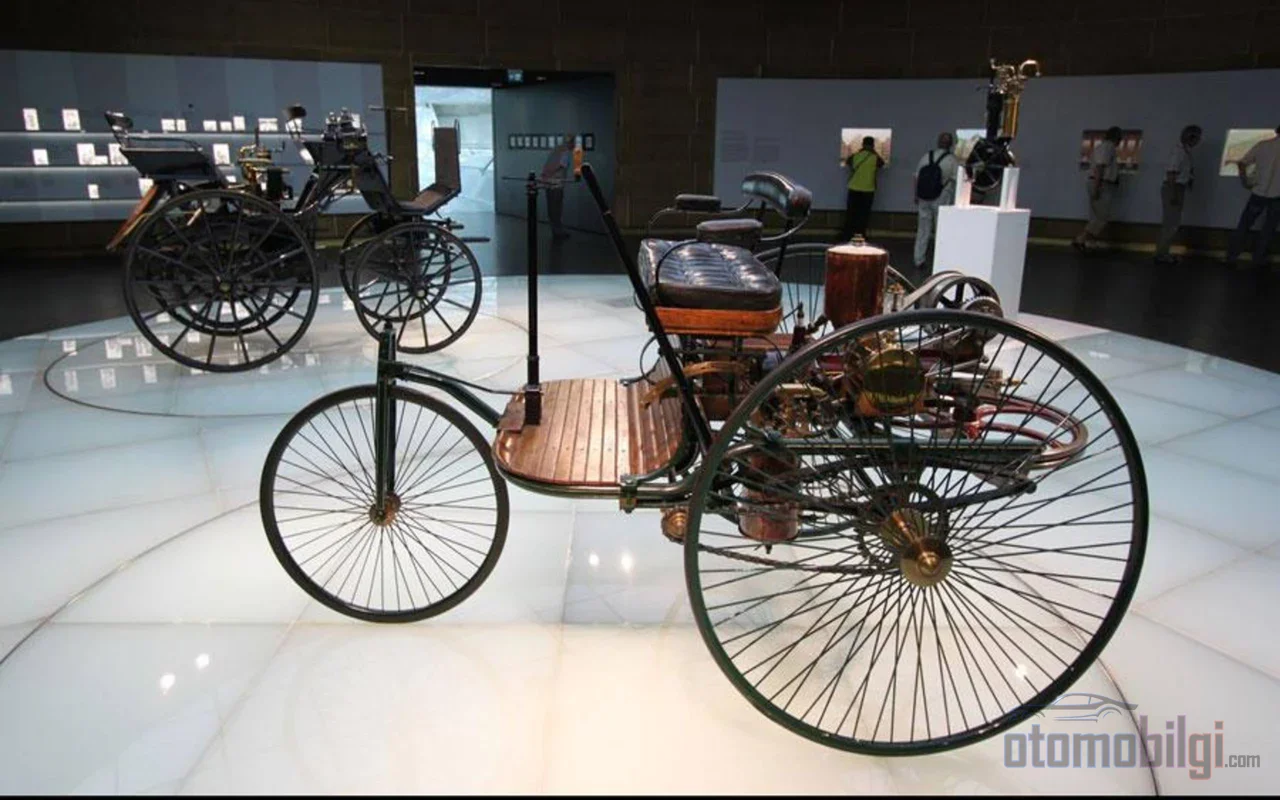
The story of Gottlieb Daimler and Wilhelm Maybach begins not with a horse carriage, but with two wheels. In 1885, the duo mounted their own Standuhr, or "Grandfather Clock" engine, onto a rough wooden two-wheeled bicycle frame. The resulting vehicle was called the Reitwagen, or "riding car", and today it is considered the first internal combustion motorcycle. A patent application was filed on August 29, 1885, and the first ride was carried out by Daimler's son Paul, who was only 17 years old: a short but historic journey from Cannstatt to Stuttgart-Untertürkheim on November 18, 1885.
The significance of the Reitwagen is this: Daimler and Maybach's aim was not to build vehicles, but to demonstrate that the engine worked. The engine was their real product; whatever they put underneath it didn't matter. This mindset would shape all the decisions of the coming years - in both the best and worst senses.
Why Did the First Automobiles Look Like Horse Carriages?
Imagine: you have a working engine in hand, but there is no such thing as an "automobile" anywhere. What would you do? Naturally, you would use the ready-made solution at hand: the horse carriage. Nearly all manufacturers of that era thought this way. The engine was placed into the body of an existing horse-drawn carriage, and the result was vehicles even named accordingly: "horseless carriage". Sad but true - people called these contraptions not automobiles, but horseless carriages, because what they saw was simply a motor in place of the horse, beneath a carriage body.
The problem was this: the horse carriage body was a design optimized over centuries for the horse's speed and balance. Long body, narrow wheels, a high seating position... None of these had anything to do with the engine. Putting an engine inside such a shell is like mounting a jet engine on the roof of a country house - it might work, but how sensible is it?
Daimler's Motorized Carriage: A Quarter-Century-Old Habit
Daimler, too, could not escape this trap. The vehicle introduced to the public in November 1886 had been prepared by fitting an engine onto a horse-drawn stagecoach purchased from another manufacturer. This vehicle, known today as the Daimler Motorized Carriage, is regarded as the world's first four-wheeled motorized vehicle, but because it was an adaptation, it is not considered a fully-fledged "real automobile." That title goes to the Benz Patent-Motorwagen, which was designed as a motorized vehicle from the very beginning.
| Specification | Daimler Motorized Carriage (1886) |
|---|---|
| Engine | 462 cc, single cylinder |
| Power | 1.1 PS (0.82 kW) |
| Transmission | Single speed |
| Weight | 290 kg |
| Layout | Mid-mounted engine, rear-wheel drive |
| First sale | 1892 |
Looking at the numbers, it's hard not to smile: A 1.1-horsepower engine pushing a 290-kilogram horse carriage. But wait - this vehicle is a bridge in history. For the two men, it was the final example showing that the engine deserved far more than a horse carriage.
The 1889 Stahlradwagen: How Did the Real Break from the Horse Carriage Happen?
Here's my favorite part. In 1889, Daimler and Maybach, even before DMG was founded, produced their first automobile designed entirely from scratch, without adapting a horse carriage or stagecoach. The vehicle was called the Stahlradwagen - the steel-wheeled automobile. Even the name tells you everything: this was no longer something belonging to the world of wooden-wheeled, horse-drawn carriages, but a machine made of steel.
Why is this so important? Because Daimler and Maybach asked this question for the first time: If there are no horses, but there is an engine, how should the vehicle be? Their answer meant a new design in every respect. In June 1889, Daimler's first two-cylinder V-type engine emerged - the world's first V-twin. There was a 17-degree angle between the cylinders, and the engine produced 1.5 hp at 600 rpm. It was an incredibly compact and lightweight solution for its time; two cylinders were compressed side by side at a narrow angle, without needing the length occupied by classic inline cylinders.
Technical Innovations: What Did This Vehicle Have?
What set the Stahlradwagen apart from being just an ordinary prototype was the package of innovations underlying it:
- High-revving four-stroke gasoline engine - a noticeably livelier character than its rivals
- Two-cylinder V configuration - the first V-engine in history
- Four-speed transmission - recorded in the German Patent Office registers as an innovation that was enthusiastically received at the Paris World Exhibition
- Belt drive turning the rear wheels and a fuel vaporization system
The vehicle was introduced to the public in Paris in October 1889, and it was precisely there, in the place it deserved, that it found its reward. Series production was not undertaken in Germany; instead, the way was opened for the engine to be produced under license in France. And this decision changed the course of automotive history.
Panhard and Peugeot: Why Did the French Immediately Fall for This Engine?
One of those who saw the Stahlradwagen at the World Exhibition in Paris was Levassor, a co-founder of Panhard et Levassor. Daimler's 1889 prototypes convinced him so much of building automobiles that the company took a production license for the Daimler engine and put its first car on sale with that license in 1890. So France's automotive pioneer is, in fact, the grandchild of Daimler's 1889 design. One more relevant detail: While Daimler at the time deliberately steered production toward marine engines, he left car construction to the French - the division of labor was very clear.
The license was not limited to Panhard. Panhard et Levassor shared this license with bicycle manufacturer Armand Peugeot, and Peugeot founded his own automobile company. The roots of a brand still standing today rest, indirectly, on that 1889 engine. Can a vehicle change the world? It can - and sometimes it changes not in its own country, but in its neighbor's.
There is measurable proof of the impact, too: In the 1894 Paris-Rouen race, ten vehicles with Daimler-licensed engines, including five racing Peugeots, did not even finish - all 15 vehicles that did finish had Daimler engines. In other words, the finish line of the first automobile race turned into a veritable victory ceremony for Daimler-Maybach engineering.
DMG, the 1901 Mercedes, and the Maturing of the Architecture
Meanwhile, the company's incorporation story was anything but smooth. DMG was founded in 1890; but the shareholders saw automobile production as a bad investment, and Daimler was forced to resign at the end of 1892. Imagine - the man who invented the automobile resigning because he could not produce automobiles at his own company! The two only returned to the company on November 1, 1895, through F. R. returned to the company through Simms. Daimler lost his life in 1900; Maybach, in turn, left DMG in 1907 and founded his own company.
But the foundation laid in 1889 did not stop. In 1901, Maybach created the Mercedes, named after Emil Jellinek's daughter. Jellinek had asked Maybach for a lightweight 4-cylinder 35 hp engine on a chassis with a low center of gravity, and paid 550,000 DM for 36 vehicles. The 1901 Mercedes brought together many of the design features we still use today for the first time. The French press gave Maybach the nickname "King Designer" - did he deserve it? Look at the list of inventions below and decide:
- 1889 - The first V-engine
- 1889 - Gear transmission
- 1893 - Carburetor with spray nozzle
- 1897 - Tube radiator
- 1900 - Honeycomb radiator
Why Do the Architectural Foundations of the Modern Automobile Date Back to 1889?
The answer becomes clear when you add up the question. Internal combustion engine, high revs, gear transmission, a light and sensible chassis... All of these are the product of reversing the mindset that merely stuffed the engine into a horse carriage. Until 1886, the vehicle was the master of the engine; after 1889, the engine became the master of the vehicle. Today, when you get into a vehicle, you see that the engine, the transmission, and the wheels are brought together as a whole with a single architectural logic - and the father of that integrity is the 1889 decisions of that team that rejected the horse carriage.
So what should be drawn from this story? In my view, this: A technology cannot reach its true potential as long as it is squeezed into the old mold. Daimler's and Maybach's genius was not making engines; it was being able to imagine the vehicle the engine required. Are you also working within a "horse carriage mold" in your own work, or designing from scratch? I'd love to hear your thoughts in the comments!
Sources
- Daimler, until 1926 - Mercedes-Benz
- Daimler Motorized Carriage - Wikipedia
- Daimler Reitwagen - Wikipedia
- The Daimler riding carriage from 1885 - Mercedes-Benz
- Wilhelm Maybach - DPMA
- Gottlieb Daimler - Wikipedia
- Panhard - Wikipedia
- Panhard & Levassor, 1894 – 1896 - Mercedes-Benz Archive
- Our History of Innovation - Wilhelm & Karl Maybach Foundation
- Horseless carriage - Wikipedia