What Was Benz's First Mass-Produced Car Model?
Share This Page
Benz's first series-produced automobile was not the Patent-Motorwagen Nr. 1 prototype that stayed in the workshop in 1885; The motorized Stanhope (Nr. 2) driven publicly on the streets of Mannheim in the summer of 1886, followed by the Model 2 that went on sale in 1888. Priced at 3000 Marks, with 1.5 horsepower and two gears, this vehicle can be considered the first practical automobile actually produced.
Highlights
- The first patent was filed on January 29, 1886 and registered on November 2, 1886.
- Nr. 1's prototype engine displaced 954 cc and produced only around 0.75 hp.
- The first public drive took place on July 3, 1886 in Mannheim, with the Nr. 2.
- The first sale happened in 1887 to Émile Roger; sales to the public began in 1888.
- 1888 Model 2: 1.5 hp, about 16 km/h, 2 gears, priced at 3000 Marks.
The picture in our heads is always the same: Carl Benz invents a strange three-wheeled vehicle in 1885, and the automobile opens up to the world that same year. The truth is a bit more complicated and, in my opinion, far more interesting. Because that famous 1885 vehicle was, as its name suggests, a prototype and its early days did not go as smoothly as supposed. Now let me tell you that story, following the Nr. 1 and Nr. 2 labels in its files; I think you'll be left with question marks about the automobile's birthday.
Nr. 1 Couldn't Leave the Workshop: The 1885 Prototype's Weak Points
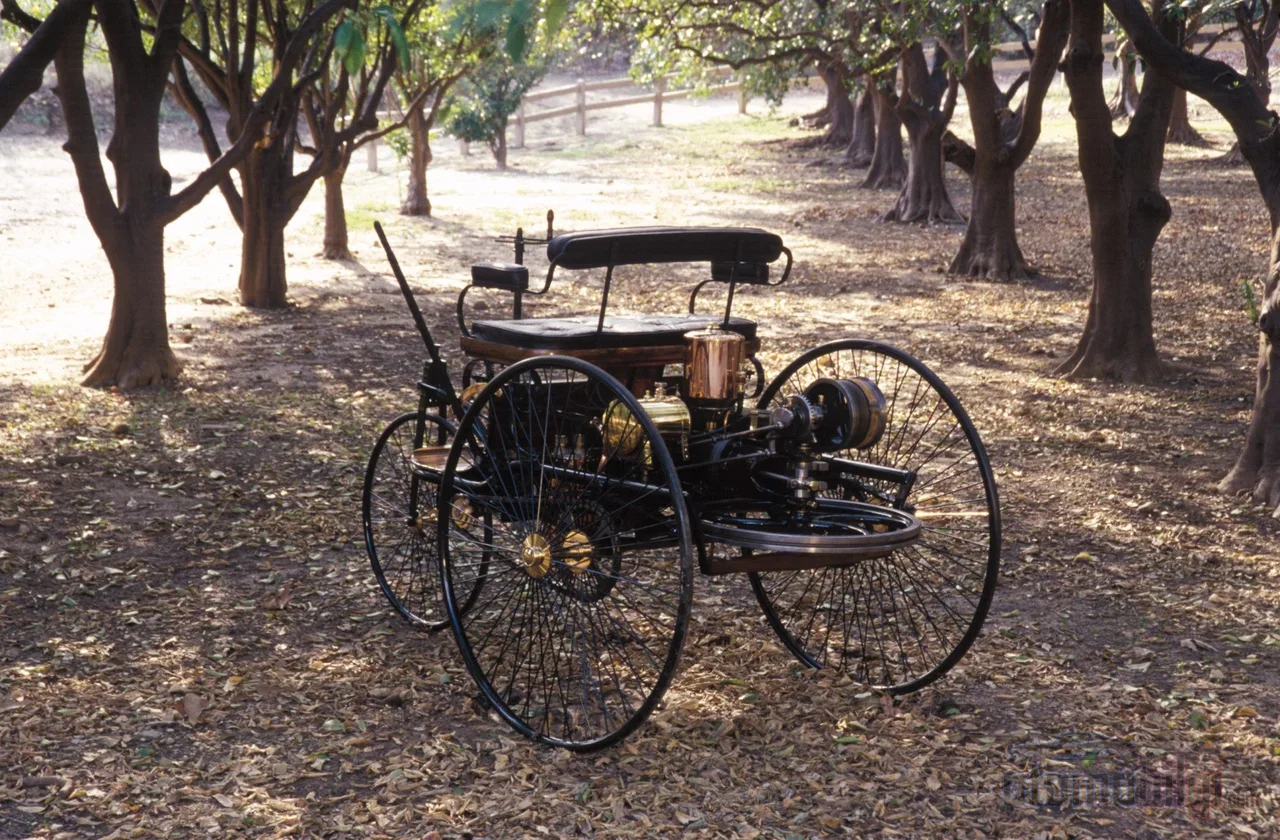
Benz developed his first motorized velocipede, that is, the Nr. 1, from 1884 until early 1886. Its single-cylinder, four-stroke engine, running on a petrochemical fuel called ligroin, had a displacement of 954 cc but its output was comically low: 0.68 PS, which is about 0.75 horsepower. If you consider that even a lawn mower is more powerful today, let me warn you in advance, as someone who has filled up with gas: with this vehicle there is no road, only patience.
The most striking detail is this: Nr. 1 could at first only be used on the factory grounds and was run over short distances. Throughout 1885, Benz gradually increased its range, but with the vehicle he preferred the night and deserted roads. Why? Because there is no inventor who would want to drive such an easily tipping vehicle with exhausting controls in front of everyone's eyes in broad daylight. Benz later describes these secret test nights in the memoirs he wrote; so in a way, the birth of the automobile is the story of midnight experiments.
Let's also add this: Nr. 1's final form is not known exactly today. The vehicle was not originally a completely new whole; its engine and transmission were largely transferred to the Nr. 2. In 1895, the company's sales manager made a reconstruction from the surviving parts, and that vehicle was given to a museum in 1906; it is still on display there. So the 'first automobile' you see in the display case is actually a vehicle reassembled later.
Patent Day and July 3, 1886: Nr. 2 Takes to the Streets
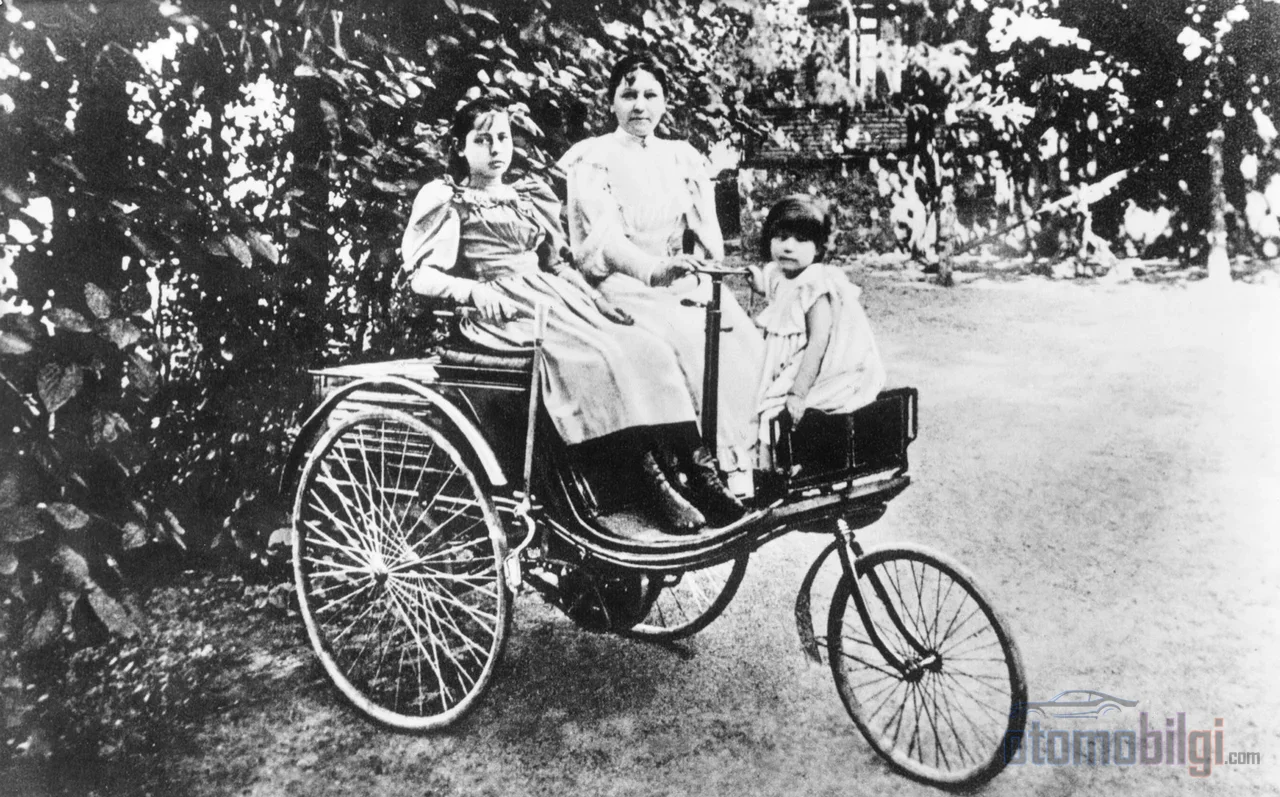
Benz filed his patent application on January 29, 1886, and registration took place on November 2, 1886. This is officially considered the automobile's birth certificate, and it deserves that reputation. But a patent doesn't make something practical. What made it practical was the public drive that took place in Mannheim on July 3, 1886, and that drive goes down in Benz's own records as its first public outing. In the photos, Benz is seen driving the Nr. 2 together with Max Rose. The speed was around 16 km/h; slow today even for a school zone, but revolutionary for its day.
The Nr. 2 had a body called a motorized Stanhope gig; so not a car, but literally a horse-carriage type. But this is exactly where the story gets interesting: many assessments point to the Patent-Motorwagen Nr. 2, not the Nr. 1, as the first practical automobile. So why? The list of reasons is both short and convincing:
- A two-speed gearbox, meaning different gear selection on hills and flat roads.
- Better brakes.
- All the controls within the driver's reach.
- Less tendency to tip over thanks to iron-tired, sturdier wooden wheels.
Let me make a simple analogy: if the Nr. 1 was the first experiment that worked in the lab, the Nr. 2 was actually starting to write with that chalk. Both matter, but people read what you write; not the chalk. That's why using the phrase practical automobile for the Nr. 2 makes a lot of sense to me.
1888 Model 2: The Actual Start of Series Production
This section is the heart of the article. In his memoirs published in 1925, Benz himself labeled a photo: the first series-production vehicle, dated 1888; 1.5 hp, up to about 16 km/h with 2 gears, and priced at 3000 Marks at the time. This line directly supports the thesis at the center of the matter: in Benz's eyes, series production begins with the 1888 Model 2. Today, most of the automotive world accepts that public sales, and therefore production, began in 1888; even Benz's grandson and the brand's own records confirm it.
Here is the technical breakdown of the Model 2: 1.5 hp, a top speed of about 16 km/h, and 2 gears. The 1888 price was about 3000 Marks. The engine displacement grew depending on the production years: between 1886 and 1889, the single-cylinder engine went from 1045 cc to 1660 cc and then up to 1990 cc, and power rose from 1.5 hp to 2.5 hp, and then to 3 hp. In total, about 25 vehicles were produced between 1886 and 1893; so when you think of series production, don't picture Ford's thousand-vehicles-a-day line, think of it as a workshop rhythm.
| Feature | Nr. 1 (1885 prototype) | Model 2 (1888) |
|---|---|---|
| Power | About 0.75 hp | 1.5 hp |
| Number of gears | Insufficient, impractical | 2 gears |
| Top speed | Short distances, on-site | About 16 km/h |
| Use | Factory grounds, night trials | Public sale (1888) |
| Price | Not offered for sale | 3000 Marks |
Looking at this table, the difference is clear, isn't it? The vehicle on the left is the inventor's pride, the vehicle on the right is the customer's product. The first step in automobile history was taken precisely by the bridge between these two roles.
Émile Roger and the Story of the First Sale
Once a product is manufactured, it is time for sales; and the first buyer of the automobile was no ordinary customer. Benz's first vehicle sale was made to Émile Roger in 1887. Roger was a bicycle manufacturer from Paris who held the rights to licensed vehicle and engine production in France. Here is the sweet part of the story: Roger visited Mannheim in 1887, saw the vehicle in person, was impressed, and bought one on the spot. This sale went down in the records as the first vehicle Benz sold.
But the status of the sale is a bit gray: since it was a purchase that could be called semi-private, the company recognizes that public sales began in 1888. Roger later became Benz's agent for automobiles in France; before 1890, all sales were made exclusively through Roger in Paris, and Roger was the one who decided how many vehicles would be produced. In other words, the world's first automobile dealership was a one-person operation, and he also held stock control.
Roger also exhibited his vehicle at an exhibition in Paris, but serious sales only began in 1892. Benz, for his part, displayed a vehicle in Munich in September 1888 and was pictured in a newspaper while driving around Munich with his wife Bertha; so the promotional journalism of the automobile also began that autumn.
How Did Bertha Benz's Journey Change Production?
Anyone wanting a lesson in marketing should note the date of August 5, 1888. That day, Bertha Benz became the first person to undertake a long-distance journey in an internal combustion engine automobile: a route from Mannheim to Pforzheim exceeding 100 km, via the Nr. 3. This journey exposed the vehicle's real-world shortcomings through the eyes of someone who, like an engineer, wanted to see them with her own eyes.
Two major problems emerged during the journey. The first was climbing ability: hills practically suffocated the vehicle, and this triggered the development of a second belt system added instead of a larger engine with a reduction gear. Turning the flywheel from horizontal to vertical was also part of this revision period. The second was the brakes: it is known that when going downhill, passengers had to get out and walk, as the brakes proved weak. In my opinion, Bertha repeatedly fitting leather linings to the worn brakes can be considered history's first roadside brake maintenance.
In short, the long-distance trial directly improved production. Today, a test drive shaping a model is very normal, but in 1888 the person who put this idea into practice was a woman; she deserves to be remembered every time we get into our cars and shift into first gear.
A Historical Correction, or a Fight Over Names?
So, to whom does the title of 'first automobile' belong? Most sources and the company itself accept the 1886 Nr. 1, because it was patented. The opposing view favors the Nr. 2, citing the practicality reasons I listed above. Moreover, the company's own classification groups all three-wheeled variants between 1886 and 1894 under a single model heading; in other words, the Nr. 1 / Nr. 2 / The Model 2 distinction is a relatively recent re-evaluation in the literature. Another notable gap is this: not a single photo of a Model 2 exists today. It is even claimed that only one development vehicle was converted to four wheels for the model above it. In other words, we cannot know exactly what the face of the first series-production car looked like; strange but true.
There is also a more general question: did Benz really invent the automobile? Benz's vehicle is described as the first practical gasoline-powered automobile; it is not the first moving machine. Alternatives from the same period also exist, such as the 1886 Daimler. So don't think of the word 'invent' as a jar: inside it there are multiple inventors, multiple dates. Benz's claim is to be the brightest layer of that jar; but not the whole jar on its own.
What Remains Today?
The reconstructed example of the original Nr. 1 has been standing in a museum since 1906. The brand has been producing handmade replicas since 2001; they can run on gasoline but cannot be driven on public roads. To date, approximately 150 copies have been produced by various suppliers. So the first automobile in history is still being reborn in workshops; and with the smell of gasoline, no less.
In my view, the real lesson is this: the history of an invention is not just the patent date. Prototype, practical vehicle, first sale, and first long journey are each milestones in their own right. Benz's story has all of them; we only get confused when we try to squeeze them all into a single year. Now it's your turn: if it were up to you, which vehicle would you stick the 'first automobile' label on? The patent for Nr. that was driven publicly on the streets of Mannheim in the summer of 1886, or the 3000 Mark series-production car of 1888? I'll be waiting in the comments.