Is the TPMS Light On? What Does the Tire Pressure Sensor Indicate
Share This Page
If the TPMS light is on and your tires are perfectly fine, don't panic: a steadily lit light usually indicates that a tire has dropped at least 25% below its label pressure, whereas a light that flashes for a while at each startup and then stays solid indicates a fault in the system itself. In other words, it's not the color of the lamp but its behavior that makes the diagnosis. In this article, I explain how the system works, what the two different forms of the light mean, and why the light can come on even when the pressure is correct.
Key Takeaways
- Steadily lit TPMS light: one or more tires are at least 25% below the label pressure.
- At startup 60-90 seconds of flashing light: a fault in the TPMS system.
- Sensor batteries last an average of 5-10 years ; a worn-out battery is the most common cause of false alarms.
- Air pressure drops in cold weather; a morning light that goes off once the tires warm up is usually harmless.
- Even with a well-functioning TPMS, nothing ever replaces a manual pressure check.
What is TPMS and how does it work?
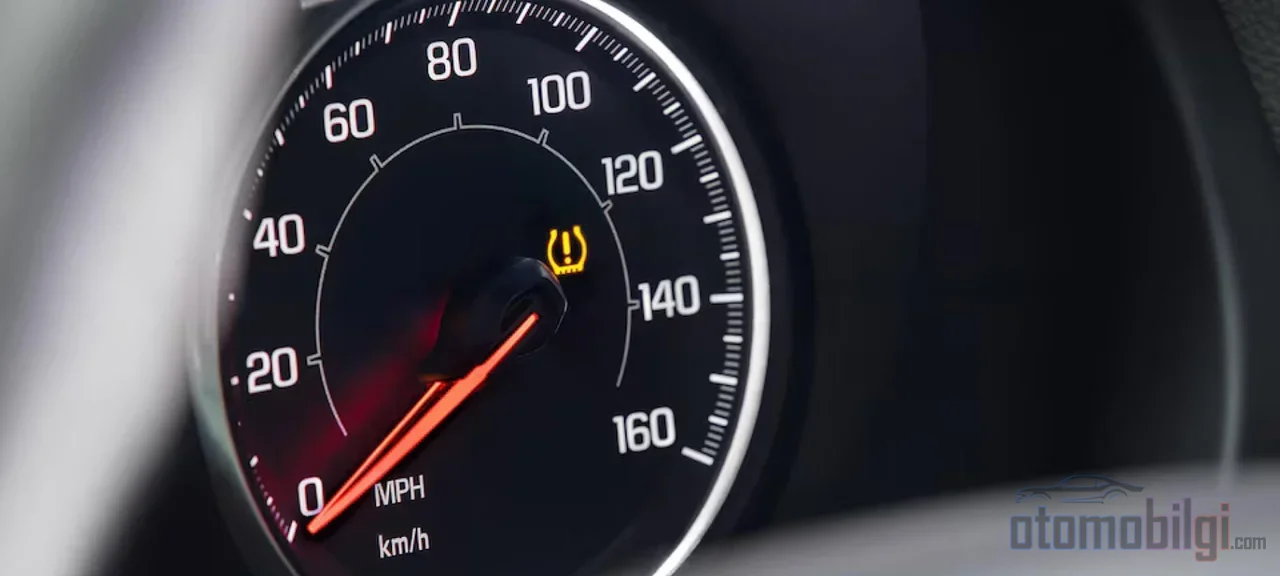
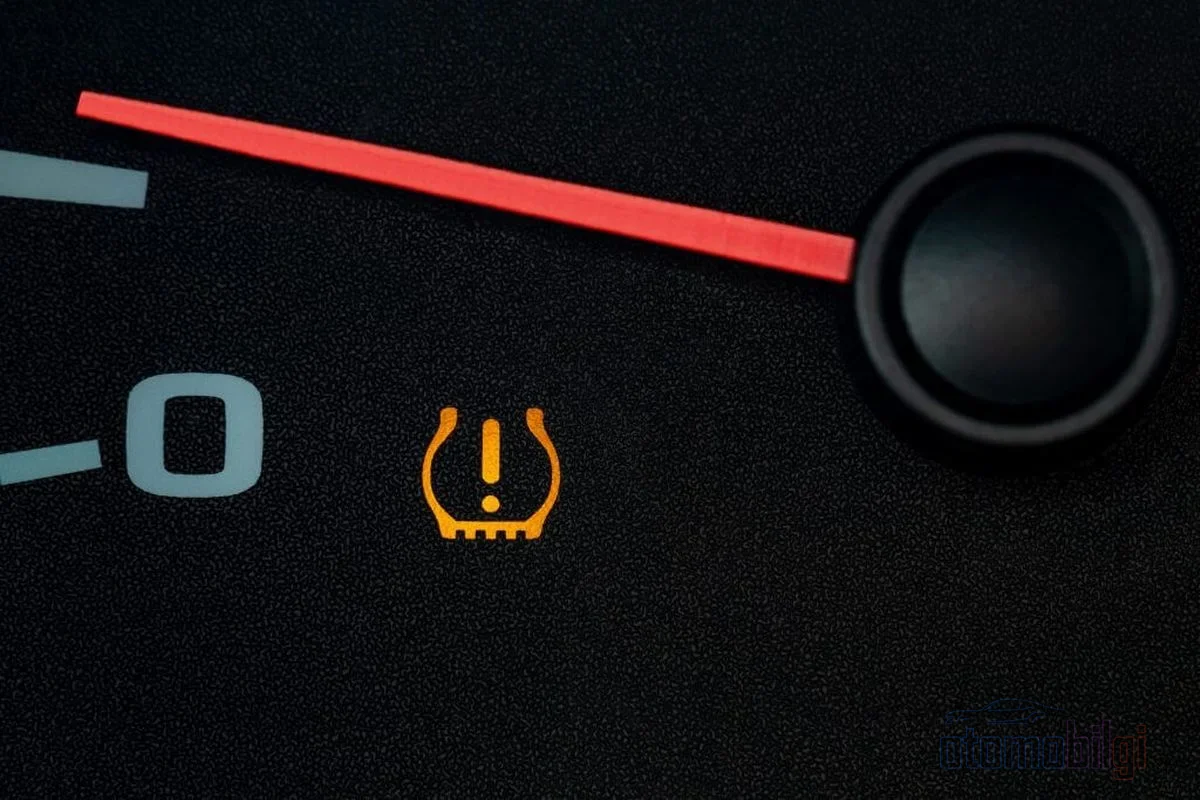
The Tire Pressure Monitoring System, or TPMS, is a safety device that alerts the driver with a yellow lamp on the dashboard when a tire is seriously underinflated. The lamp shows a tire symbol resembling a horseshoe with an exclamation mark inside it; the first question that comes to everyone's mind is the same: The TPMS light is on, what should I do? The answer depends on how the light comes on. Knowing that there are two main types of system makes it easier to understand this distinction.
Direct TPMS: real measurement inside the tire
In direct systems, each tire contains a pressure sensor, usually mounted behind the valve stem. The sensor measures the tire's actual pressure and transmits this information to the vehicle by radio frequency; it does not rely on ABS data. Each sensor has a pressure-measuring chip, a microcontroller, a transmitter, a temperature sensor, and a small battery. To save battery, the sensors sleep while the vehicle is parked, wake up when the wheels start turning, and during driving most send data every 30-60 seconds . Since each sensor has a unique serial number, the system can tell which wheel the data came from.
Indirect TPMS: estimation from wheel speed
In indirect systems, there is no sensor inside the tire; the ABS wheel speed sensors are used. The logic is simple: a tire with lower pressure has a slightly smaller diameter and rotates a bit faster than the others. The computer interprets this difference as low pressure. It is cheap and requires no maintenance, but it is less accurate. It cannot detect if all four tires lose pressure equally at the same rate, it may respond late to gradual leaks, and it requires recalibration after tire inflation or size changes.
| Feature | Direct TPMS | Indirect TPMS |
|---|---|---|
| Measurement method | Real pressure via sensor inside the tire | Inference from ABS wheel speed data |
| Accuracy | High, per-wheel notification | Lower, cannot detect equally dropping pressure |
| Maintenance | Sensor battery has a limited lifespan | Requires no maintenance |
| Calibration | Re-registration when sensor/wheel is changed | Re-calibration after inflation or size changes |
| Cost | Higher hardware cost | Cheaper, mainly software-based |
The distinction between these two approaches is not merely academic curiosity: when interpreting a fault, knowing which type your system is makes the job easier. Let us also note the mandatory side; in the USA, the TREAD Act of 2000 made TPMS mandatory on all new light vehicles from the 2008 model year. In the European Union, it became mandatory on all new passenger car models as of November 2014. So the vast majority of today's vehicles already have this system, and it is now necessary to get used to it.
Is the light steady or blinking?
What determines the meaning of the TPMS light is its mode of illumination. Two behaviors tell two different stories, and when they are confused, people either run to the tire shop unnecessarily or ignore a real fault.
- Steady light: One or more tires are at least 25% below the pressure on the vehicle's placard. Your first task should be to inflate to the correct pressure; the light usually goes out. If it does not go out despite inflation, the possibility of a slow puncture should be taken seriously.
- Blinking light: A light that blinks for about 60-90 seconds after the ignition is turned on and then becomes steady indicates an internal fault in the system itself. This means a sensor fault, battery depletion, or communication loss; it may have nothing to do with your tire.
Yet in the past this light did not exist at all; pressure checking was entirely in the driver's hands - the tires were checked with a gauge at every fuel stop and squeezed by hand once a month. Today the system gives the warning on our behalf, but reading the warning still falls to us. When you see a steady light, first measure all four tires by hand with a mechanical gauge; this habit saves you from unnecessary work and also gives you the chance to compare the system's reading with the actual value.
Why does the TPMS light come on when the pressure is correct?
Everything looks fine when you measure with a gauge, but the light stays on. Although this scenario seems frightening, especially in older vehicles, it is usually a solvable problem. The most common cause is depletion of the sensor battery. Although the sensor's lifespan varies from manufacturer to manufacturer, it is reasonable to think of an average range of 5-10 years; in vehicles used in frequent stop-and-go traffic, this period can be shorter. When the battery weakens, the sensor stops transmitting, the vehicle sees "no signal" and lights up the lamp. In a vehicle over nine years old, a steady, unexplained light should first bring the battery to mind.
There are also possible causes other than the battery. We can list them as follows:
- Physical damage or corrosion; especially in winter months on salted roads, the valve stem can be damaged.
- Faulty installation or incorrect programming; if the sensor ID has not been registered to the vehicle, the system does not accept the data.
- Faulty tire repairs; for example, applications such as patch spray can damage the sensor.
- Slow leaks and a faulty pressure gauge; the problem may not be where you think it is.
- Software issues and TPMS communication failures.
The most practical way to find out which sensor is faulty is to have a tire shop read the sensors. If you want to investigate further, compare the pressure value shown by the system against the actual value in the tire using a mechanical gauge; if the values match, the sensor is probably fine and the fault lies on the receiving side. Although replacing the battery individually is possible, most drivers prefer to replace the sensor entirely; the difficulty of the work and the cost often make this the sensible choice.
Is the light coming on in cold weather a false alarm?
The lamp coming on on winter mornings is so common that many drivers assume it is a system fault. In fact, physics comes into play: cold air lowers the air pressure in the tire, and if the pressure drops below the threshold, the TPMS warns you. This does not mean there is a problem with the tire; as the tires warm up with driving, the pressure rises and the lamp usually goes off on its own. The correct course of action is to bring the tires to the recommended pressure; the lamp goes out and the day passes with peace of mind.
Just don't skip one detail: aging sensor batteries lose output power in the cold. The light coming on intermittently on cold days may be a sign that the battery is in its final days. If this complaint recurs during seasonal transitions, stopping by the tire shop is better than waiting by the roadside in spring.
System reset after tire replacement and rotation
In direct TPMS, each sensor's serial number is registered in the vehicle's control unit. After tire rotation, sensor replacement, or control unit replacement, these IDs must be re-registered; if registration is not done, the lamp comes on and keeps burning until the IDs are re-registered. This is the situation most frequently encountered by drivers who have bought new tires and are puzzled as to "why didn't the light go off."
The relearn process varies from vehicle to vehicle. Some models correct themselves after a few minutes of driving following rotation. In others, registration is done by lowering the valve pressure, pressing the TPMS reset button, or following a special relearn procedure involving the brake pedal and the ignition. For example, on GM vehicles the procedure usually starts at the front left wheel and proceeds wheel by wheel counterclockwise. Opening the owner's manual saves you more time here than knowledge.
In vehicles using indirect TPMS the situation is somewhat different: after tire inflation or a size change, the system must be recalibrated. If this is forgotten, the system compares against the old references and either warns unnecessarily or misses a real problem.
Living in peace with the TPMS light
In my thirty-year career, the most overlooked truth is this: no matter how well a TPMS works, it can never replace manual pressure checks. The system alerts you at a 25% loss; but by the time you reach that point, your tire may have been working inefficiently for weeks, fuel consumption may have increased, and wear may have accelerated. Set aside five minutes a month, and before a long trip, with a gauge. If the light stays on steadily, measure the pressures; if it is flashing, take the system fault to a tire shop; if it comes on on cold mornings, inflate first. Read correctly, TPMS is the least costly safety officer your vehicle has; read incorrectly, it becomes a source of needless worry.
Sources
- What is TPMS & How Does it Work?
- Direct TPMS
- Understanding Indirect Tire Pressure Monitoring System
- Solid vs flashing TPMS Warning Light
- What is the difference between a solid TPMS light and a flashing TPMS light?
- TPMS Light On? What it Means
- Why Is My Low Tire Pressure Light On, But Tires Are Fine?
- TPMS Light Is On But Tires Are Fine
- TPMS Sensor Batteries, Life Expectancy
- TPMS Light Coming On in Cold Weather
- Diagnostic Strategies For Solving TPMS Errors