What Did Cugnot's Steam Artillery Carriage Experience in 1769?
Share This Page
The world's first automobile was built a full century before the official birth of the automobile: the Fardier à vapeur, that is, Cugnot's steam gun carriage, produced for the French army in 1769-1770, was the first full-scale land vehicle to move under its own power. With its three wheels, two-cylinder 62-liter steam engine and top speed of only about 3.6 kilometers per hour, this strange machine was both a technical marvel and a disappointment. So why did it fail, what happened to its maker, and did the famous 1771 wall accident really happen?
Highlights
- 62 liters two-cylinder steam engine, producing about 12 hp of power
- Top speed: about 3.6 km/h - not much different from a walking person
- Steam pressure had to be regenerated every quarter hour had to be regenerated
- In 1772, King Louis XV granted Cugnot an annual salary of 600 livres
- The famous 1771 wall accident is absent from contemporary sources; it was first written about in 1804 was written
Who Is Nicolas-Joseph Cugnot?
Nicolas-Joseph Cugnot, born on February 26, 1725 in Void-Vacon, Lorraine, was trained as a military engineer and had a mind constantly working toward mechanization. The necessity of the day was simple: the French army struggled to move its heavy cannons with horses, and on rough terrain the task turned into a complete nightmare. Cugnot's idea was to eliminate the horse and pull them with steam.
Experiments began in 1765 with models. With the support of the defense minister Duke de Choiseul and General de Gribeauval behind him, Cugnot built a small-scale working model in 1769. Then came the big leap: in 1770, the full-scale version was completed. This machine is considered by most historians today to be the world's de facto first automobile. Yes, Benz's Patent-Motorwagen is accepted as the official ancestor of the automobile, but Cugnot had put the first full-size vehicle to move under its own power on the road in 1770.
What's Inside the Machine? A Technical Marvel of 1770
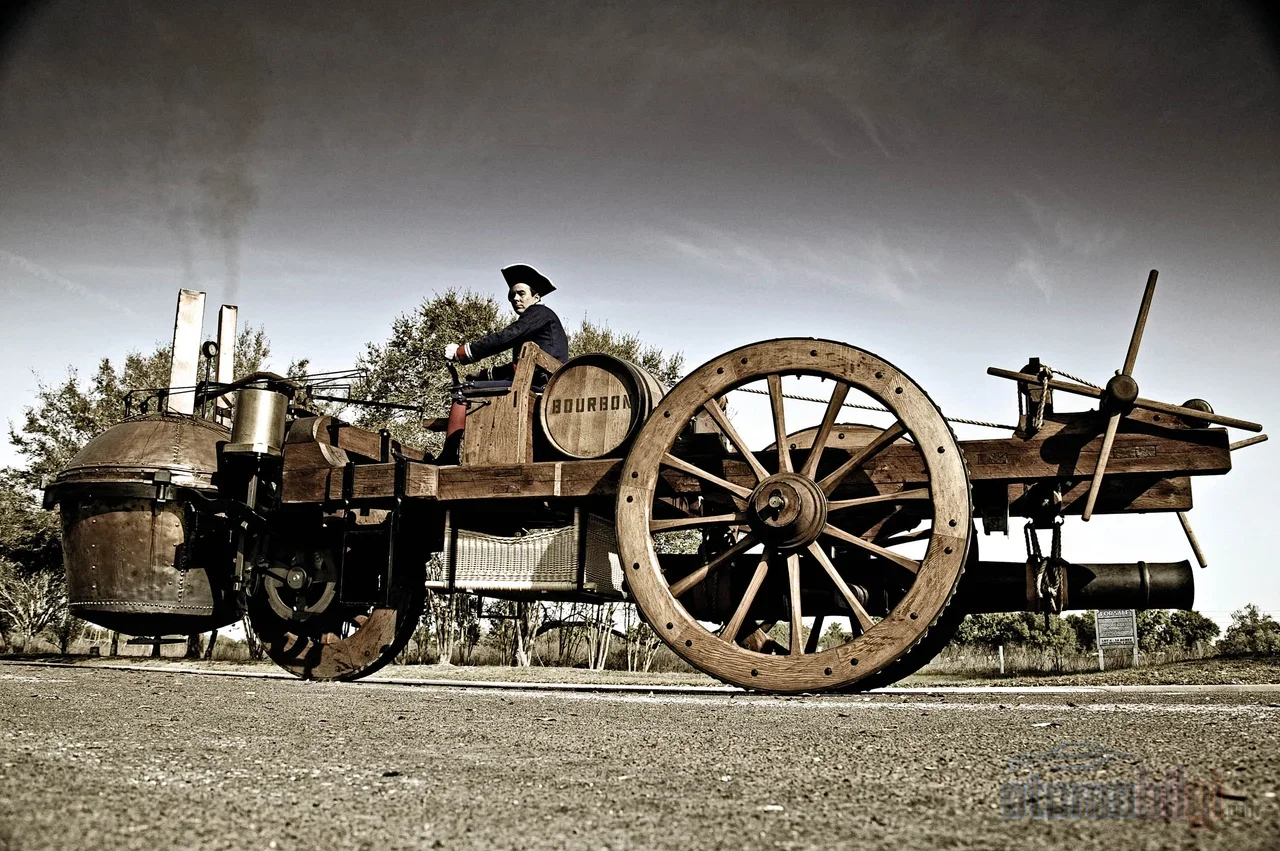
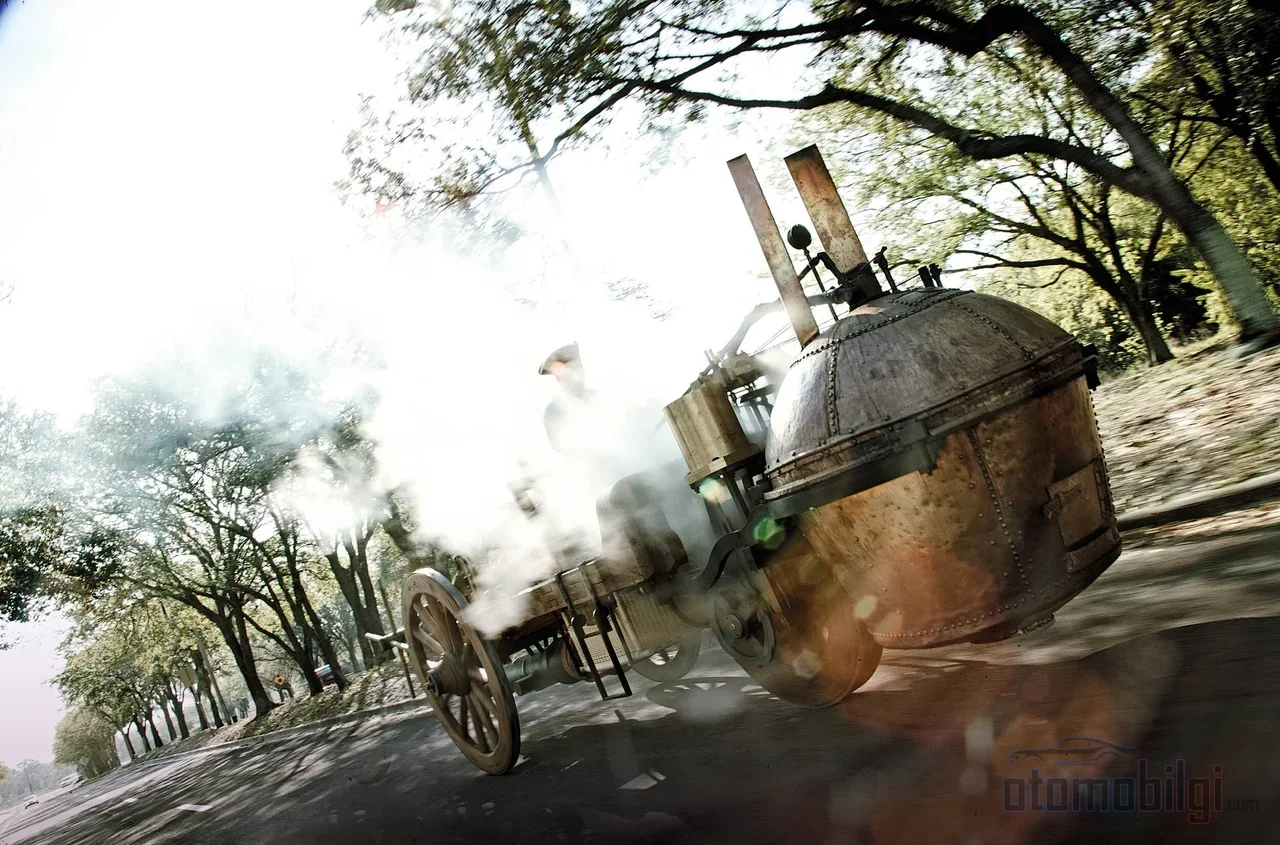
Take a look at the technical picture, and it becomes hard to believe it was built 250 years ago. At the heart of the vehicle is a 62-liter two-cylinder steam engine, producing roughly 12 hp of power and 112 Nm of torque. The layout is surprisingly modern in its thinking: front engine, front-wheel drive! The steam boiler and drive mechanism sit over the front wheel - right where the horses would normally stand. At the rear are two large wheels, the classic three-wheel layout.
Even the steering resembles today's: the front wheel is turned with a gear-and-rack system connected to a double-armed linkage. The brake, however, is troublesome; a wooden shoe pressed against the front wheel. Still, it serves well enough to stop 2.5 tons of iron (2.8 tons when loaded) with a 12 hp engine. Cugnot was also one of the first engineers to use a winding mechanism to convert the piston's linear motion into rotary motion - think of it as an old ancestor of today's crank and connecting rod.
| Feature | Value |
|---|---|
| Engine | Two-cylinder steam engine, 62 liters |
| Power / torque | About 12 hp / 112 Nm |
| Wheel layout | 3 wheels, front-wheel drive |
| Weight | ~2.5 tons empty, 2.8 tons loaded |
| Load capacity (target) | 4 tons |
| Target speed | Two lieues per hour (7.8 km) |
| Actual speed | Approximately 3.6 km/h |
| Fuel | Wood |
The goal was clear: the vehicle was to carry a 4-ton load and travel 7.8 kilometers per hour. In practice, it never came close to this goal; with four passengers, it moved at a speed of 3.6 km per hour. But wait, let's remember what the goal was: this was not a speed machine, but a load carrier meant to haul cannons. It was designed for weights that horses could not pull; speed was simply not part of the plan.
Why Did It Fail? Refiring Every Quarter of an Hour
Here is what broke the vehicle's back: the boiler. The wood-fired tubular boiler could not maintain sufficient steam pressure for long; the fire had to be relit every quarter of an hour and the steam regenerated. Let me make a simple analogy: your phone's battery dies in 15 minutes and on a long journey you need to return to a power outlet at home every half hour. For the army, this was practical nowhere at all.
On top of the boiler's performance came weight distribution problems and instability; the boiler and drive mechanism were both on the front wheel, and it could not quite balance the pros and cons. Political squabbles within the army also caused trouble; as its supporters' positions weakened, the project faded into the background. Only a handful of trials were conducted between Paris and Vincennes and at Meudon, and then the project was abandoned entirely. Thus the French Army's first mechanical vehicle experiment quietly came to an end.
From the King to a Pension: King Louis XV's Gift to Cugnot
The project did not die, though. In 1772, King Louis XV rewarded Cugnot's innovative work and granted him an annual 600 livres salary. A salaried inventor, a pleasant 18th-century career; the vehicle, meanwhile, was consigned to the arsenal. In other words, our first automobile was locked away in a garage at the very beginning of its life.
Did the 1771 Garden Wall Accident Really Happen?
Now let's come to the most delicious part: the famous first accident in automobile history. The story goes like this: in 1771, the second prototype lost control, demolished a garden wall or the Arsenal wall in Paris, and history's first automobile accident took place. Some versions even claim that Cugnot was arrested for "dangerous driving." A great story, isn't it?
The problem is: the event appears in no record of the period. It is first mentioned in a written source exactly 33 years after the accident, in 1804 . As for the arrest story, it is entirely a widespread legend. In the 19th century, an engraver visualized the scene of the vehicle crashing into the wall, and the legend was sealed: Cugnot came to be remembered not so much as "the creator of the first automobile" but as "the person responsible for the first road accident." An odd loss of reputation, admittedly.
If the accident really happened, what could have caused it? According to one prominent theory in the discussions, the control lever may have been accidentally touched while releasing steam; it is also being discussed that the small experimental boiler of the 1769 vehicle may have been fitted onto the vehicle displayed in the museum at the accident's original location, and that the chimneys may have been connected backwards. Additionally, the original accident was criticized at the time for the lack of insulation and the absence of a safety valve. It is hard to reach a definitive judgment - perhaps the accident happened, perhaps it never did. What is certain is that no contemporary evidence exists.
Revolution, Exile, and Napoleon's Final Gesture
This is the most bitter part of Cugnot's story. After the French Revolution, his royal salary was cut in 1789 and the inventor went into exile in Brussels in poverty. The man who built the world's first automobile spent the final years of his life poor and far from his homeland. That is, until Napoleon Bonaparte restored his salary shortly before Cugnot's death. Cugnot returned to Paris, but his time was up: he passed away on October 2, 1804, at the age of 79.
The vehicle was not lost. In February 1799 it was transferred to the Conservatoire National des Arts et Métiers in Paris and has been on display there ever since. In other words, the world's first automobile still stands in one of the world's first technology museums, in its original place. That alone is a relief in itself, isn't it?
It Ran 241 Years Later: The 2010 Replica and Its Connection to Today
Did the first automobile actually run, or was it just a nice idea on paper? The clearest answer to this question came in 2010. Students from Arts et Métiers ParisTech, together with the municipality of Cugnot's hometown Void-Vacon, built a working replica - exactly 241 years later. The replica ran flawlessly and proved the accuracy of the 1769 tests, that is, the validity of the concept. The vehicle was displayed at the 2010 Paris Motor Show and then returned to its hometown. There is also another fully functional replica, made with historical methods, with an oak chassis and ash wheels, at the Tampa Bay Automobile Museum; it has even been registered for road use in Florida.
And an interesting footnote: in 1935, a replica was made for the Deutsche Bahn Museum in Germany, for a film celebrating steam transport engineers; when most of the engineers turned out to be British or French, the film was banned by Hitler. Even the story of the first automobile got its share of politics.
On February 26, 2025, the 300th anniversary of Cugnot's birth passed. True, the world's first automobile was slow, smelly, and took a rest break every 15 minutes. But what that pile of iron demonstrated was simple: a machine can move without horses. Today, while riding in the fastest electric car, remember that the first meter of that road was laid in 1770 by a three-wheeled steam boiler.