From Panhard to Rambler: The Decisions That Shaped the Automobile Into What It Is Today
Share This Page
When you drive a car today, you press the clutch with your foot and turn the steering wheel with your hands - you sit in the right seat and extend your right arm toward the seat to the left of the wheel... or exactly the opposite, because that is precisely what this article is about! The architecture of today's automobile (front engine, rear-wheel drive, steering on the left) is not the work of a single inventor, but the result of a series of bold decisions made between the 1890s and the early 1900s. It was these decisions that pulled the automobile out of the horse carriage's shadow and turned it into a century-long standard.
Highlights
- 1891: The Système Panhard was born - the front-engine, rear-wheel-drive layout became the standard for roughly a century.
- 1903: The Spyker 60 HP went down in history as the first gasoline-powered four-wheel-drive automobile.
- 1898: The steering wheel was mounted on the left side for the first time.
- 1908: The Ford Model T popularized left-hand drive; by 1915 most American manufacturers had switched to the left.
- 1909: The first automobile to come with a spare wheel and tire was a Rambler.
What Is the Système Panhard and Why Is It Still Called by Name?
In the 1890s, most people who wanted to build automobiles were like engineers placing an engine under a horse carriage. The vehicle already existed; they simply bolted on an engine. Émile Levassor said "no" to this approach. In 1892, he put the engine at the front, attached the clutch and a simple gearbox behind it, and transmitted power to the rear wheels. If you were asked to describe the layout of a car today, this is most likely what you would describe: front-mounted engine, rear-wheel drive.
The company's story is just like a detective novel: Panhard et Levassor was founded in 1887 by René Panhard, Émile Levassor, and the Belgian lawyer Edouard Sarazin as an automotive manufacturing company. The Daimler license had been obtained by Sarazin, but when he died in 1887, his wife Louise Sarazin finalized the license and even married Levassor in 1890. The first automobile was sold in 1890 under a Daimler engine license; the real revolution came in 1891 : four wheels, front engine, rear-wheel drive, and a crude sliding-gear gearbox - priced at 3,500 francs . The system was named "Panhard," yet the designer was Levassor; the question "why not the Levassor system?" still puzzles enthusiasts today.
To use a simple analogy: the Système Panhard is laying the foundation of a house. Over a hundred years, hundreds of different manufacturers changed the wallpaper, the furniture, and even the roof, but the foundation always stayed the same. Levassor's layout was considered so "right" in its time that even Panhard itself did not depart from it until it switched to the front-wheel-drive Dyna X after the war. In France, the last representative of this layout said farewell in 1992 with the end of Peugeot 505 production.
From the Gearbox to the Racetracks: Panhard's Revolutionary Years
The earliest vehicles had chain-driven gearboxes controlled by a clutch pedal and a front-mounted radiator; in 1895 the forerunner of the manual gearbox we know today was produced. The sliding-gear gearbox remained the standard until Cadillac introduced the synchromesh in 1928- meaning grandpa's shout of "gosh" while shifting gears was a tradition, a necessity.
The brand's racing record also adds color to the story: 1894 In the Paris–Rouen trial, Panhard shared first place with Peugeot. 1895 In the Paris–Bordeaux–Paris race 1,205 cc Panhards finished in the top two spots, and Levassor 48 hours 45 minutes drove alone - and entirely from his own seat. Unfortunately, this unique tale of exhaustion ended in pain: 1896 In the Paris–Marseille–Paris race, he had an accident caused by a dog running into the motor vehicle, and he passed away the following year. He was succeeded by 1897–1916 Arthur Krebs, who served as general manager between.
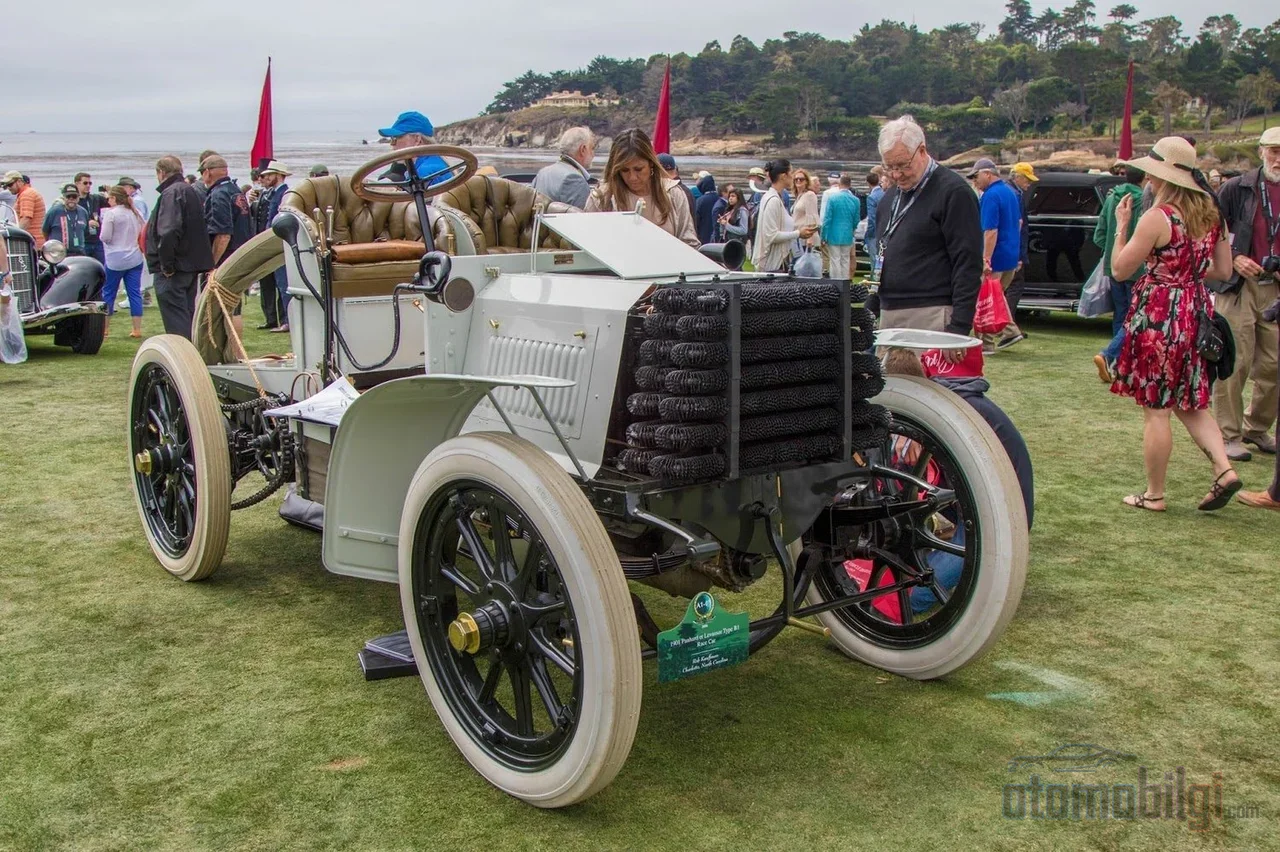
Panhard's first four-cylinder engine adventure also came through the Daimler licensing line: we know that the company 1890–1896 sourced Daimler V engines between. 1902 Panhard et Levassor Type B1 was one of the first four-cylinder Panhard engines produced under Gottlieb Daimler's license, and the engine was at the front. Owning a four-cylinder Panhard back then was so impressive that Charles Stewart Rolls (the R of Rolls-Royce!) 1897 bought one in and became one of the brand's earliest advocates.
| Specification | 1901 Type B1 |
|---|---|
| Engine | 5-liter Daimler inline 4-cylinder |
| Power | 12 hp |
| Transmission | Clutch-operated 3-speed chain drive |
| Top speed | 35 mph |
| Weight | 1,279 lbs |
| Racing record | Vanderbilt and Newport races, 1901 New York–Buffalo victory |
This car appeared in Willie K. Vanderbilt's 1900–1903 Newport races and in September 1901 it won the New York–Buffalo endurance race outright. The company 1967 kept building cars until; the civilian branch passed to Citroën that year while military production continued. The brand's most visible remnant today is, ironically, a mechanical part: the Panhard rod, which locates the axle laterally. That's just how a brand's name keeps on living.
What Was the First Four-Wheel-Drive Car? The Story of the Spyker 60 HP
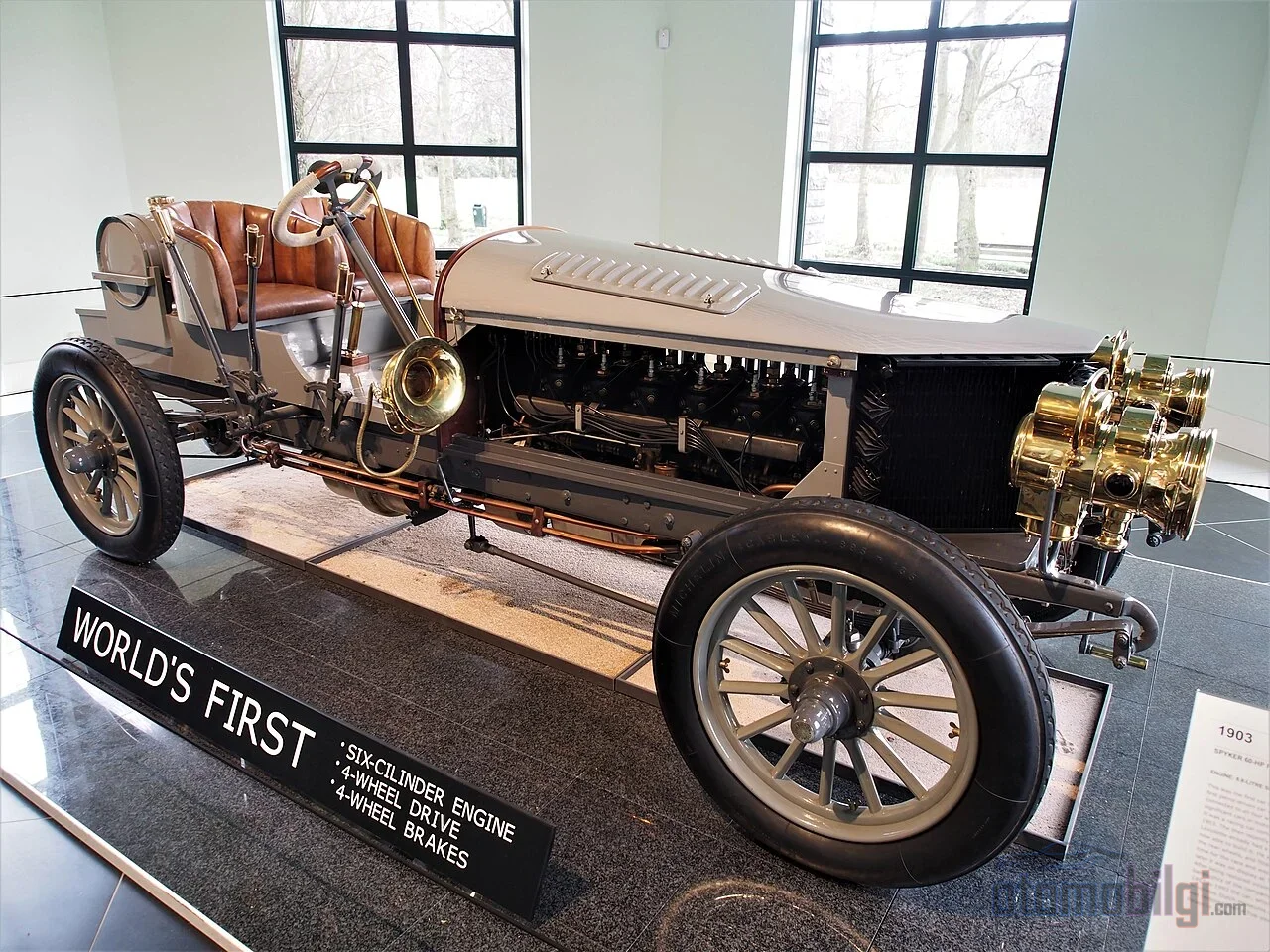
If you buy an SUV or a pickup today, you're greeted by four-wheel-drive driving modes; the first system that comes to mind when "off-road" is mentioned. So when does the history of this luxury (or mud-saving hero) begin? The answer 1903: the Dutch Spyker built the 60 HP, the first gasoline-powered four-wheel-drive automobile.
And this car doesn't settle for a single "first." The Spyker 60 HP in the Louwman Museum's collection is the world's first vehicle with a six-cylinder engine, the first with four-wheel drive, and the first gasoline-powered car with brakes on all four wheels. In other words, you could think of it as a single car onto which three major technologies we still use today were assembled together - back in 1903. The car was built for racing; an inline six-cylinder engine, four-wheel brakes, and a four-wheel-drive transmission all came together in one body. Its production was completed 1902–1903 between, and top speed estimates range from 110 to 145 km/h depending on the source - which, for that era, were rocket-like figures.
Think of it this way: in 1903, most people's dream car was a rickety horse carriage; Spyker's engineers, on the other hand, were building a racing machine that sent both power and braking to all four wheels. Today, four-wheel drive saves lives in snow, mud, and on the track; and the six-cylinder engine still knocks on the door of performance enthusiasts' hearts. That is why the car is displayed today at the Louwman Museum in the Netherlands almost like a sacred relic. The ancestor of four-wheel drive is still alive, and its doors are open for the curious.
Why Is the Steering Wheel on the Left? Rambler's Lasting Decision
Around the world, the steering wheel is sometimes on the left and sometimes on the right - that seems very logical, doesn't it? Yet in the beginning there was no standard at all. In fact, in most of the first vehicles, what you'd call a steering wheel wasn't even a steering wheel as you might imagine; there were tillers, levers, and strange control mechanisms. Alfred Vacheron, 1894 for the Paris-Rouen race, 4 hp fitted a steering wheel to his Panhard - one of the earliest known applications of this principle. So why is the wheel on the left side today (in most countries)?
The answer bears the name of an American brand: Rambler. 1898 an English inventor and founder of the Rambler brand, Thomas B. Jeffery, mounted the steering wheel on the left side of the vehicle, and in the 1910s automobile manufacturers switched to it. Jeffery's story is also interesting: he produced Rambler bicycles in Chicago, 1897 built his first automobile, and set up a shop in Kenosha, Wisconsin. The first Rambler was a single-cylinder vehicle with wire wheels and did not receive much attention in the motoring press; but the decisions that followed changed history. Model A (1901), was produced at the Kenosha factory as the first model designed by his son Charles T. Jeffery.
The logic of left-hand drive is simple and clever: the driver can see the oncoming lane better. The real explosion, however, came with the 1908 Ford Model T - it was Ford's first left-hand-drive vehicle. The Model T's massive success set the standard; by 1915 most American manufacturers had switched to the left, and the last right-hand-drive cars were pulled from the field in the early 1920s. So if you don't find yourself wondering "what if the steering wheel were on the right?" as you settle into your seat in the morning, you owe a great deal to Jeffery and Ford.
The First Car to Come with a Spare Tire: the 1909 Rambler
Today you're so used to the spare tire under your trunk that it's actually its absence that worries you. But in its day, cars didn't come with a spare tire - if you had a blowout, you were stranded, period. That's why the innovation introduced by the 1909 Rambler may seem small, but it radically changed everyday car use: 1909 the Rambler became the first car to come with a spare wheel and tire. That year, 1,692 units were produced by Thomas Jeffery & Company.
So the habit of checking for the fear of a flat tire before a long journey comes from that small but smart checklist that leads us to lift the trunk lid today and ask "is the spare in there?" Left seat, left-hand steering, spare tire: Rambler's legacy to automobile usage habits is far bigger than one might think.
Why Do These Decisions Still Stand Before Us?
What makes the automobile's basic architecture and usage habits so enduring? I think the answer is simple: these decisions were found to be "the most correct" within the conditions of their era, and as every new manufacturer adopted the same schema, costs fell, parts became common, and roads were planned accordingly. Once a standard takes hold, changing it is like moving the feet of a working factory - technically possible, practically impossible.
Yes, there are exceptions, and they color the story: Panhard, the inventor of the schema, abandoned its own system after the war and switched to front-wheel drive. While BMW and Mercedes are seen as the last bastion of the "système Panhard," Audi not producing rear-wheel drive is still met with suspicion among car enthusiasts. Spyker's four-wheel-drive racer, on the other hand, was a miracle made only once; the spread of four-wheel drive lasted until the end of the 20th century. So when you sit in your seat today, shift gears, adjust your mirrors, or open your trunk to check the spare, you are actually the final link in a 130-year chain of decisions. What if it were you - would you have put the engine in the front in 1892, or would you have trusted a Levassor? I think the latter.
Sources
- Panhard
- 1901 Panhard et Levassor Type B1 - Audrain Auto Museum
- Theme: Benchmarks - Le Système Panhard
- 1902 Panhard et Levassor Type B1 - ConceptCarz
- Spyker 60 HP
- Spyker 60-hp Four-wheel Drive Racing Car - Louwman Museum
- Spyker's Antique Racer Was The First Car To Sport A Six-Cylinder - CarBuzz
- Evolution Of The Steering Wheel - CarBuzz
- Rambler (automobile)
- 1909 Rambler Model 44 Touring - ConceptCarz
- On The Right Side of the Road - FHWA