JAS Tensei: A Judd-Powered Second Life for the Honda NSX
Share This Page
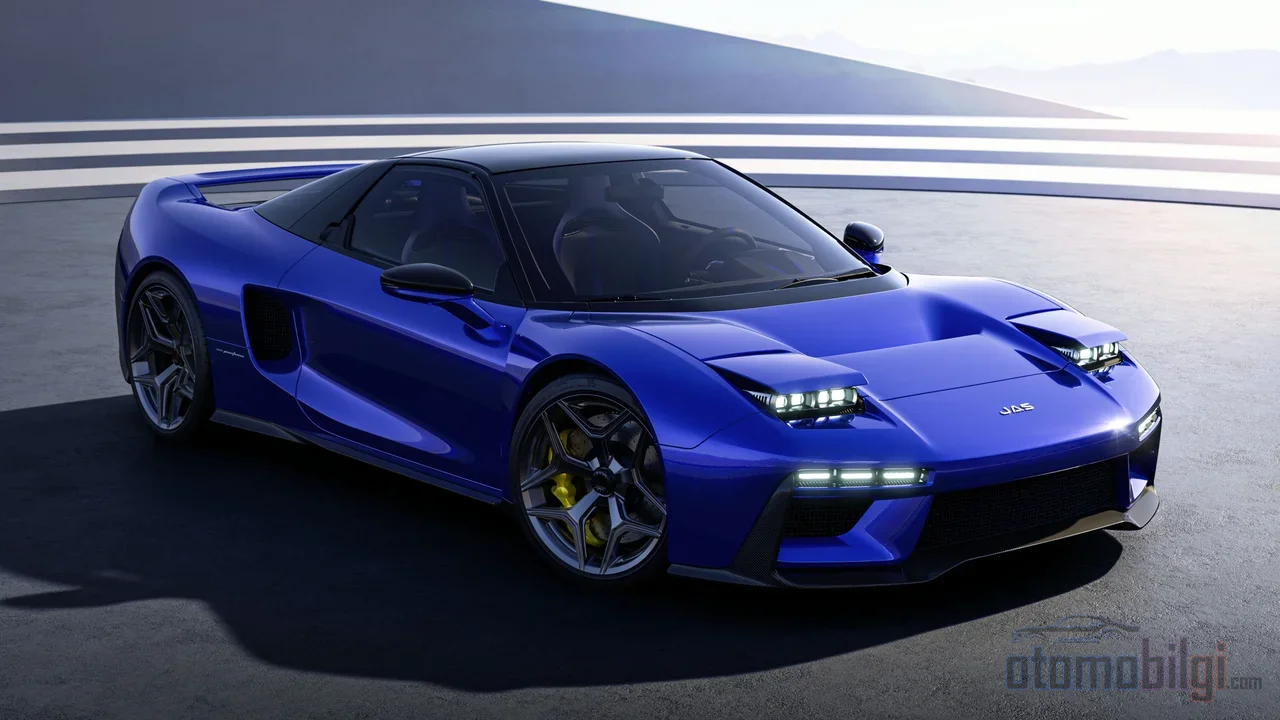
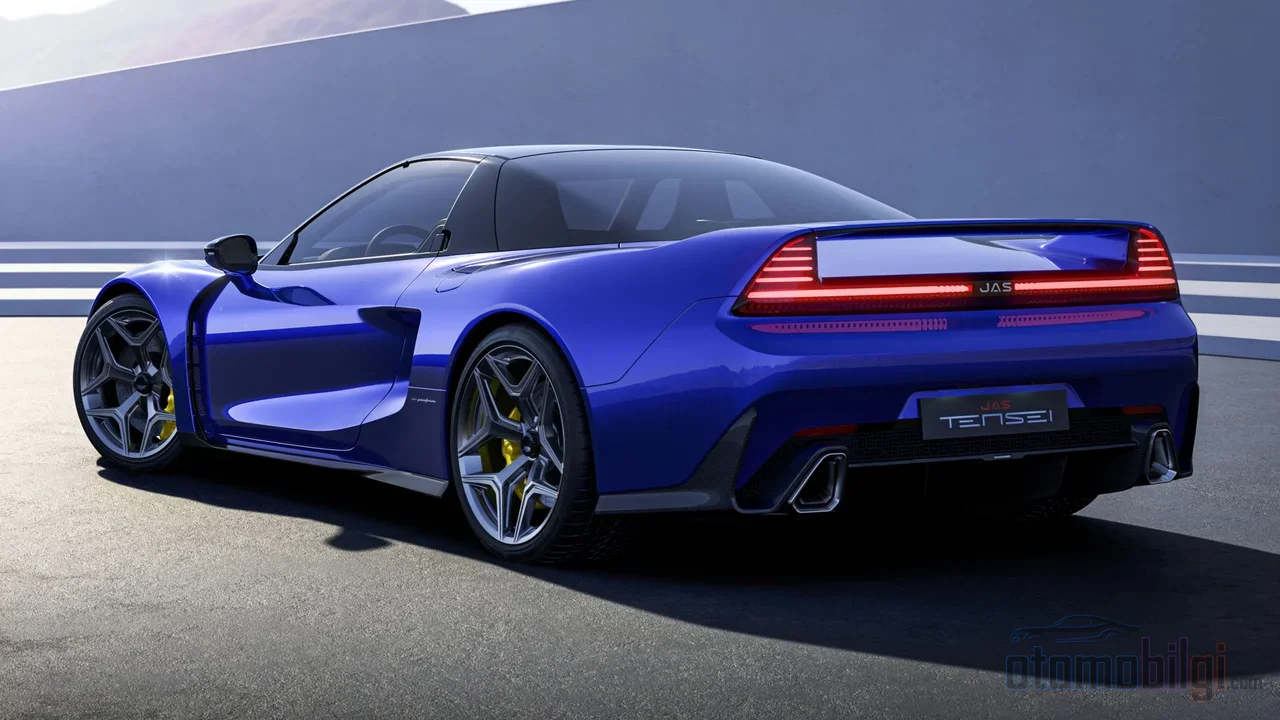
JAS Tensei is a restomod based on the first-generation Honda NSX, born from the collaboration between Honda's long-time racing partner JAS Motorsport and Pininfarina. A Judd V6 that enlarges the donor NSX's original C30A engine block to 3.5 liters, a six-speed manual transmission, and a dry weight of 1,250 kilograms offer the classic Japanese super sports car a second life straight from the racetrack. Production is limited to 35 units, and the price has been announced as 880,000 euros plus taxes.
Highlights
- The finished car was unveiled at Pininfarina's Cambiano headquarters on October 8, 2026; its public premiere will be at the Paris Motor Show, October 12-18.
- The Judd-built 3.5-liter naturally aspirated V6 revs to a redline of 8,500 rpm thanks to its fixed-timing racing valvetrain.
- Dry weight of 1,250 kg; about 135 kg lighter than the original NSX.
- Production limited to 35 units; price 880,000 euros + taxes, donor vehicle not included.
- The pop-up headlights have been preserved, complete with their titanium-linkage servo system.
What Is JAS Tensei and Who Is Behind It?
Starting with the project's name: "Tensei" means rebirth, reincarnation in Japanese. The architects of the project are names that have earned this title. The design belongs to Pininfarina; the very studio that drew the HP-X concept, considered the NSX's ancestor in the 1990s, is back in the game. Engineering and production, meanwhile, belong to JAS Motorsport. JAS, Honda's official racing partner since 1998, has a demanding track record: the 2013 WTCC manufacturers' title, a seven-year Civic WTCC program, the development of the NSX GT3, and the Civic Type R TCR operations still running today. So the team that kept the NSX alive on racetracks for years is now bringing it back to the road.
On the engine side, British Judd Power is involved. Honda has no direct contribution to the project; this is an independent workshop interpretation. Still, the choices are no accident: the donor chassis is laser-scanned, the body is entirely carbon fiber, and the final product is positioned, in JAS's own words, as its first true road car. The restomod side also has a legal advantage: the rebuilt car is subject only to the regulations of the 1990 model. Honda itself could not sell such a car as new today; JAS can.
The Racing-Bred Judd V6: Letting Go of VTEC
The heart of the project is the original Honda C30A block. That block is the only original part carried over to the engine; the rest comes from Judd's hands. Displacement has been raised from 3.0 to roughly 3.5 liters: a new crankshaft, lightweight alloy cylinder heads, titanium valves, an individual throttle body per cylinder, dry-sump lubrication, Inconel exhaust, and a carbon plenum. No turbo, no hybrid; everything is naturally aspirated.
For anyone who knows this field inside out, the most striking decision is the removal of VTEC. Instead of Honda's signature variable valve timing, a fixed-timing racing valvetrain has been used. This means a more predictable and powerful character throughout the rev range at the expense of smoothness in a street engine. The redline is 8,500 rpm. As for the power figure, no official data sheet has been released yet; news reports mention values ranging from 414 to 425 hp. The difference is most likely due to the measurement standard and test conditions; a few horsepower of deviation is not surprising for a naturally aspirated racing-derived engine. The claim that torque peaks at 5,500 rpm is common to all reports. 0-100 km/h and top speed have not been announced; JAS is in no hurry on this matter.
Chassis, Transmission and the 1,250-Kilogram Diet
Power goes to the rear wheels only through a six-speed manual gearbox, a twin-plate carbon clutch and a Torsen limited-slip differential. In 2026, three pedals and an H-pattern are still up for debate; JAS has not even opened it up for discussion. On the chassis side, the donor skeleton, mapped by laser scanning, has been reinforced with carbon-Kevlar in the A/B pillars and center tunnel. KW's electronically adjustable dampers, Brembo's carbon-ceramic brakes (380 mm front, 355 mm rear; steel discs optional) and a front axle lift system are also on the equipment list.
The engine block has been mounted 45 mm lower than its standard position; details like this are the best clues as to how a refined NSX will feel on the road. The result: 1,250 kg dry weight. The original Mk1 weighed around 1,370 kg; JAS has achieved a difference of nearly three hundred pounds. A thirty-year-old athlete losing weight is a rare thing, and this is the hardest part of the engineering work.
Pininfarina's Eli: Preserving and Expanding the Silhouette
The priority of the design is clear: not to spoil the NSX's matured silhouette. The roofline has been preserved, and the body is entirely carbon fiber. Track width has been increased by about 170 mm at the front and 190 mm at the rear; the wheelbase has also grown by roughly 55 mm. In other words, the car has widened noticeably, but it did so through body volume rather than by adding a wing. Aerodynamics were solved with internal airflow instead of visible bolt-on accessories; thus avoiding the habit of "sticking a wing on the back of every restomod."
The most emotional detail is undoubtedly the pop-up headlights coming to life. Protected by a titanium mechanism and a sensor-equipped servo system, these headlights bring back the signature of the 1990s. The interior features Sabelt carbon seats, a one-piece carbon dashboard, a combination of leather, Alcantara and titanium, and OLED displays. An interesting choice left to the buyer is the gauge layout: either a semi-digital setup or a faithful recreation of the original's six-dial arrangement with yellow needles.
Price, Production and Sales Network
Production is limited to 35 units; the number marks the NSX's 35th anniversary. The price is 880,000 euros plus taxes and there is a critical detail: the donor car is not included in the price. The customer must bring their own first-generation NSX. When you factor in the donor and taxes, it is clear the total bill will exceed one million dollars; that is hypercar money for a new one. JAS knows this is a car that will not be judged by numbers alone but by feel; We see that the market has recently grown accustomed to this level through projects like Lanzante and Kimera.
The sales network has also been chosen symbolically: In North America, the US side is represented by Graham Rahal Performance; Bobby Rahal having contributed to the development of the original NSX is the elegance of the matter. In Canada, the duty belongs to Pfaff Reserve. The project's history shows it wasn't rushed: the car was shown to a small group of customers at Fuji Speedway in the fall of 2025, displayed at the Monaco Historic Grand Prix in the spring of 2026, the final design was published in August, and the finished car was spotted in Cambiano in early October. The public premiere will take place in the Ultimate Supercar Garage section of the Paris Motor Show, alongside Honda's Prelude HRC Concept.
The Historical Significance of the NSX: Which Cycle Does Tensei Close?
Without knowing the context, this price is hard to understand. The NSX was introduced in 1990 after a long development process; with its pioneering all-aluminum body and a V6 of roughly 300 hp, it aimed to compete with European sports cars. It was sold in North America under the Acura brand and gained cult status as one of the few high-performance vehicles that could be used daily. Ayrton Senna's name became synonymous with the Mk1's story; Gordon Murray looked to this car as a reference for comfort and handling when designing the McLaren F1.
Two details set Tensei apart from an ordinary restomod. First, the original HP-X concept was already Pininfarina's work; the Italian studio's return effectively turns the project into the closing of a 40-year cycle. Second, the market value of the first-generation NSX has been climbing for years: while these cars used to circulate around 25-35 thousand dollars back in the day, today they can exceed 100 thousand dollars. The one-million-dollar restomod price tag can be read as the natural peak of this appreciation. The old NSX's 250-290 hp output remained modest by today's standards; Tensei is trying to fill that gap without compromising the original spirit.
Conclusion: A New Level in the Restomod Trend
Restomod used to mean fitting a modern engine into a classic 911; now the effort involves Pininfarina's design office, a WTCC champion racing workshop, and an engine manufacturer with Formula 1 origins. JAS Tensei is the most ambitious step taken for the Japanese classic on the path opened by Singer and similar projects. What the 35 customers who can bring their donor car will receive is not simply a more powerful NSX: it's a legend given new breath with a V6 from the racetrack, while preserving the original's silhouette and three pedals. This is the value that is hardest to measure in numbers; and that is precisely what JAS is really selling.
Sources
- Judd Power to develop engines for JAS Tensei supercar designed by Pininfarina
- JAS Motorsport - The Company, Our History
- The Honda NSX has returned: meet the finished V6-engined JAS Tensei
- The NSX Restomod Is Ready For Production
- JAS Motorsport and Pininfarina's Honda NSX Revival Is Finally Here
- JAS Tensei: €880,000 Honda NSX Restomod With a 420 hp V6
- The JAS-Pininfarina Honda NSX Restomod Is Finally Here
- Reimagined Honda NSX, the JAS Tensei, officially revealed
- This $1M Honda NSX Restomod Will Knock You Out Of Your Shoes