The Story of the Lunar Roving Vehicle, the First Car That Ran on the Moon
Share This Page
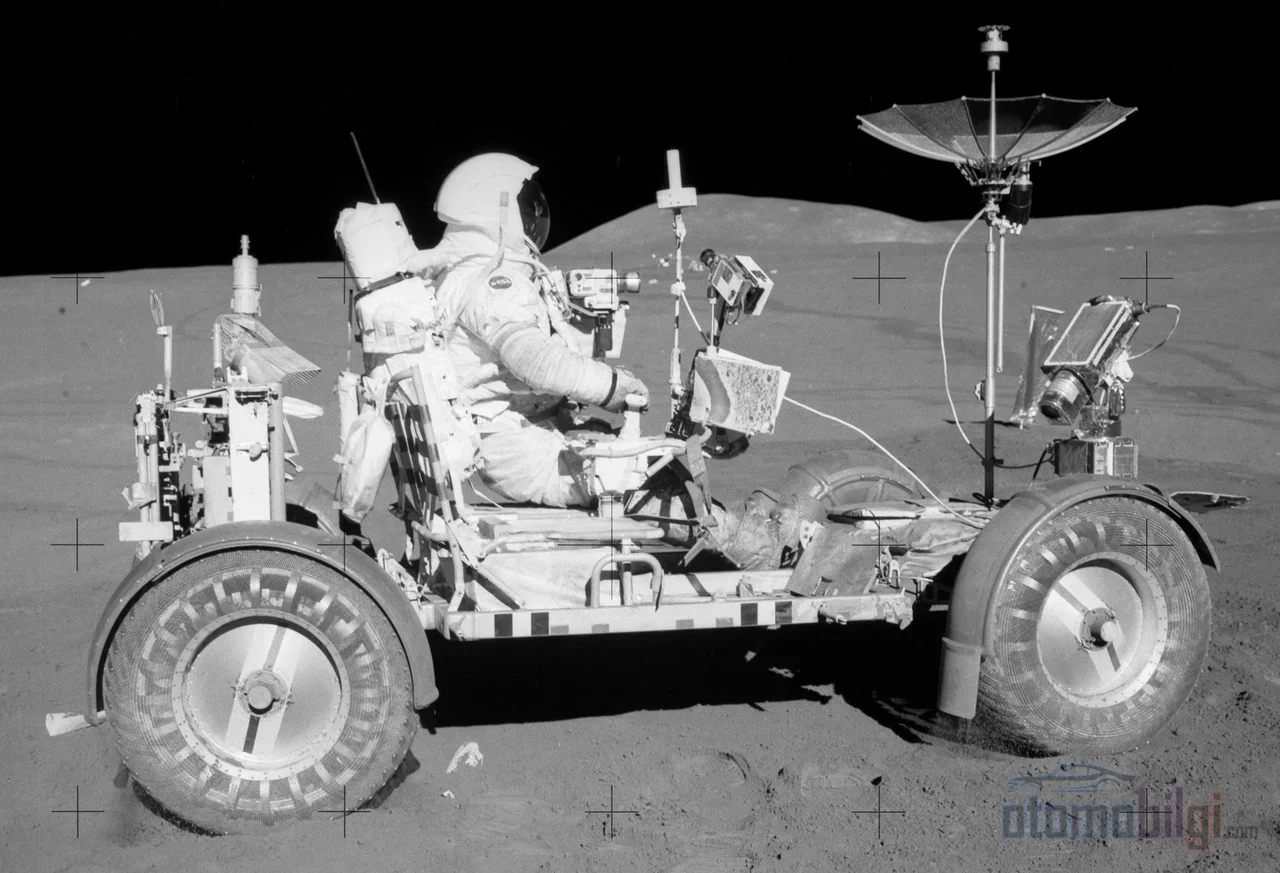
The Lunar Roving Vehicle, the four-wheeled electric rover of the Lunar Roving Program, reached the lunar surface on July 31, 1971 with the Apollo 15 mission. Developed in only 17 months with Boeing as prime contractor and propulsion system contributions from Delco Electronics, a subsidiary of General Motors, it is a battery-powered vehicle. With an unladen mass of 210 kg and a range of 92 km, this vehicle represents the most extraordinary milestone in the history of the electric car: It is the first and, to date, the only purpose-built electric vehicle to operate on a surface with no roads, extreme temperature variations, and abrasive dust.
Highlights
- First use: July 31, 1971, Apollo 15 mission
- Unladen mass 210 kg; payload 440 kg (two astronauts, equipment, and lunar samples)
- A separate 0.25 hp DC motor on each wheel; range 92 km
- Lunar speed record: 18 km/h, Apollo 17, Eugene Cernan
- Total development time of only 17 months
Why Was an Electric Vehicle Taken to the Moon?
The question should be asked in reverse: Were there any other options on the Moon? The Moon's atmosphere is virtually nonexistent, so both fuel and oxygen would have had to be carried for an internal combustion engine; this would have destroyed the mass budget. Electric propulsion, on the other hand, is limited only by the energy carried, has few moving parts, and creates no exhaust problems in a near-vacuum environment. In other words, the electrification of lunar vehicles was not an environmental choice, but pure engineering necessity.
This choice also had deep roots in history. In the late 19th century, roughly forty percent of automobiles were electric; silent, odorless, and requiring no hand crank, these vehicles were clearly ahead of gasoline cars for urban use. The idea of a lunar vehicle did not even come before literature: In 1959, Georg von Tiesenhausen designed a concept for a four-wheel-drive lunar rover with non-pneumatic, flexible wheels. So the LRV was born not during the decline of electric propulsion, but precisely at the point where this technology met the most extreme requirements.
A Lunar Vehicle in 17 Months: The Boeing and GM Partnership
NASA's official approval came in May 1969; the tender announcement was made on July 11, 1969, just before Apollo 11's landing. Boeing, Bendix, Grumman, and Chrysler submitted bids, and on October 28, 1969, Boeing was selected as prime contractor. The initial contract, structured as cost-plus-incentive fee, was worth $19 million, with the first delivery date set for April 1, 1971. With material costs and design changes, the final cost rose to $38 million; approximately $302 million in today's value. This overrun drew criticism, but the figure was close to NASA's initial estimate.
The division of labor was clear: Boeing took on the electronics and navigation system; General Motors' defense research laboratory in Santa Barbara developed the mobility system consisting of wheels, motors, and suspension. Names like Samuel Romano and Ferenc Pavlics worked on this team; Pavlics' flexible wire-mesh wheel design received special recognition from NASA. Saverio Morea served as project manager. The result became one of the rare examples of automotive and aerospace engineering working together at this pace: 17 months from concept to the lunar surface, and with a reliability that would complete all missions without a major failure.
Four flight vehicles were built. Three went to the Moon, while the fourth entered the spare parts pool after Apollo 18 was cancelled. In addition to these, a static model, an engineering model, two 1/6 gravity models, a 1-g trainer, a mass model, a vibration test unit, and a qualification test unit were also built. Low-gravity tests were conducted using the parabolic flights of the KC-135A aircraft; these tests also revealed that the wheel fender was necessary to limit dust contamination.
Technical Specifications: One Motor Per Wheel
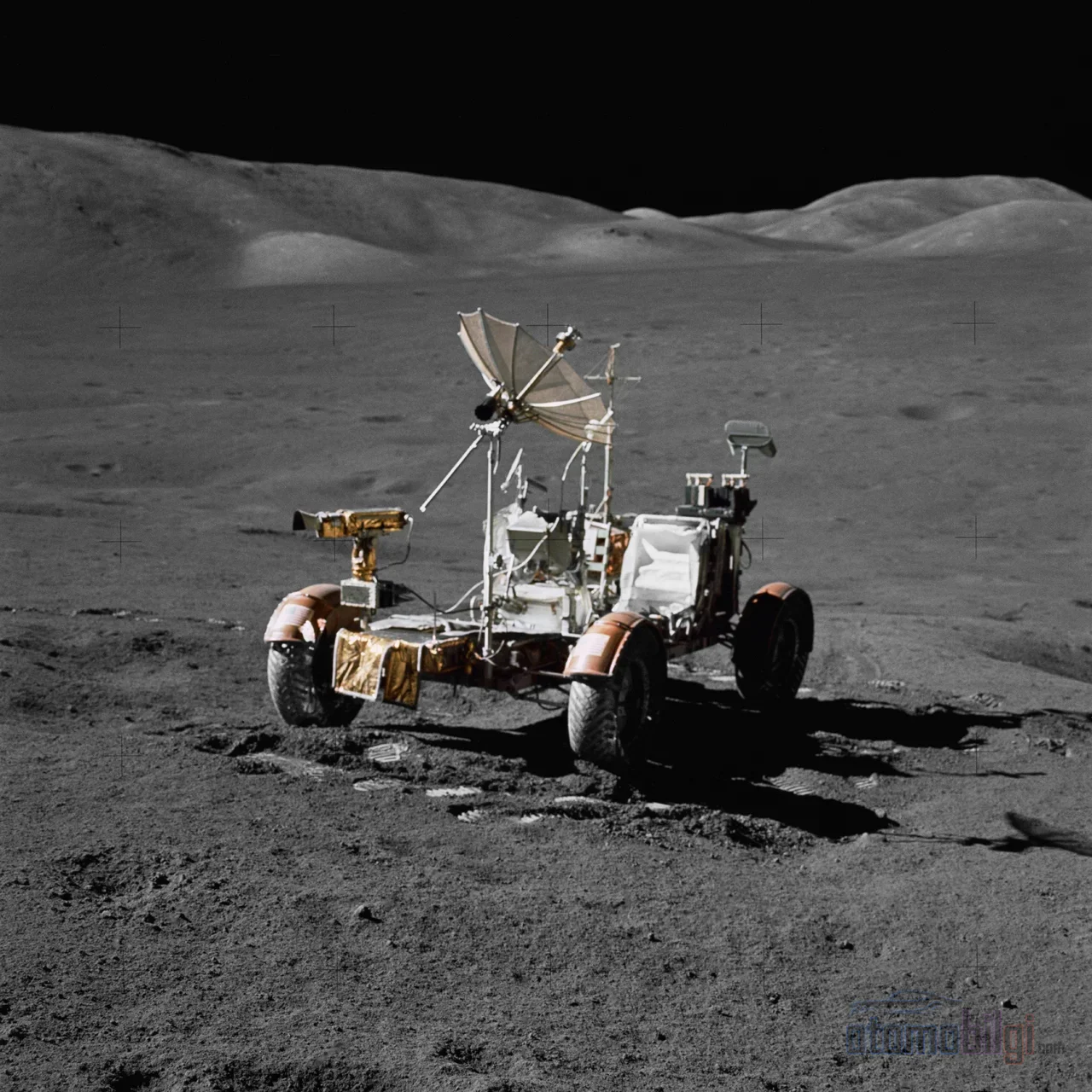
The LRV's drivetrain architecture is the purest form of the motor-per-wheel approach we see in modern electric vehicles today. Each of the four wheels had a series-wound brushed DC motor delivering 0.25 hp (190 W) of power, running at 10,000 rpm; each motor drove the wheel through an 80:1 ratio harmonic drive. If a motor failed, pins were removed and the wheel switched to freewheeling; in other words, a single failure could not stop the vehicle from moving. For steering, separate 0.1 hp (75 W) DC motors were used at the front and rear; with Ackermann geometry, the turning radius went down to as low as 3 meters.
Power came from two 36-volt silver-zinc primary batteries made by Eagle-Picher; each had a capacity of 121 ampere-seconds, and the total range was defined as 92 km. These batteries could not be recharged, and this was not a flaw but a design decision: the vehicle would never return from the Moon, so instead of recharging infrastructure, a single-use, reliable, and high-energy-density chemistry was preferred. On the front, there was a separate 36-volt outlet for the communication relay unit and the television camera.
One of the most challenging conditions of the lunar environment was thermal management. The LRV had no active cooling system; instead, passive cooling was achieved with phase-change wax thermal capacitor packages and upward-facing reflective radiator surfaces. During driving, the radiators were covered with a mylar blanket, and during stops the astronauts cleaned off the dust with a hand brush. This simple yet disciplined solution kept the electronics running in the scorching heat of the lunar day.
| Feature | Value |
|---|---|
| Empty mass | 210 kg (462 lb) |
| Maximum payload | 440 kg (two astronauts, equipment, samples) |
| Length / wheelbase | 3.0 m / 2.3 m |
| Motor per wheel | 0.25 hp DC, 10,000 rpm, 80:1 harmonic drive |
| Battery | 2 × 36 V silver-zinc (primary), Eagle-Picher |
| Range | 92 km |
| Design top speed | 10 km/h (18 km/h measured on Apollo 17) |
| Wheel | 32 inches in diameter, zinc-coated steel wire mesh, with titanium chevrons |
Chassis and Wheel Design for the Moon
The chassis was made of 2219 aluminum alloy tubing, with a three-part folding body hinged at the middle. Foldability was not a coincidence but a necessity of transport: the vehicle was folded and stowed in Quadrant 1 of the Lunar Module. After the astronauts landed on the surface, they unfolded the vehicle and lowered it to the ground using a rope and pulley system with brakes, through a largely automated process. At full weight, the ground clearance was only 36 centimeters; the low center of gravity reduced the risk of tipping over on rough terrain.
The tire problem does not exist on the Moon in the classical sense: tires cannot be inflated with air, and rubber cannot withstand the extreme temperature differences. The solution was a zinc-coated wire mesh wheel woven from 0.033-inch steel wire; titanium chevrons covering half of the contact surface provided traction, while the 25.5-inch-diameter titanium bump stop protected the body from impacts. The controls were reduced to a single T-shaped handle: pushing forward meant throttle, moving left or right meant steering, pulling back meant braking, and pushing to the far end meant the parking brake.
Mission Mission Data and Lunar Record
The three vehicles covered an average of 30 kilometers each, trouble-free, in total. Navigation came from a combination of a directional gyroscope, a wheel odometer, and a computer; since the Sun moves across the sky on the Moon at about half a degree per hour, the astronauts could also determine direction manually with a simple sun-shadow device when needed. According to the safety calculation, if the rover broke down, the crew had to be able to walk back to the Lunar Module; this walking limit was relaxed for Apollo 17's longest traverse, based on proven reliability.
| Mission | Total distance | Total driving time | Maximum distance from the LM |
|---|---|---|---|
| Apollo 15 | 27.76 km | 3 h 02 min | 5.0 km |
| Apollo 16 | 26.55 km | 3 h 26 min | 4.5 km |
| Apollo 17 | 35.89 km | 4 h 26 min | 7.6 km |
Although the design top speed was 10 km/h, a speed of 18 km/h was reached during Apollo 17; this unofficial lunar speed record is named after Eugene Cernan. At the end of the mission, Cernan parked the rover away from the television camera remotely operated by Mission Control to record the liftoff, and the ascent was successfully filmed on the third attempt.
Malfunctions, Patches, and the Three Vehicles That Remain on the Moon
Like every engineering product, the LRV was put to the test in field conditions. During Apollo 16, John Young struck the rear fender extension during the second traverse; the scattered lunar dust covered the crew, the console, and the communications equipment, and battery temperatures and power consumption increased. During Apollo 17, the fender that Cernan broke with the hammer's handle could not be held in place with tape; before the second traverse, the crew built a substitute fender using lunar maps, duct tape, and clamps retrieved from the lander. Those maps are now on display at the National Air and Space Museum; meaning that parts of an electric vehicle repaired with duct tape on the Moon have become an axis of space history in a museum.
All three rovers were left on the Moon. The reason is simple physics: only the upper stage of the Lunar Module could return to orbit, and every extra kilogram meant extra fuel. On Earth, test vehicles and trainers are exhibited in various museums: the vibration test unit is at the U.S. Space & Rocket Center in Huntsville, the 1-g trainer at Johnson Space Center, the qualification test unit at the National Air and Space Museum, and the engineering mockup at the Museum of Flight in Seattle. LRV-3 was re-imaged during the Lunar Reconnaissance Orbiter's passes in 2009 and 2011; in 2020, Washington State declared the rovers that went to the Moon historical landmarks.
The LRV's Place in the History of the Electric Car
The LRV marks a distinctive point on the electric car's uninterrupted but bumpy timeline. At the end of the 19th century, electric cars were a common sight in cities; by 1897, London had already launched its first electric taxi service. But gasoline cars gained the upper hand in the range-versus-cost balance, and with the pressure of the electric starter and the Ford Model T, electric cars were pushed aside. Throughout the 20th century, this technology struggled to survive with a few interim attempts and short-lived programs like the GM EV1; the field revived with the maturation of the lithium-ion battery and the 2008 Tesla Roadster proving that a highway-legal, series-produced lithium-ion electric sports car was possible.
The lesson of the LRV on this line is this: the fate of electric propulsion does not depend solely on battery chemistry; when combined with the right mission definition and the right mission profile, an electric vehicle can deliver superior performance even in the harshest environment. On the Moon, range was limited to 92 km and no customer wanted charging infrastructure; yet the vehicle completed all of its missions without any major failure. NASA's Lunar Terrain Vehicle program being developed today, as the official heir to this legacy, continues the same logic with a new generation of batteries.
Conclusion: A Milestone Parked on the Moon
The Lunar Roving Vehicle, with its 17-month development period, final cost of 38 million dollars, and flawless field performance spread across three missions, is a measurable testament to what engineering discipline can achieve. A separate DC motor at each wheel, silver-zinc batteries, wire-mesh wheels, and wax-based passive cooling: none of these were for show; they were direct answers to the constraints imposed by the Moon. Today, three vehicles are still parked on the lunar surface; at the farthest point in electric car history, they continue a silent endurance test against solar radiation and micrometeorites.
Sources
- Lunar Roving Vehicle
- The Apollo Lunar Roving Vehicle
- The Lunar Roving Vehicle - Historical Overview (S.F. Morea)
- Mobility Performance of the Lunar Roving Vehicle - NASA TR R-401
- Lunar Roving Vehicle Qualification Test Unit
- The Boeing Company wins NASA contract for lunar rover
- NASA's Lunar Rover: Everything You Need to Know