Why Did Cars Suddenly Become Round and Bulgy in the 1930s?
Share This Page
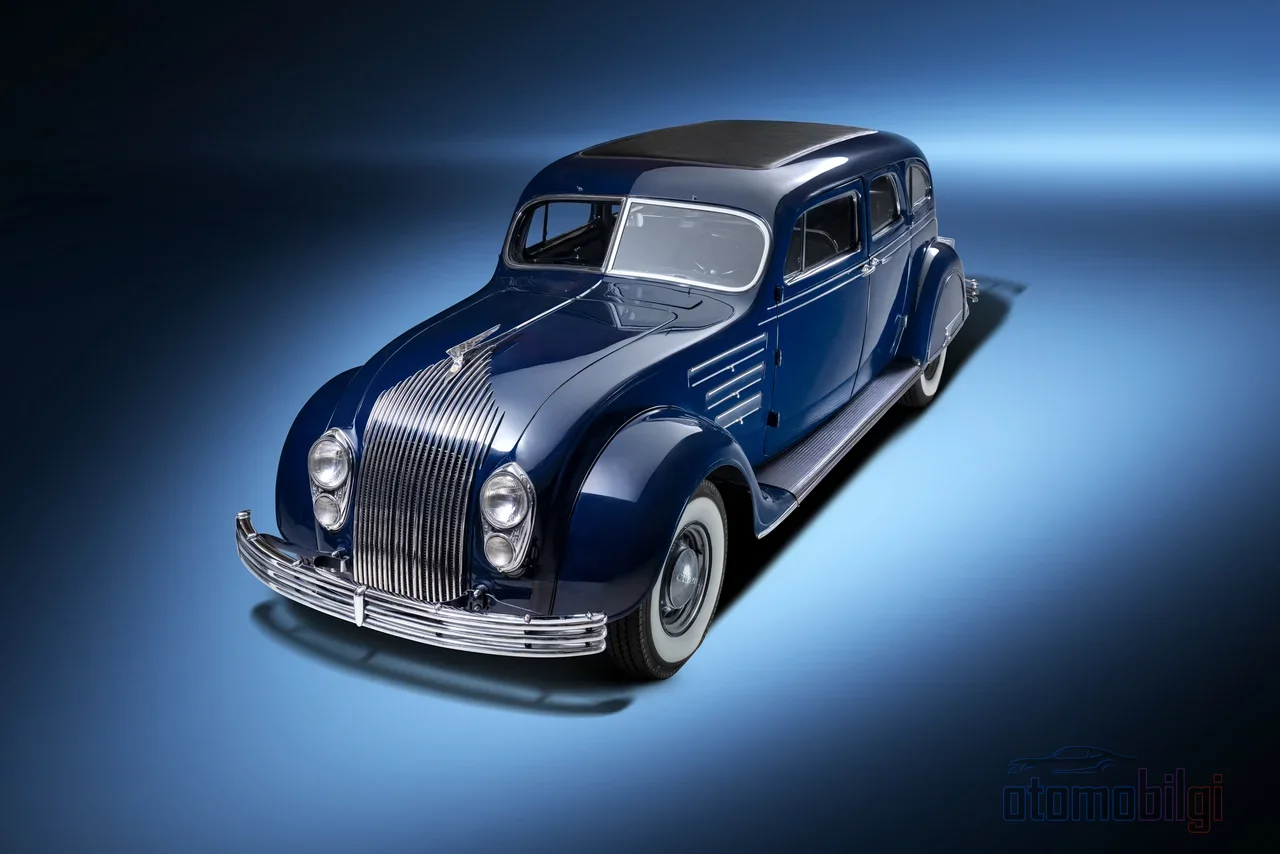
In the 1930s, cars suddenly became rounded and bulbous because engineers and designers carried over an idea from aviation - the idea that the teardrop shape offers the least wind resistance - to mass-produced vehicles. This streamlining wave was a design revolution that swept the entire world, extending from the wind tunnel experiments of the Chrysler Airflow to the Czechoslovak Tatra models and Jean Bugatti's sculpture-like bodies. So where did this teardrop craze come from, and why did everyone give up on it after a while? Let me tell you, because its story is truly exciting.
Highlights
- Introduced in 1934, the Chrysler Airflow was the first full-size American production car based on the principle of streamlining.
- Chrysler's team, with the collaboration of Orville Wright, tested more than 50 scale models in the wind tunnel.
- The Tatra 77 (1934) is considered one of the first truly aerodynamic cars to be mass-produced.
- The curved seams along the back of the Bugatti Type 57SC Atlantic were the inevitable consequence of a magnesium alloy that could not be welded.
- The Airflow was a commercial failure, but its legacy extended all the way to the VW Beetle and Peugeot's and Toyota's first models.
Where Did the Teardrop Shape Come From? An Idea Stretching from the Zeppelin to the Automobile
First, a simple physics lesson - I promise it will be short. When a body moves through air or water, the shape that encounters the least resistance is the teardrop form, tapering toward the rear. Fish have known this for millions of years; we only figured it out at the beginning of the 20th century.
One of the names who seriously carried this idea to the automobile was the Hungarian-born engineer Paul Jaray. Jaray was an aviation man who had worked on the design of Zeppelins, and in the 1920s and 30s he set out to bring the teardrop shape to the broad masses. He adapted aerodynamics from aviation to the automobile, promised fuel efficiency with teardrop-section bodies, and sold design licenses to manufacturers. So the mind behind the bulbous cars of the 1930s was more of an aircraft engineer than a car designer.
The goal was not actually to spark a revolution overnight; even in its own time, Jaray's teardrop form was not seen as "a complete revolution." There were predecessors too: The Rumpler Tropfenwagen set out in 1921 as the first mass-produced example of the teardrop form (around 100 units were built). Aurel Persu built a car in 1922-23 with the wheels enclosed within the body. Then came the Stout Scarab, the Dymaxion, and in 1933 the Pierce Silver Arrow. So the ground was ready; the 1930s was the decade in which this seed sprouted.
The Chrysler Airflow: The Boldest Experiment to Come Out of the Wind Tunnel
Now we come to the star of the story. In the early 1930s, Chrysler's engineering team of Carl Breer, Fred Zeder and Owen Skelton, together with designer Oliver Clark, embarked on an incredible endeavor: They set up a wind tunnel at the Highland Park facility and tested at least 50 scale models by April 1930. Even more strikingly, Orville Wright - yes, that Orville, of the Wright brothers - collaborated on the process.
The finding revealed by the wind tunnel changed everything: The classic car of the era, with its two-box design (long hood + upright cabin), was so aerodynamically inefficient that when reversed - that is, when you imagined it being driven backwards - it produced less air resistance. Chrysler didn't just bury this in a report; they even staged an actual demonstration like this on the streets of Detroit for promotional purposes. Imagine a test that criticized the car design of the era in a single stroke!
Just How Advanced Was the Airflow Technically?
The Airflow was far more than its looks suggested. On the engineering side, there were astonishing solutions for those years:
- A semi-unibody-like body structure working as a whole (wooden frames were still common among rivals, while the Airflow was all steel)
- With the engine moved onto the front axle, about 54% of the weight was concentrated at the front
- The rear seat was moved forward 20 inches and placed inside the rear axle
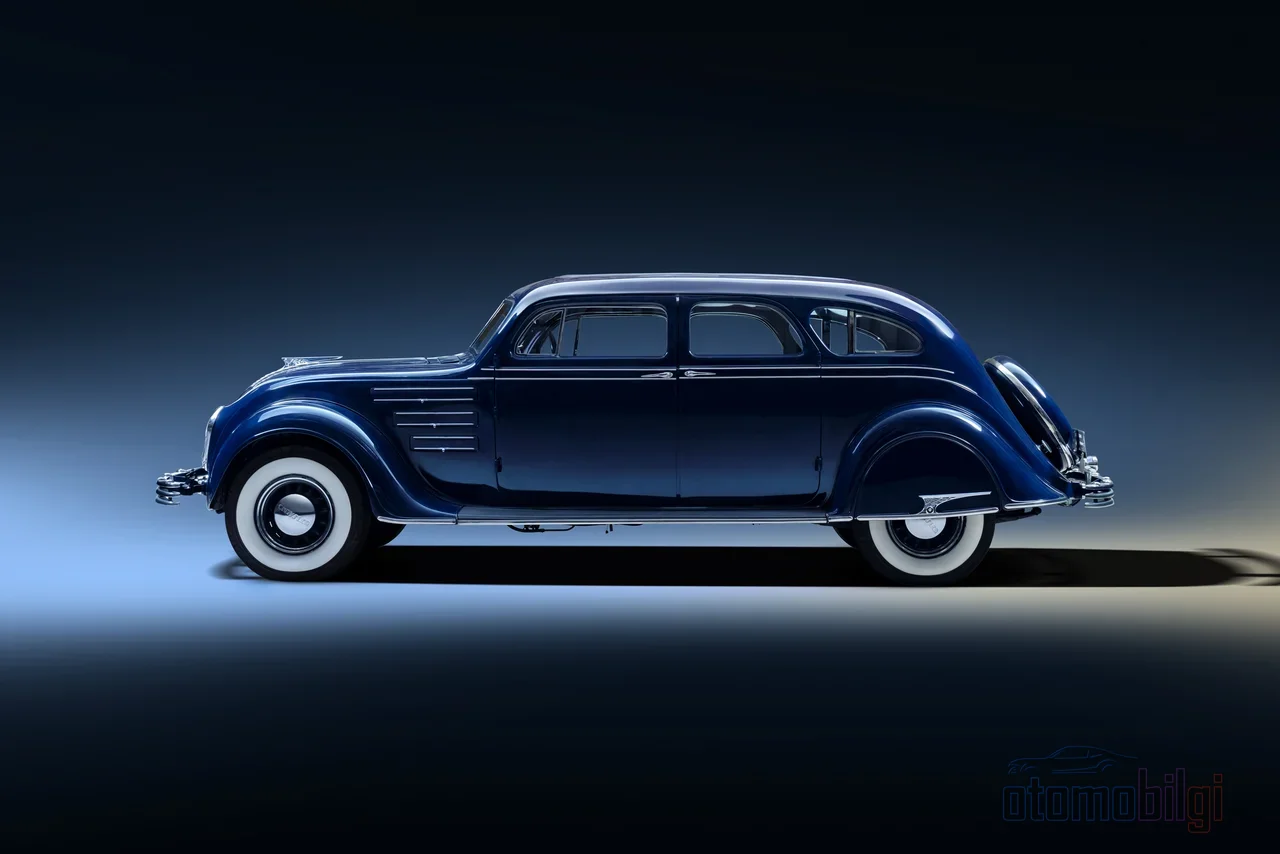
- A V-shaped raked windshield, a waterfall grille, semi-recessed headlights, and rear wheel covers
Even the CW Custom Imperial version carried the first one-piece curved windshield in a production car; its body was built by LeBaron. Its price in 1934 was $1,345. The advertising slogans were ambitious too: "Fashioned for Function" - in other words, "Shaped for Purpose". In a promotional film, an empty Airflow was dropped off a cliff from a height of 34 meters in Pennsylvania and then driven down under its own power. Not a safety test, not a marketing exaggeration: a full-fledged example of reckless audacity.
So Why Didn't It Sell?
This is where the story gets painful. The general consensus among historians is this: Buyers didn't like the looks. The way the hood, grille, headlights, and fenders melted into a single monolithic form struck people as "an anonymous lump". At the depths of the Great Depression, customers were seeking reassurance; the Airflow was deemed "too far ahead, too different".
On top of that came a rival campaign: GM published ads disparaging the Airflow, and rumors spread that the body was unsafe - most of which were unfounded. There were indeed serious manufacturing defects in the first 2,000-3,000 vehicles; there was even a claim that the engine's bearings would break apart at 130 km/h. This triple blow - the design backlash, production problems, and the Depression economy - was large enough to shake Chrysler.
Let's look at the numbers: 10,839 units were sold in 1934, but Chrysler's conventional sedans outsold the Airflow at a ratio of 2.5 to 1. By 1937, production had fallen to just 4,600 units and the program was cancelled. In total, slightly under 29,600 vehicles were produced - a rather modest figure for a span of about seven years. DeSoto was hit even harder, since it sold only the Airflow; moreover, its version looked short and stubby. In response, Chrysler softened the design: in 1935 came a peaked grille, and in 1936 a rear trunk was added along with a more prominent grille. So whatever the public wanted, that trend gradually came back.
Tatra: The Ones Who Turned the Teardrop Idea into a Real Road
While the story ended in disappointment in America, in Czechoslovakia the teardrop idea reached its purest form. The Tatra 77, produced from 1934 onward, was considered one of the first truly aerodynamic cars to be mass-produced. The design belonged to Hans Ledwinka and was shaped with Paul Jaray's contribution; thanks to Jaray's Zeppelin connections, Tatra models were already being tested in a highly advanced wind tunnel for the time.
Try to imagine these rear-engined cars with their streamlined teardrop bodies. Then came the Tatra 87, on which Ledwinka worked with Erich Übelacker; they used Jaray's design licenses and also looked at John Tjaarda's ideas. The round headlamp arrangement on its front gave it a character like a "one-eyed giant" - the kind of face that still makes everyone who sees it say "what on earth is that!"
To understand the career of this movement coming from aviation, there is also a European example: The flowing fastback body that began on the Mercedes 500K in 1934 evolved and continued until 1937. So the teardrop idea was not the work of a single brand or a single country; almost everyone had turned their face to the same wind.
Bugatti Atlantic: Aerodynamics Turned into Art
In Europe, the most striking - and in my opinion the most romantic - expression of the movement happened at Bugatti. Ettore Bugatti's son Jean Bugatti unveiled an entirely new design in 1934: the Type 57. The Type 57SC Atlantic that developed from it was born from a prototype called the Aérolithe, and its body used an aviation-grade Elektron magnesium alloy. The problem was this: This alloy could not be welded! As a solution, the body edges were joined with outward-curved "dorsal" seams - and these seams became that famous spine signature along the Atlantic's back.
Just think about it: Today's designers choose a shape for aesthetics; Jean Bugatti's dorsal line, however, was the forced result of a material constraint. Constraints sometimes create the most beautiful signatures, don't they?
"The most beautiful car ever designed."
This sentence was said about the 1937 Talbot-Lago Type 150-C Teardrop, and the car was called "the pinnacle of the Streamline Moderne movement." So the teardrop form was not only engineering but also a language of art.
Streamline Moderne: An Aesthetic That Spread from Cars to Kitchen Appliances
The interesting part is this: This teardrop craze was not a fashion exclusive to car enthusiasts. The movement called Streamline Moderne reflected American optimism in the midst of the Great Depression of the 1930s, faith in technology, and the democratization of modern design. Teardrop aesthetics went beyond automotive and spread to kitchen appliances, furniture, trains, and even steamships. Even the toaster wanted to "look fast"!
The name remembered as the pioneer of this movement is Norman Bel Geddes. He created designs ranging from automobiles to trains and steamships; he drew a teardrop-shaped (never produced) car concept and designed a new hood for the 1935 Airflow model. In his book "Magic Motorways," he imagined the highways of the future. But here's the ironic part: Despite being called "the founder of the streamlining movement," most of the cars he designed were never produced. This also reveals a tension within the movement: Some designers were pursuing genuine engineering, while others were selling the image of progress. The gap between aerodynamic claims and real engineering has been a debated topic ever since.
Why Were the Rounded Lines Abandoned?
So why did this aesthetic that everyone admired eventually fall by the wayside? There are several reasons. In the Airflow case, commercial failure, production problems, and buyer reactions pushed Chrysler away from advanced styles. But the real turning point was the history of the world itself: World War II. When production resumed in 1945, the "Machine Age" was over and the "Atomic Age" had begun. The atmosphere of the design world, its sources of inspiration, and buyer expectations had completely changed.
But the movement didn't actually die entirely - or rather, it lived on by transforming. Aerodynamic ideas were gradually adopted by all manufacturers. GM applied fastback bodies across all its brands between 1942 and 1950: the Chevrolet Fleetline, Pontiac Streamliner and the like. In the 1930s, streamlining was described as "a magical language transcending cultural, social, and economic differences" - and that language continued to be spoken with different accents.
The Legacy That Remains Today: From the Beetle to Today's Lines
Could the Airflow's most surprising heir be... the VW Beetle. Ferdinand Porsche was influenced by the Airflow's engineering principles and began working on a small rear-engined design; in an assessment published in Scientific American, the Beetle was cited as evidence of the Airflow's influence. Volvo took a small copy into the early production phase. The Peugeot 202 and 402 achieved great sales success with their teardrop-inspired forms. Even Toyota's first automobile, the AA, was heavily influenced by this design.
The art world didn't forget this car either: Claes Oldenburg's "Profile Airflow" prints and sculptures were inspired by this vehicle. And the 1935 DeSoto Airflow won the Grand Prix style award at the Monte Carlo Concours d'Elegance - meaning the car the public didn't love also won a style award. You couldn't find a better example in design history to illustrate the difference between "being liked" and "being important."
In fact, in 2022, Chrysler announced it was reviving the Airflow name for an electric crossover. Even after nearly 90 years, that name still has something to say: Bold design doesn't always sell easily at the right time, but it always leaves the right story.
Here's my summary: Although the round, bulbous cars of the 1930s may look like a fashion craze, they were actually a turning point. From that point on, car design was no longer just "nice-looking boxes" but became a discipline that speaks with the wind, drawing engineering and aesthetics on the same page. When you look at the flowing lines on the back of a car today, remember: The first great breath of those lines was taken with a teardrop-shaped dream. Which of today's cars do you think will be remembered as such a turning point thirty years from now? My guess is hidden in the first simple silhouettes of the electric age - but you should also think about your own favorite.
Sources
- Chrysler Airflow
- The Chrysler Airflow Offered a Streamlined Design | 2022
- Video: Engineering the 1934 Chrysler Airflow
- Streamlined design: speed becomes style
- A Story about Aerodynamics and Streamlined Shape
- Tatra 77
- The Teardrop that Fell from the Sky: Paul Jaray and Automotive Aerodynamics
- The Origins of Streamline Design in Cars
- Norman Bel Geddes
- The Bugatti Type 57 SC Atlantic – a style icon
- Bugatti Type 57
- Changing Winds: The 1934-1937 Chrysler Airflow
- 1930s Auto Design: Art Deco and Streamline Moderne
- Streamliner Car Design and the Evolution of Fastbacks