China Introduces a Mandatory Safety Test Requirement for Vehicles with Touchscreens
Share This Page
China is introducing an official safety threshold for touchscreen-heavy vehicle interiors. According to the draft announcement published by the Ministry of Industry and Information Technology (MIIT) in October, vehicles with large central infotainment screens and complex head-up displays will have to pass driving safety, reliability under extreme conditions, and crash safety tests before receiving sales approval. Together with the hidden door handle ban that took effect in the first months of the year, the regulation represents China's most comprehensive intervention yet into the vehicle interior fashions that have spread rapidly in recent years. For someone who has been following this industry for more than three decades, the picture is familiar: the cockpit, once considered a designers' playground, is now on the regulators' desk.
Highlights
- With its October draft, MIIT is introducing a mandatory safety testing requirement for vehicles with large screens and innovative designs
- Foldable and flexible screens will be completely banned
- Physical controls required for basic functions such as signals, wipers, and defrosting As of July 1, 2027 it will cover newly produced vehicles
- Hidden door handle ban Takes effect on January 1, 2027 already approved models are granted an extension until January 2029 is extended until
- Passenger cars must undergo at least 30,000 km of reliability testing and one year of environmental compliance testing
What does China's new safety rule for touchscreen vehicles require?
With its draft announcement, made public on Saturday, October 10-11, MIIT proposed stricter approval requirements for innovative vehicle designs. The ministry is not alone behind the draft; the ministries of Public Administration and Public Security as well as the State Administration for Market Regulation are also partners in the work. The consultation period is open until November 10, 2026. Once it enters into force, central infotainment screens, large displays, and complex head-up displays will be assessed for their impact on driving safety, reliability under extreme conditions, and crash safety.
The draft's harshest clause is not limited to screens. While the vehicle is in motion, zero-gravity seats, swivel seats, and bed-seat functions are proposed to be blocked by technical measures . The draft also includes a requirement for soft-closing doors to have pinch protection and a manual opening option in the event of a power failure. Another clause prohibits passengers other than the driver from controlling the doors, hood, or lights by voice command while the vehicle is moving. OTA updates are also required to undergo comprehensive validation.
Testing requirement: 30,000 kilometers, two winters, one summer
The test requirements forming the backbone of the draft are far more ambitious than the cursory validation the industry is accustomed to. Passenger cars will undergo at least 30,000 kilometers of reliability testing. In addition, an environmental compliance test is required lasting at least one year, defined as two winters and one summer covering a sequence of severe cold and high temperatures. Models that are untested, incompletely tested, or based on fraudulent documentation will not receive approval.
Innovative-design models that have already been approved are not being left alone either: July 1, 2027 to offer the additional parameters. Models that miss the deadline and are found to pose safety risks will be withdrawn from production and subjected to a voluntary recall. This provision alone means that screen-heavy designs that entered the Chinese market in the last two years will inevitably be reassessed.
Are physical buttons coming back?
Screens are not being banned; this widespread misunderstanding needs to be corrected at this point. Manufacturers will still be able to use large touchscreens for navigation, entertainment, and vehicle settings. The condition introduced is a physical control requirement for critical safety functions: functions such as turn signal stalk, wipers, defrosting, and demisting must now be on a tactile, findable control rather than in a touchscreen menu.
In this respect, the regulation is a continuation of the GB4094-2016 revision prepared in February. That draft required physical controls for turn signals, hazard warning lights, horn, P/R/N/D gear selection, ADAS activation, wipers, heating and demisting, electric windows, emergency call system, and the power cutoff switch of electric vehicles. Gear selection via screen alone was already banned. According to the revision, the control's effective working area must be at least 10x10 mm fixed in position, suitable for blind operation, and provide tactile or auditory feedback. In addition, basic functions must continue to work even if the infotainment system crashes. The standard, July 1, 2027 onward, covers only newly produced vehicles; vehicles in stock have been left outside the calendar.
With what timeline will the hidden door handle ban be implemented?
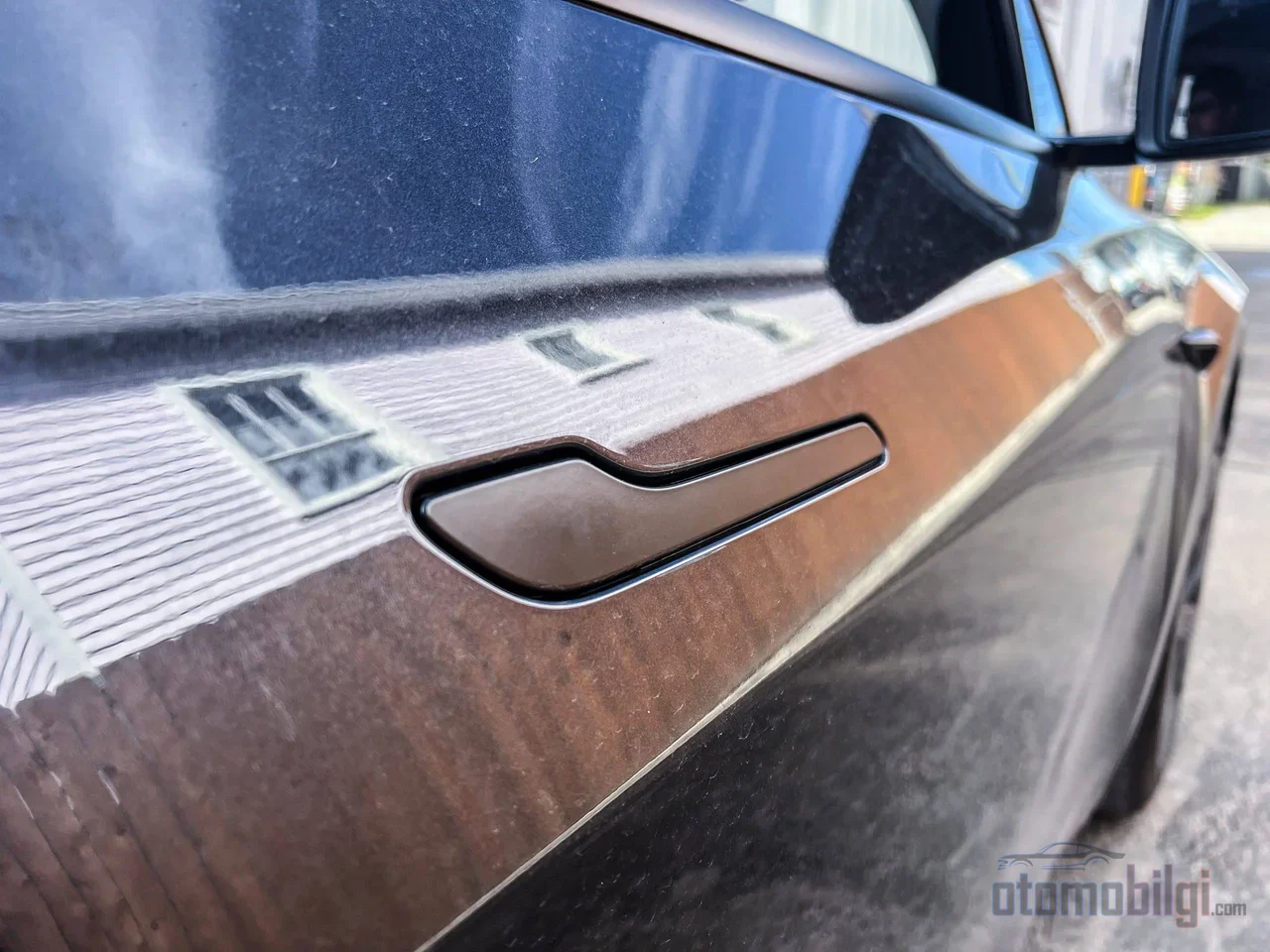
The October draft also reconfirmed another important rule that came into force in February. MIIT had published the mandatory national standard requiring mechanical interior and exterior door handles on February 2. The rule, January 1, 2027 will enter into force; models already approved are given until January 2029 to comply. The scope covers all new vehicles under 3.5 tons and ends fully hidden, flush door handles that open only electronically.
Tesla played a major role in the spread of this design, and China became the first country to phase out this fashion. The rationale was also concrete: electric locking systems failing to open the door after an accident or battery failure, making the job of rescue teams harder. When this work began, the door handle was a detail sacrificed entirely to aerodynamics; now regulators view it once again as safety equipment. The flair of design has inevitably given way to function.
A framework looking at the industry as a whole: a standard roadmap from autonomous driving
The screen and door handle rules are part of a broader wave of regulation in China. On August 4, a mandatory national standard for L3 and L4 autonomous driving systems (GB 44721-2026) was announced; July 1, 2027 which will enter into force, covers category M and N vehicles except automatic parking and requires for Level 3 that the driver's readiness to take over be monitored. The MIIT also released the 2026 standardization task list, the first annual roadmap of the 15th Five-Year Plan, at the end of May; it foresees accelerating mandatory standards in the areas of active and passive safety, ESP and brake assist.
At the end of August, four agencies had launched a one-year vehicle quality campaign following the ministry official's finding that some aggressive designs were being fitted to vehicles without adequate validation. The entire series delivers the same message: the bar in front of the market entry gate is rising, and designs that evade testing for aesthetic reasons will no longer be able to pass through that gate.
How will global manufacturers be affected by these rules?
Every global brand selling in China will have to adapt its interior design to these rules. In practice, this means the cockpit architecture of existing platforms will have to be reworked, even in the middle of a model cycle. Many brands will have to develop both a physical control set and a mechanical door handle solution for models they produce in China or produce for China; that is a job that will affect cost and supply planning.
The really interesting question, however, is the spillover effect. The size of the Chinese market has led to assessments that these rules will likely influence international standards and shape vehicle design worldwide. Beijing is establishing itself as a global safety regulator in EV technology; that is a picture no one could have predicted a decade ago. On the other hand, China is not alone: Euro NCAP has made physical buttons for important functions a five-star requirement as of January 2026, and 2026 tests show manufacturers returning to simple controls. European manufacturers are also reworking their interiors. On the US front the picture is different; while a bill has been introduced at the representative level calling for federal research on the driver impact of touchscreens, the transportation department's approach is still based on voluntary guidelines. The US reducing its regulations while China tightens its own is a comparison frequently drawn in industry corridors.
Do screens really make driving harder?
The technical rationale behind the regulation is based on years of accumulated evidence. A 2026 peer-reviewed review shows that touchscreens generally perform worse than physical controls in terms of driving performance, visual attention and reaction time. Since touch surfaces provide no tactile feedback, the driver cannot operate them without taking their eyes off the road; this means reproducing a problem that old-style knobs and buttons quietly solved. There is unease within the industry as well; a senior executive at a Chinese manufacturer expressed the view that the industry has fallen victim to a current of blindly following trends. Regulatory intervention is, in a sense, this criticism made institutional.
Design shift: fashion or safety?
Assembling the implementation calendar makes the picture clearer:
| Regulation | Effective Date | Scope |
|---|---|---|
| Mechanical door handle standard | January 1, 2027 | Newly approved models, under 3.5 tons |
| Mandatory physical control (GB4094 revision) | July 1, 2027 | Newly produced vehicles |
| L3/L4 autonomous driving standard | July 1, 2027 | Category M and N, except automatic parking |
| Door handle compliance for already approved models | January 2029 | Models currently on sale |
The conclusion to be drawn here is that the world's largest automotive market now sets its design agenda based on safety goals. There used to be debates about who was the innovator; now the question is which innovation can be verified. The proposal to ban foldable screens, impose a technical lock on rotating seats, and place 41 design elements under scrutiny is enough to show the scope of this era. It will be a troublesome period for manufacturers, and for users, most likely a less irritating cockpit era is beginning. Both can happen at once; it has happened throughout automotive history.
The point to watch is how much the October draft will change after the consultation process. Feedback received by the end of November will determine the final form of the test conditions and the ban list. But the direction is clear: the era of large-screen, button-free, hidden-handle vehicles is closing in China, and the countdown has begun.
Sources
- China proposes tighter vehicle design rules, reiterates concealed-handle ban and targets foldable screens - CnEVPost
- China Proposes Stricter Testing Rules for New Car Designs - Caixin Global
- China to require physical controls for vehicle functions - CarNewsChina
- China to ban 'hidden' car door handles to address safety fears - Reuters
- China unveils safety standard for autonomous driving systems - gov.cn
- MIIT Issues 2026 Key Tasks for Automotive Standardization - SESEC
- China's safety crackdown positions Beijing as global regulator - Automotive News
- New Chinese Regulation Constrains Displays, Driver Distraction - Driving Vision News
- Buttons are back for basic functions - Euro NCAP
- A review of in-vehicle touchscreen safety and usability - ScienceDirect
- US DOT voluntary guidelines - transportation.gov