How Was the First Race Around the World by Car Won?
Share This Page
The first round-the-world automobile race is a legendary event that started in New York in 1908 and finished in Paris, lasting 169 days. Of the six cars that set out in this contest, the American-made Thomas Flyer won after crossing Alaska, Siberia and Europe along the way, accelerating the automobile's emergence onto the world stage as a "reliable vehicle."
Highlights
- The Race On February 12, 1908,in Times Square, before more than 250,000 spectators, the race began.
- Six cars represented four countries: the USA, Germany, Italy and France.
- The Thomas Flyer arrived in Paris 169 days later, on July 30, 1908.were there.
- Of the six cars, only three were able to complete the route.
- The winning margin was 26 days - still the largest in motorsport history.
How Did the 1908 New York-Paris Race Come About?
Just think about it: 1908. No asphalt on the roads, no traffic lights, no gas stations, no road maps. In fact, most people in the world had never even seen a car in their lives. Horses were still considered more reliable than automobiles. And in exactly such a world, a newspaper idea explodes: "Let's drive cars around the world!"
The name of the event was The Great Race: New York to Paris by Automobileand it was sponsored by The New York Times and the Paris newspaper Le Matin. The prize was nothing to sneeze at: a massive trophy weighing 1,400 pounds. The inspiration came from the 1907 Peking-Paris race; that race was already a crazy undertaking, but this time the line to be drawn was much longer.
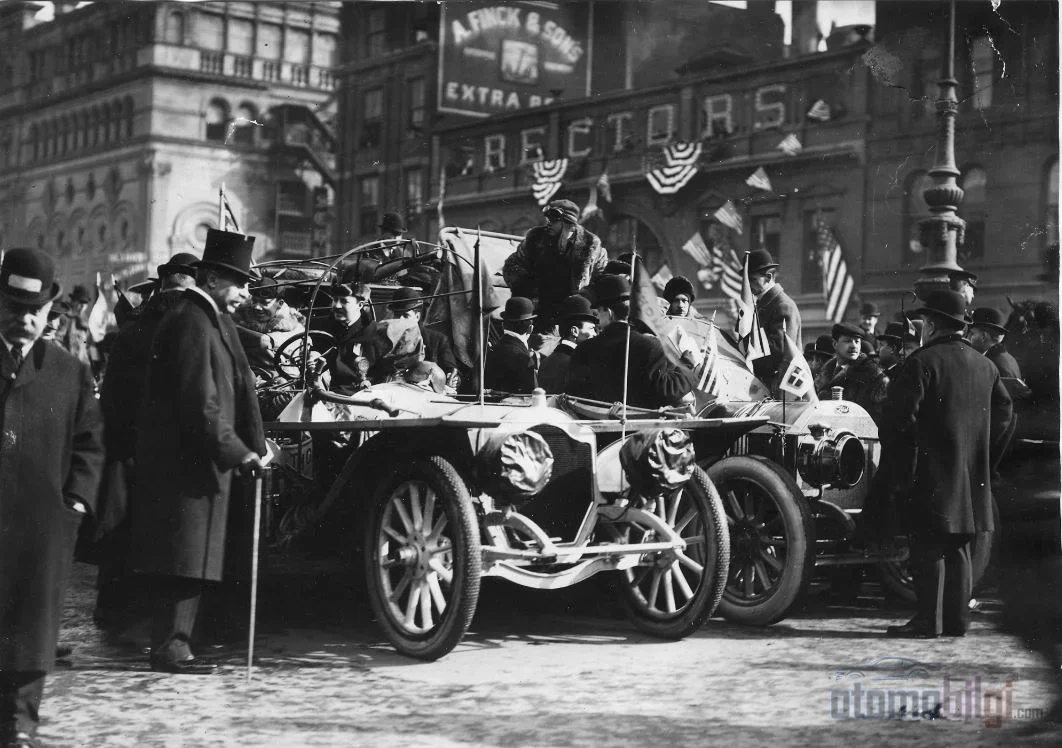
Even the starting moment of the race was a magnificent scene in its own right: On February 12, 1908,at 11:15, Times Square. A gold-plated pistol fires, and more than 250,000 people bear witness. A quarter of a million! Think of the crowd going to a rock festival today - in 1908, people were flocking to watch a car set off on its journey.
Who Was on the Track?
Six cars set out from four countries:
- USA: Thomas Flyer
- Germany: Protos
- Italy: Züst
- France: De Dion-Bouton, Motobloc and Sizaire-Naudin
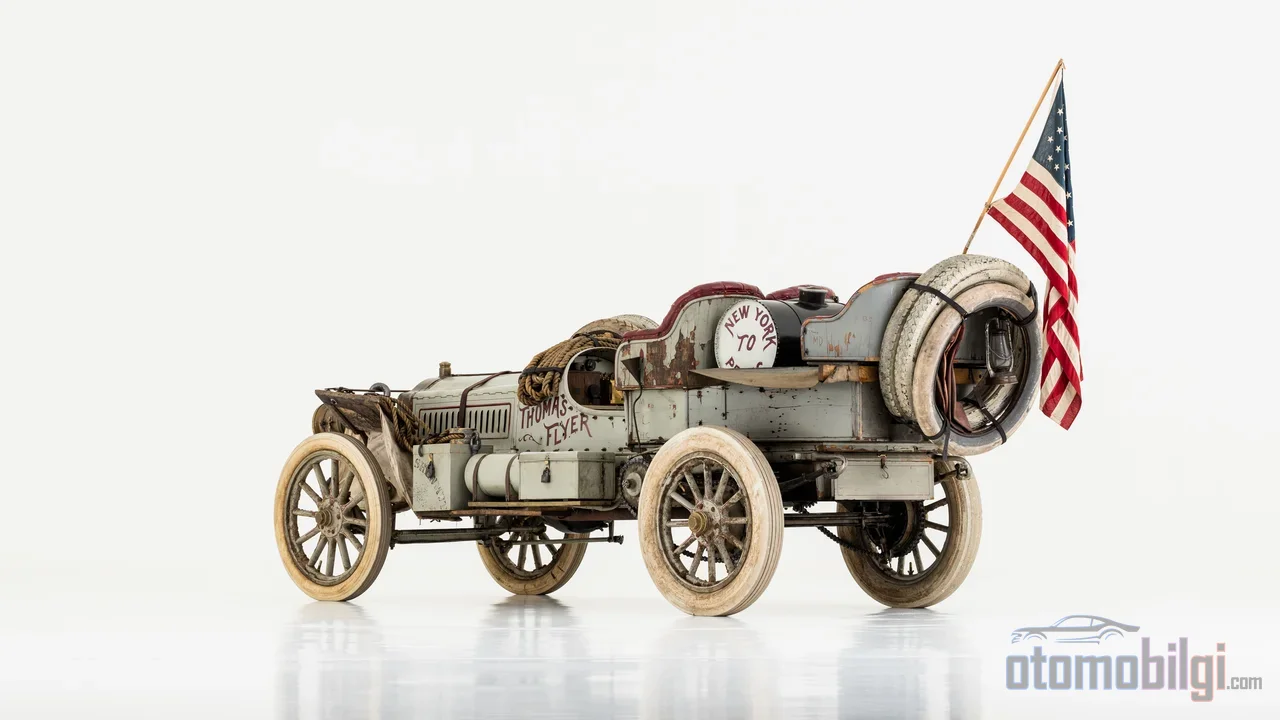
The funny part is this: established Buffalo companies like Pierce-Arrow refused to participate in the race. Thomas Motor Company, on the other hand, pulled a production car straight off the factory floor and onto the track at the last minute. So it wasn't a luxury prototype - it was an automobile sold on the street, available to the public for $3,750. I think part of the secret of its victory lies here: this car was made for everyday use, not a fragile showcase piece.
How Was the Route Planned and Why Did It Change?
The plan was wonderful on paper: from New York to San Francisco via Albany and Chicago, from there to Seattle, then by ship to Valdez in Alaska. The craziest part was this: they planned to cross the Bering Strait while it was frozen! A ship crossing of approximately 150 miles (240 km) from Nome would reach East Cape in Siberia, then the route would continue via Vladivostok, Omsk, Moscow, St. Petersburg and Berlin to Paris. Crossing the strait over the ice - this is the very definition of "if there's no road, we'll make one."
But real life doesn't listen to plans. In Alaska, there was no such thing as roads, and the Bering crossing turned out to be impossible. So the route changed: the team crossed to Japan by ship - the first time a car crossed Japan - and then entered Siberia after three voyages by steamer to Vladivostok. One door closed, another opened, and history was made, a perfect road movie scene.
The Journey of the Thomas Flyer: How the 169 Days Passed
Completing the US leg took the Thomas Flyer 41 days 8 hours 15 minutes and reached San Francisco, marking a car's first winter crossing of the USA. The planned time was two weeks - it took six weeks. They made it to Chicago in eight, because a blizzard had swallowed everything. On impassable terrain, the cars advanced on railroad ties, with special tires. Imagine, today we have a nervous breakdown when a tire blows out on a road; they were moving forward on ties in a storm.
In Siberia and Manchuria, things got even crazier. The spring thaw - what the Russians call rasputitsa , the period that turns everything into mud - meant progress was sometimes 15 miles a day, and on some days measured in meters. 15 miles a day is about 24 kilometers. So you could have gone faster by bicycle, even on foot! The number of vehicles that managed to get past Vladivostok dropped to three: Protos, Züst and Thomas. The rest were left on the roads.
The Name at the Wheel: George Schuster
Perhaps the real heroes of the race were the people at the wheel. Initially there was race driver Montague Roberts, but when he had to leave due to a legal issue, chief mechanic George Schuster (1873-1972) took over. And Schuster became the only American to cover the entire distance from New York to Paris without interruption. This achievement brought him a very late but well-deserved honor: on October 12, 2010he was inducted into the Automotive Hall of Fame.
The team returned to New York after Paris and on August 17, 1908took part in the victory celebration in Times Square. Do you know what happened to Schuster afterwards? He returned to his old job at the Thomas factory. Be a hero, return home, get back to work - the humility of the old days. Unfortunately, the company went bankrupt five years later.
Protos Entered Paris First, So Why Didn't It Win?
Here is the most controversial scene of the race. The German Protos, driven by Lieutenant Hans Koeppen, on July 26was the first to enter Paris. Another detail: Kaiser Wilhelm personally chose Koeppen for his entry. So Germany was the side that crossed the finish line first. So why did the trophy go to the Thomas Flyer?
The answer lies in the penalties: Protos received a total of 30 days in penalties. 15 days for not stopping in Japan on the route; the other 15 for loading the car onto a train after an engine failure in the USA and skipping 1,000 miles of difficult terrain. When calculated with these penalties, the Thomas Flyer 26 days was declared the winner by a margin. Yes, you read that right: a 26-day margin - still the largest winning margin in the history of motorsport. Today, winning a race by 2 seconds is celebrated like a funeral; here there was a month's difference!
The race also saw a nice moment of sportsmanship: at a point where the Protos was stuck in the mud, Schuster rescued it with a chain. Koeppen, in turn, opened champagne and raised a glass to American sportsmanship. Fierce competition, sweet friendship - the classic combination of motorsport.
The Italian Züst arrived in Paris in third place in September 1908. In other words, only three of the six vehicles completed the route; the other three vanished into history along the way.
| Team | Country | Result |
|---|---|---|
| Thomas Flyer | USA | Won (169 days, July 30, 1908) |
| Protos | Germany | Arrived first but was declared 2nd with a 30-day penalty |
| Züst | Italy | Third (September 1908) |
| De Dion-Bouton | France | Did not complete the route |
| Motobloc | France | Did not complete the route |
| Sizaire-Naudin | France | Did not complete the route |
How Much Distance Was Actually Covered?
This question doesn't have a single answer, because it depends on which measurement you take. The account of arrival in Paris gives roughly 16,700 km an idea; some records give 13,341 milesfor the entire route, while others give more than 22,000 miles the figure. The difference comes from this: one count covers the entire planned route, while another covers the actual distance traveled, even including the return journey. What is clear is this: the crew crossed three continents and made a full journey around the world to reach Paris - whether it's 16,700 km or 35,000 km or a multiple of it, all these figures fall into the "strange enough, incredible" category.
It is also said that the 169-day duration has not been surpassed to this day - as a motorsport event, it remains the longest. Think about it once more: a Formula 1 race lasts two hours, the Dakar Rally two weeks. This affair took nearly six months to complete.
How Did This Race Change the Perception of the Automobile?
Here is, in my opinion, the most beautiful part of the story. In that era, the automobile was a toy that the wealthy used for getting around the city. A long journey? No no, the horse was more reliable. When the Thomas Flyer crossed three continents in a factory-standard production car, this perception didn't change overnight, but the crack was revealed: so the automobile could indeed be a long-distance, reliable means of transportation. Along with Peking-Paris, this race opened the door for the automobile's emergence onto the world stage as a "serious vehicle."
Its impact was not limited to perception: it triggered calls for better roads to be built in many parts of the world. The newspapers sponsoring the organization reported the story in their headlines every day, and the race became one of the biggest promotional events of the era. In a way, it was the great "endurance advertisement" of the modern automotive world - the ancestor of the tests that brands conduct today in deserts and at the North Pole.
Where Is the Winning Car Today, and Does Its Legacy Live On?
It lives on, and it looks beautiful too. The winning 1907 Thomas Flyeris on display along with its trophy at the National Automobile Museum in Reno, Nevada. So even after more than a century, you can go see that car - the same body, the same trophy, the same story.
The story's traces in popular culture are a bonus: Georges Méliès's 1908 film Mishaps of the New York-Paris Race and the 1965 The Great Race film and the 2008 documentary The Greatest Auto Race on Earth . There was also an attempt to reenact the race: the 2008 centennial plan was canceled due to the revocation of Chinese permits, but in 2011 the World Race 2011, April 14, started from Times Square and followed the original route; four vehicles (1929 Ford Model A, 1932 Ford 3 Window Coupe, 1967 VW Beetle and 2007 Chevrolet Corvette) reached Paris on July 21, 2011. The most touching detail: among the participants was Jeff Mahl, Schuster's great-great-grandson. History itself once again turned its wheels on the same route.
Frequently Asked Questions
- How many vehicles finished the race? Only three of the six vehicles: the Thomas Flyer, the Protos and the Züst.
- How many days did it take? 169 days - from February 12 to July 30, 1908.
- Why was the route changed? There were no roads in Alaska and crossing the Bering Strait while frozen was impossible; the route was diverted through Japan to Siberia.
- The Protos arrived first, so why didn't it win? It received a total of 30 days in penalties for not passing through Japan and for transporting the car by train.
- Where is the winning vehicle? It is on display with its trophy at the National Automobile Museum in Reno, Nevada.
Next time you think a car is "just a means of transportation," remember that Thomas Flyer making its way over the railroad ties in the snows of the winter of 1908. Who knows, perhaps today's endurance tests, rallies, and even the long-range advertising of electric vehicles are all extensions of that crazy 169-day journey. Which modern race do you think could measure up to it?
Sources
- 1908 New York to Paris Race
- New York to Paris Race | The Great Automobile Race
- The Greatest Race – 1908 New York to Paris
- The Photographic Story of the Great New York to Paris Auto Race of 1908
- George Schuster Wins 1908 NY to Paris Automobile Race
- George Schuster (driver)
- 1908 Great Race-Winning Thomas Flyer Featured at Amelia Island
- The Greatest Race You Have Never Heard Of